
Informal groups exist in every organization. They form naturally when people bond over shared interests or support each other outside formal work duties. These groups influence morale, productivity, and even the resilience of a company.
In this blog post, you’ll learn what informal groups are, why they form, how they help or hinder performance, and how managers can work with them.
What Are Informal Groups?
An informal group is a collection of people who connect and interact beyond the formal structure of the company. Unlike a department or team defined by the organization chart, informal groups grow through social interaction. They arise spontaneously, often around shared interests, friendship, or mutual assistance.
Researchers note that modern organizations operate not only through formal structures but also through informal networks, which play a critical role in strengthening resilience. These networks help people exchange information, build relationships, and solve problems creatively.
Why Do Informal Groups Form?
Informal groups emerge for many reasons:
- Social and emotional support: People seek connection and friendship at work. During stressful projects or organizational change, colleagues may lean on one another for understanding and encouragement.
- Shared interests and hobbies: Employees who enjoy similar activities or belong to the same community often spend time together and develop an informal bond.
- Need for information: When formal channels are slow, workers turn to trusted coworkers to get timely answers. Informal advice networks allow people to find shortcuts and clarify doubts quickly.
- Protection and advocacy: Sometimes employees band together to support each other against perceived unfairness or to advocate for better working conditions.
These groups may overlap or change over time, reflecting the dynamic nature of human relationships.
Key Features of Informal Groups
Informal groups differ from formal teams in several ways:
- Spontaneous formation: They arise naturally without official sanction. Membership is voluntary and often fluid.
- Common interests: Members share personal connections, hobbies, or mutual concerns rather than job descriptions.
- Lack of formal rules: There is no written policy or hierarchy. Leadership is emergent and based on influence rather than position.
- Emotional ties: Relationships are often built on trust and friendship. Members provide psychological support and share ideas freely.
Types of Informal Groups
Informal groups vary by how they behave and their underlying purpose.
The following categories illustrate common patterns.
Behavioral Categories
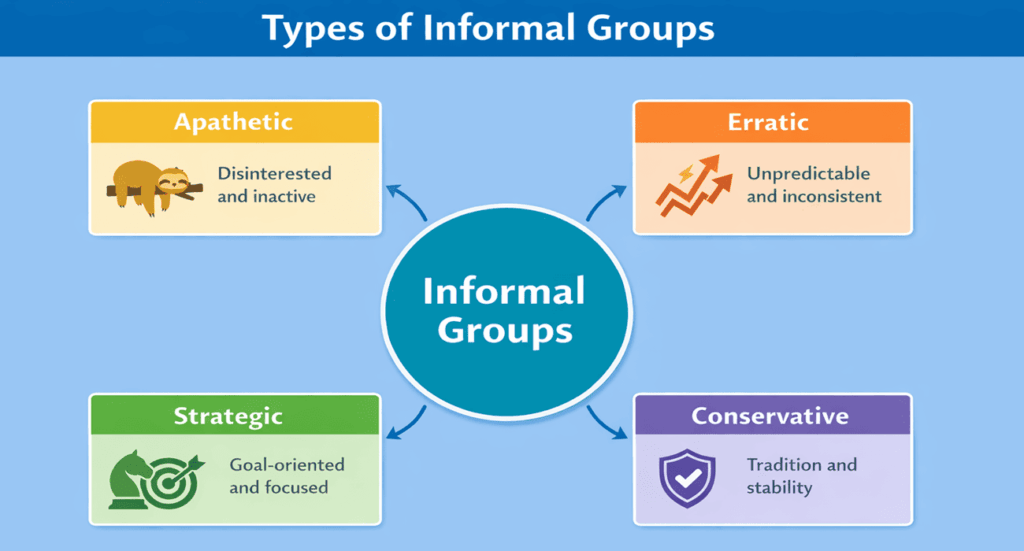
We can classify informal groups based on member attitudes and participation. The infographic below summarizes four common types:
- Apathetic groups: Members show low interest and low involvement. They rarely participate in company discussions and often stay on the sidelines.
- Erratic groups: Participation is inconsistent. Members may engage enthusiastically in one moment and withdraw the next, making their influence unpredictable.
- Strategic groups: These are goal‑oriented and purposeful. Members collaborate to achieve specific objectives, such as sharing expertise or solving complex problems.
- Conservative groups: Members value stability and resist change. They maintain traditional approaches and may slow down innovation to preserve familiar processes.
Structural Categories
Informal groups can also be categorized by how they relate to the formal organization:
- Horizontal groups: These arise among peers at the same hierarchical level. Colleagues from different departments may team up to share knowledge or tackle cross‑functional issues.
- Vertical groups: These connect people across hierarchy, such as a mentor and a junior colleague. Vertical informal ties encourage knowledge transfer and career development.
- Mixed groups: These include both horizontal and vertical connections. They often form around shared interests, like social clubs or volunteer initiatives.
Understanding the type of group helps managers decide how to engage with them and integrate their strengths into the organization’s goals.
Benefits and Challenges of Informal Groups
Benefits
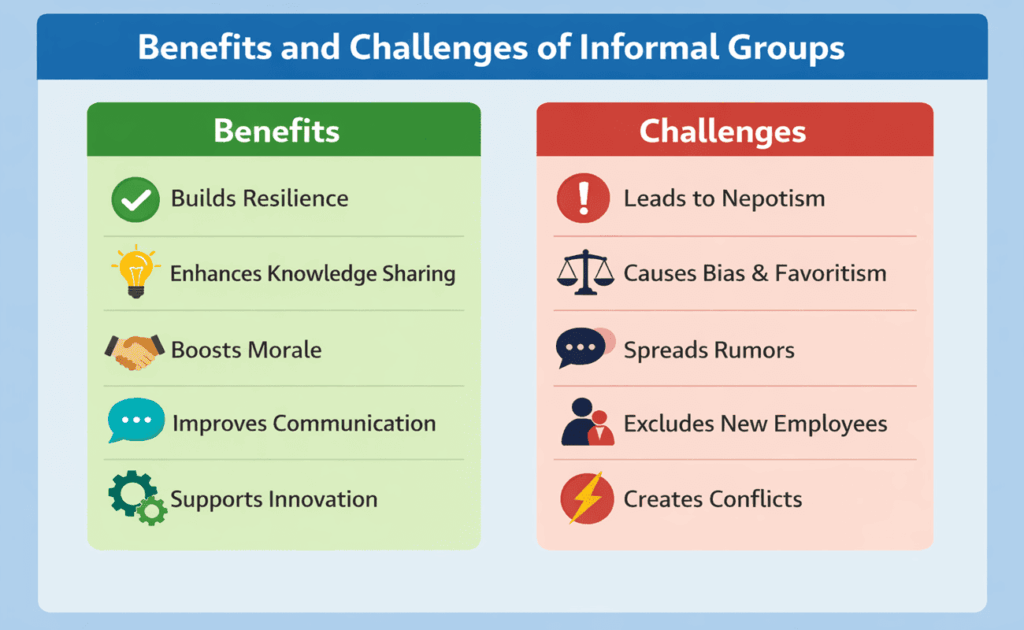
Informal groups can be powerful assets when managed wisely. Research shows that informal advice networks inside companies strengthen contextual resilience by promoting information exchange, relationship‑building, and creative problem‑solving. They offer several concrete benefits:
- Improved information flow: Because informal networks cut across departments, they allow employees to get answers quickly. This reduces delays and prevents mistakes when formal channels are slow.
- Knowledge sharing: Members exchange expertise and experience without bureaucratic barriers. Advice networks help employees access crucial resources like technical skills and emotional support.
- Enhanced resilience: By building relationships and supporting each other, informal groups help organizations adapt to crises or change.
- Stronger morale and engagement: Feeling heard and supported makes people more engaged. Gallup’s 2024 State of the Global Workplace report found that global employee engagement fell to 21% and cost the economy $438 billion in lost productivity. Informal groups can counteract disengagement by creating a sense of belonging and purpose.
- Creative problem solving: When diverse perspectives meet in a casual setting, new ideas emerge. Informal discussions often lead to innovative solutions that formal meetings might overlook.
By nurturing these networks, leaders can harness these benefits to improve overall performance.
Challenges and Ethical Issues
Informal groups are not always positive. If unchecked, they can create problems:
- Favoritism and nepotism: A study on informal networks and social capital noted ethical challenges such as corruption, gender discrimination, and biased hiring that favors network members. These practices undermine fairness and diversity.
- Exclusion and discrimination: Informal cliques can exclude newcomers or people from different backgrounds, hindering collaboration and innovation.
- Rumors and misinformation: Without official oversight, rumors can spread quickly, damaging trust and morale. Misunderstandings may lead to conflict and reduce productivity.
- Resistance to change: Conservative groups may oppose new initiatives or technologies, slowing organizational progress. They can also pressure members to conform, discouraging new ideas.
Managers need to recognize these challenges and address them proactively to maintain a healthy work environment.
Balancing Formal and Informal Networks
Leaders cannot eliminate informal groups, nor should they. Instead, they can align them with organizational goals:
- Map informal networks: Use surveys or network analysis to understand who influences whom. Identifying advice, trust, and communication networks helps leaders see where information really flows.
- Encourage inclusion: Promote a culture where everyone feels welcome to join discussions. Rotate group participation and pair new hires with mentors from different networks.
- Provide clear channels: Strengthen formal communication so that employees don’t rely solely on rumor. Regular meetings, transparent updates, and open forums reduce confusion.
- Set ethical guidelines: Train managers on diversity, equity, and inclusion to prevent favoritism and bias. Encourage employees to speak up against unethical behavior.
- Leverage group strengths: Invite informal groups to contribute ideas for projects or improvement initiatives. Recognize their contributions publicly to reinforce positive behaviors.
By balancing formal structures with informal networks, organizations can capitalize on spontaneous collaboration while minimizing risks.
FAQs
Q1. What is the main difference between formal and informal groups?
A formal group is created by the organization with defined roles and responsibilities. An informal group forms naturally when people bond over shared interests or social needs.
Q2. Are informal groups always beneficial?
No. Informal groups can improve communication and morale, but they can also lead to favoritism, exclusion, or rumor spreading if not managed carefully.
Q3. How can managers make the most of informal groups?
By understanding who influences whom, promoting inclusivity, and aligning informal networks with business goals, managers can harness the positive effects of informal groups and reduce the negatives.
Conclusion
Informal groups shape how people connect, share ideas, and support each other at work. They grow naturally from daily interactions and shared interests. When managed well, they improve communication, morale, and problem solving. They help employees feel heard and valued. Still, they can also create conflict or exclusion if ignored. Leaders should understand informal groups, respect their influence, and guide them with care. A balanced approach helps organizations gain the benefits while reducing risks and confusion.
Thanks 👆👆