
Ever wonder why some companies stay ahead in crowded markets while others stagnate? Successful organizations often look outward, comparing their strategies with the best in the industry and even outside it. Strategic benchmarking is the structured approach that makes this possible. It goes beyond checking a competitor’s numbers; it learns from leaders, adapts their best practices, and turns those lessons into long‑term growth.
What is Strategic Benchmarking?
Strategic benchmarking compares a company’s long‑range strategies, goals and practices with those of industry leaders or cross‑industry innovators. The purpose is to identify gaps, adopt proven methods and align the organization’s direction with high‑performing models. Unlike basic performance or process benchmarking — which look at outputs such as cost per unit or cycle time — strategic benchmarking examines why top performers choose certain markets, business models and cultures. It is a powerful tool for developing competitive strategies and launching new products or services.
In addition to external comparisons, strategic benchmarking can occur internally. A company may compare a low‑performing division with a high‑performing division to uncover practices that could be replicated. External benchmarking looks beyond company boundaries, often to direct competitors or firms in unrelated industries that excel in a particular area.
How Strategic Benchmarking Works
Strategic benchmarking follows a structured process. Each step requires careful planning and collaboration across departments. The infographic below summarizes the typical flow.
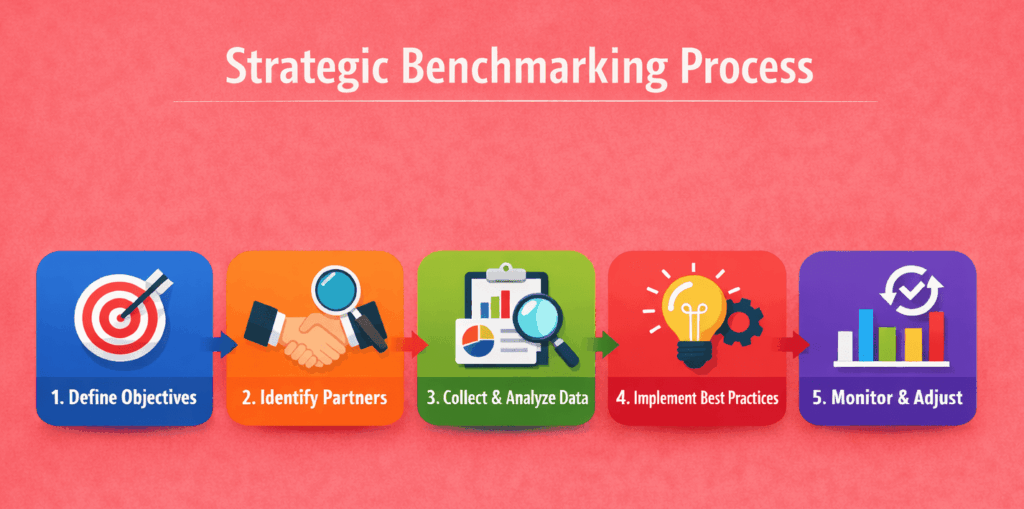
1. Define objectives.
Set clear goals for what you want to achieve. Goals may include entering a new market, improving customer satisfaction, reducing waste, or increasing innovation. Without a defined objective, benchmarking can become unfocused.
2. Identify benchmarking partners.
Select organizations that excel in the area you want to study. They could be direct competitors, companies in other industries, or even different divisions within your own firm. Look for partners willing to share information and whose strategies are relevant to your goals.
3. Collect and analyze data.
Gather qualitative and quantitative information on your partners’ practices. Sources include public reports, industry analyses, interviews and site visits. Analyze gaps between their performance and your own. Consider factors like corporate culture, resources and regulatory environments to avoid misinterpreting data.
4. Implement best practices.
Adapt the lessons learned to fit your organization’s context. Copying another company’s strategy without adjustment rarely works. Customize the practices, ensure compliance with laws and intellectual property rights, and prepare a change management plan.
5. Monitor and adjust.
Benchmarking is continuous. Measure results, gather feedback and refine your approach. According to McKinsey, companies that commit to operational excellence see lasting improvements — customer satisfaction can rise by ten percentage points, carbon emissions drop by 20 percent and employee retention improve by 25 percent[1].
Types of Benchmarking
Strategic benchmarking is one of several benchmarking methods. Understanding the distinctions helps you choose the right approach:
- Internal Benchmarking: Compares performance within your company. For example, comparing the sales processes of two regional offices to identify the more effective approach.
- Competitive Benchmarking: Assesses direct competitors to see where they outperform you. It’s often narrower in scope and may yield quick wins but doesn’t always inspire radical change.
- Functional Benchmarking: Looks at companies in different industries that excel in a specific function, such as customer service or logistics.
- Process Benchmarking: Focuses on workflow metrics like cycle time, cost per unit or error rates. It is often combined with performance benchmarking to identify operational improvements.
- Strategic Benchmarking: Examines long‑term strategies, business models and cultures, aiming to reshape the organization’s strategic direction.
Competitive research is sometimes confused with benchmarking. Competitor research typically tracks market share, pricing or marketing campaigns to respond tactically. Benchmarking is proactive and continuous; it evaluates fundamental practices and inspires strategic shifts.
Why Strategic Benchmarking Matters
Strategic benchmarking offers significant benefits when executed well:
- Focuses resources on what works. Studying market leaders reveals where to invest time and capital. Companies that adopt operational excellence models can see dramatic results: McKinsey’s 2024 research notes that organizations reaching this standard can boost customer satisfaction by ten percentage points, cut carbon emissions by 20 percent and improve employee retention by 25 percent[1].
- Drives continuous innovation. Learning from outside your industry sparks creativity. McKinsey also found that organizations using rapid experimentation and continuous improvement raise productivity by 25 percent or more[3]. Adopting small, frequent experiments encourages teams to test new ideas and refine them quickly.
- Builds a shared vision. Benchmarking clarifies long‑term goals and aligns departments behind common objectives. Employees are more engaged when they understand why changes are happening and how their work supports the company’s strategy.
- Enhances competitive advantage. By understanding and integrating best practices, a company can differentiate itself. Benchmarking insights often lead to improved product quality, faster service delivery and stronger brand positioning.
- Reduces risk in new ventures. Launching a new product or entering a new market becomes less risky when informed by benchmarking data. Studying how others handled product launches, marketing strategies and regulatory challenges helps avoid costly mistakes.
- Encourages a culture of learning. Regular benchmarking fosters curiosity and openness to change. When employees see leaders looking outward for inspiration, they are more likely to suggest improvements.
Challenges and Pitfalls
Despite its advantages, strategic benchmarking has limitations:
- Incomplete or inaccurate data. Publicly available information may be outdated or misleading. Legal agreements and confidentiality can limit access to detailed practices. Always cross‑check data and consider context.
- Intellectual property and ethical concerns. Avoid copying proprietary processes or violating nondisclosure agreements. Respect intellectual property rights and maintain ethical standards during data collection.
- Cost and time investment. Effective benchmarking demands resources for research, site visits, analysis and change management. Plan realistically and prioritize high‑impact areas.
- Resistance to change. Employees may be skeptical of adopting external practices. Communicate the reasons for benchmarking, provide training and involve teams early in the process.
- Misapplication of best practices. Blindly replicating another organization’s strategy can backfire. Always adapt findings to your own culture, resources and market conditions.
Best Practices for Successful Strategic Benchmarking
- Set SMART goals. Specific, measurable, achievable, relevant and time‑bound objectives keep the project focused and provide clear success indicators.
- Choose the right partners. Look for organizations that excel in the area you wish to improve and whose circumstances are comparable to yours. Diversify partners to include cross‑industry innovators for fresh perspectives.
- Protect confidentiality. Sign non‑disclosure agreements where appropriate. Clarify what information can be shared and how it will be used.
- Gather both qualitative and quantitative data. Numbers are important, but so are insights into culture, decision‑making and leadership styles. Interviews and site visits add context that reports cannot.
- Involve stakeholders from the start. Engage leadership, managers and frontline employees. This builds buy‑in and ensures that implemented changes reflect real needs.
- Adapt rather than copy. Assess whether a best practice aligns with your company’s resources, culture and strategy. Modify it accordingly.
- Track progress and iterate. Establish metrics to monitor the impact of changes. If results fall short, adjust your approach. Only 30 percent of organizations successfully scale and sustain digital improvements[2], highlighting the importance of continuous monitoring and iteration.
- Celebrate small wins. Recognizing progress keeps teams motivated and reinforces the value of benchmarking. Share successes across departments to encourage wider adoption.
Strategic Benchmarking Vs Competitor Research
Competitor research is reactive and often centered on market positioning, pricing and recent campaigns. It answers questions like “What are our rivals doing right now?” Strategic benchmarking is proactive and holistic; it asks “What makes top companies successful in the long term, and how can we adapt their strategies?” It involves ongoing learning and a willingness to question existing assumptions. Competitor research might inform a single marketing push, while strategic benchmarking reshapes organizational culture and strategy.
Real‑World Example of Strategic Benchmarking
Consider a mid‑sized food manufacturer aiming to reduce waste and improve customer satisfaction. Internally, the company discovered that one plant consistently outperformed others in on‑time delivery and defect rates. Managers benchmarked this plant’s processes — from supplier relationships to employee training — and adapted the best practices across all locations. Externally, they studied lean manufacturing pioneers in the automotive industry. By combining internal insights with cross‑industry practices, the company cut production waste by 15 percent, improved delivery times by two days and increased customer satisfaction scores. This example illustrates how strategic benchmarking blends internal and external learning to produce measurable results.
FAQs
Q1. What is strategic benchmarking in simple terms?
Strategic benchmarking means comparing your company’s long‑term plans and practices with leaders in your industry and beyond to identify what you can learn and adapt.
Q2. How does strategic benchmarking differ from performance benchmarking?
Performance benchmarking measures outputs like costs or cycle times. Strategic benchmarking examines business models, cultures and long‑term goals, aiming for broader transformation.
Q3. How often should a company perform benchmarking?
It’s a continuous process. Review benchmarks annually at minimum, and conduct focused benchmarking projects whenever you plan major changes or notice performance gaps.
Q4. Can small businesses use strategic benchmarking?
Yes. Small firms can learn from industry leaders, adapt practices to scale and gain a competitive edge without large budgets. Start with areas that matter most to your business.
Conclusion
Strategic benchmarking is more than a buzzword; it’s a proven method for aligning your organization with the highest standards of performance. By defining clear goals, selecting the right partners, collecting meaningful data and adapting best practices, you create a roadmap for continual improvement. The journey requires time, openness and collaboration, but the rewards are substantial — higher customer satisfaction, improved efficiency and a workforce committed to innovation.