
Ever wonder how your company stacks up against the leaders in your industry? Performance benchmarking is a way to find out. By comparing your organization’s processes and results with competitors, industry standards, and your own past performance, you can spot gaps and plan improvements.
In this blog post, you will learn what performance benchmarking means, why it matters, how it differs from key performance indicators (KPIs), and how to carry out a benchmarking project from start to finish.
Let’s get started.
What Is Performance Benchmarking?
Benchmarking involves setting standards and measuring your work against those standards. A benchmark is a predetermined standard, and benchmarking is the process of setting those standards and comparing results against them. You can benchmark against competitors, your own previous results, or your goals. Comparing with competitors shows what is normal in your industry and helps you adjust your product or message to remain competitive.
Using previous results shows whether you are improving and highlights gaps that need attention. Benchmarking against goals lets you check if your outcomes match what you set out to achieve.
Performance benchmarking focuses on how well a company performs compared with its peers. Coresignal describes industry benchmarks as business metrics used to compare a company’s performance against itself, industry standards, and competitors. These metrics can include revenue growth, customer satisfaction, operational efficiency, and more. The goal is to identify areas for improvement and adopt best practices.
Performance benchmarking is different from KPIs. KPIs track internal progress toward specific goals such as sales, revenue per employee or defect rate. Benchmarking compares those results against others to see if you are leading or lagging. In other words, KPIs tell you how you are doing, while benchmarking tells you how good “good” really is.
Why Benchmark? Key Benefits
Benchmarking helps you set standards based on data rather than opinions. It gives everyone clear evidence for why goals and tasks matter and shows the rationale behind workplace expectations. Some of the main benefits include:
- Define success clearly: Benchmarking lets you decide what success looks like. For example, if your goal is to increase lead generation by 10 percent year‑over‑year, you know you have exceeded expectations when you reach 11 percent.
- Identify gaps: Comparing your performance with competitors highlights areas where you are falling behind. If your team produces three product features at the same time your rival produces eight, the gap is obvious.
- Improve quality and customer satisfaction: Setting benchmarks forces higher standards for products or services. For instance, aiming to host four community events every year leads to more regular customer engagement.
- Support continuous improvement: Benchmarks help you set targets, measure progress, and repeat the cycle until desired outcomes are reached. This ongoing feedback loop encourages constant learning and adaptation.
Benchmarking also promotes transparency and accountability. When teams see how their output compares with competitors or past performance, they feel motivated to improve. Benchmarking is particularly valuable in a fast‑changing landscape where technology, regulations, and customer expectations evolve quickly. It ensures that your organization doesn’t fall behind.
Types of Benchmarking
Not all benchmarking is the same. Different types serve different needs:
Internal Benchmarking
Internal benchmarking is the easiest place to start. It involves comparing performance among departments, teams, or past projects within your own organization. Because you own the data, collection is straightforward and entirely under your control.
Questions to ask include:
- Which department handles customer inquiries fastest?
- What practices made a past project successful?
- Are there high‑impact initiatives that we can replicate?
By reviewing past initiatives, using surveys, and studying high‑impact cases, you can spot best practices that can be standardized. Internal benchmarking also reveals performance gaps — the difference between current results and desired results.
Competitive Benchmarking
Competitive benchmarking looks outward. It compares your performance with that of other companies in your industry. Gathering reliable competitive data can be difficult because you depend on competitors to share information or on third‑party reports. However, the payoff is substantial. Once you have the data, you can spot patterns common to your industry and set realistic targets for your own organization.
For example, if a competitor’s customer support team responds to emails in 24 hours and your team takes 72 hours, the difference highlights an opportunity for improvement.
Strategic Benchmarking
Strategic benchmarking stretches beyond immediate competitors. It looks for best‑in‑class practices, even in other industries or cultures. You might study an unrelated company known for outstanding customer service or a manufacturing firm recognized for lean operations. The goal is to adapt innovative practices that can help you overhaul outdated processes. This kind of benchmarking often drives significant breakthroughs and innovation.
Performance Benchmarking Vs KPIs
Many organizations confuse benchmarking with KPIs. Both are essential, but they serve different purposes. Benchmarking compares your results with external or internal standards to see how you stack up. KPIs are internal metrics that show progress toward your goals. The infographic below summarizes the differences:
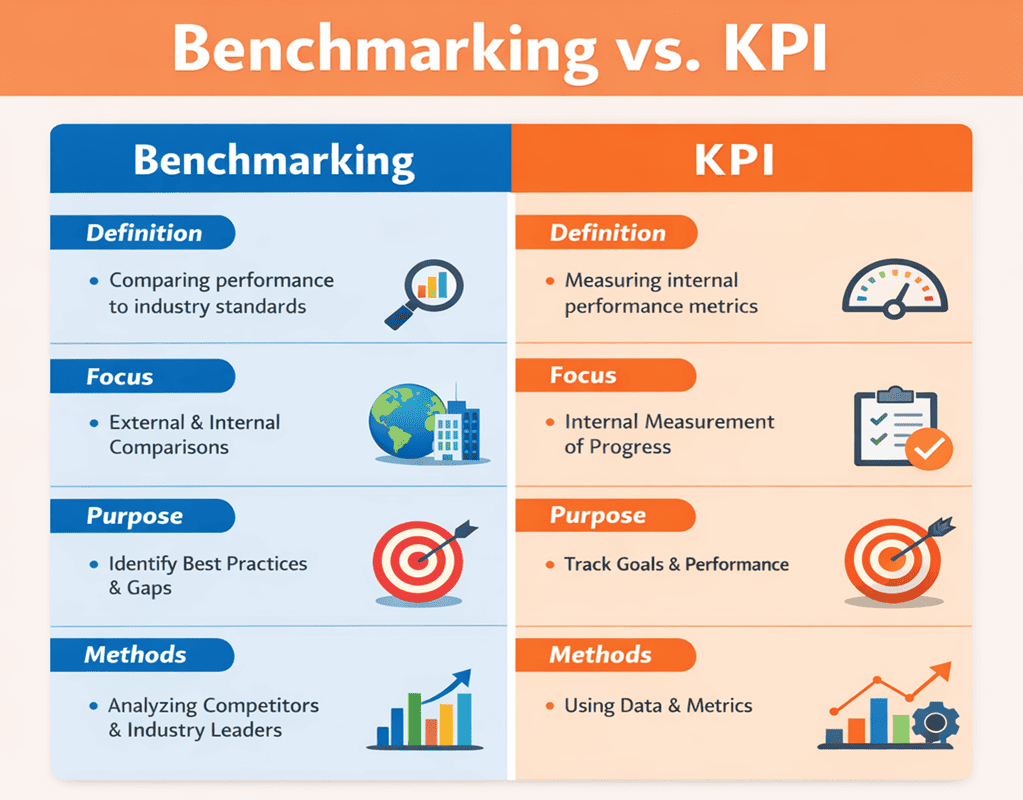
In short, KPIs tell you how you are performing internally, while benchmarking tells you how your performance compares with others. You need both. Without benchmarking, you may meet your KPIs but still fall behind competitors. Without KPIs, you have no baseline for comparison.
How to Conduct Performance Benchmarking
Effective benchmarking follows a structured approach. You can follow the following eight steps for a successful benchmarking project. The infographic below summarizes these steps.
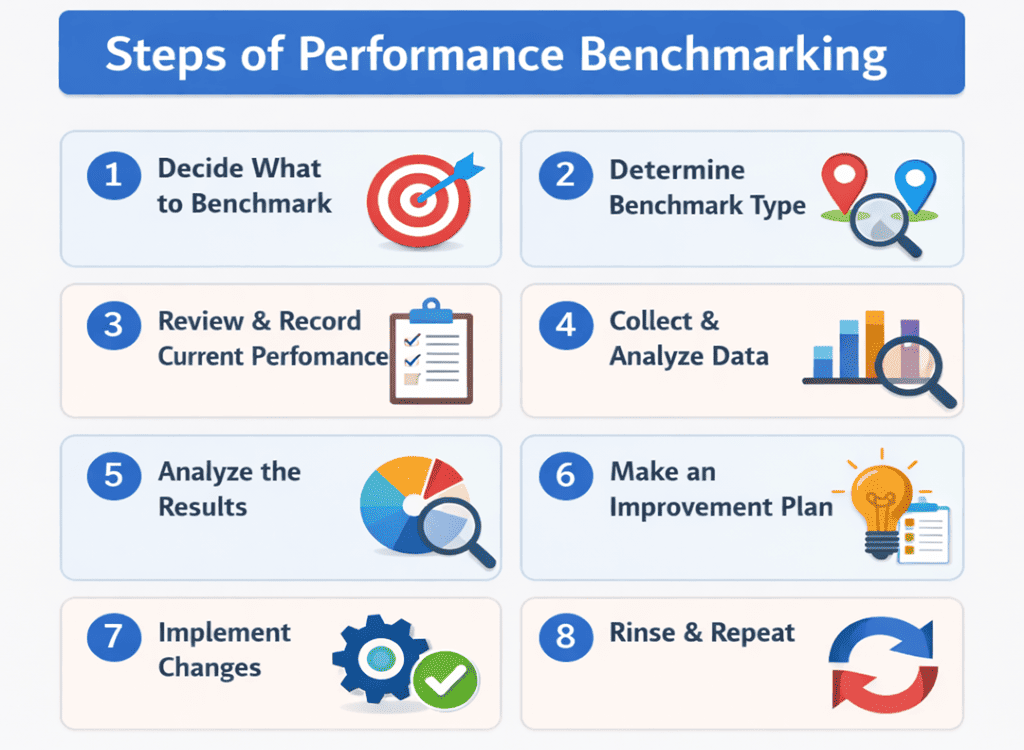
Step 1: Decide What to Benchmark
Start by selecting the projects, processes, or outcomes that have the greatest impact on your business. You should pick areas where improvement will produce significant benefits. For example, a software company might focus on bug resolution time, while a retailer might benchmark customer order fulfillment.
Step 2: Choose Your Benchmarking Type
Decide whether to pursue internal, competitive, or strategic benchmarking. Your choice determines where the data will come from. If you are new to benchmarking, start internally; it is easier to gather data and still yields valuable insights.
Step 3: Review and Record Current Processes
Document how things are done now before comparing them with external standards. Record every step of the process, related metrics, and workflows. This baseline enables you to identify areas where time, resources, or quality are compromised. In our software example, the team notes that its average bug resolution time is 72 hours.
Step 4: Collect Data
Gather data from internal records, competitor research, or industry reports. When collecting external information, verify the sources; secondary sources like news articles or websites can be hard to fact‑check. Attend conferences, subscribe to benchmarking reports, or participate in industry roundtables to access reliable data.
Step 5: Analyze the Data
Compare your performance with the collected benchmarks. Look for gaps, patterns, and opportunities for improvement. In the bug‑fixing example, the team finds that industry leaders resolve bugs in 24 hours. The 48‑hour gap reveals a clear need for change.
Step 6: Make a Plan
Use the insights to set realistic targets and decide how you will reach them. Planning involves selecting specific actions, assigning responsibilities, and allocating resources. Our software team might plan to automate testing and adjust triage processes to cut resolution time in half.
Step 7: Implement Changes
Put your plan into action. This might involve new tools, revised procedures, training programs, or structural changes. Engage your team, communicate clearly, and monitor progress closely. Implementation often requires cross‑department collaboration.
Step 8: Repeat and Improve
Benchmarking is not a one‑time activity. After implementing changes, reassess performance and repeat the process. Continuous benchmarking helps maintain momentum and ensures that improvements stick. In our example, after three months the team reviews its new resolution time and makes further adjustments to reach its goal.
Best Practices for Effective Benchmarking
Benchmarking can deliver huge benefits, but success depends on thoughtful execution. Keep these best practices in mind:
- Select meaningful metrics: Choose measures that relate directly to your strategic goals, such as revenue per employee, on‑time delivery rate, or customer satisfaction score.
- Ensure data quality: Reliable benchmarking requires accurate data. Use multiple sources and verify information before drawing conclusions. Avoid outdated or biased reports.
- Use technology wisely: Despite advancements, many companies still use basic spreadsheets to track performance. Spreadsheets can be error‑prone and slow. Consider dedicated benchmarking tools or analytics platforms to collect and analyze data efficiently. Investing in good software also helps create consistent performance management systems.
- Engage leadership and employees: Leadership buy‑in is vital. Hiring quality team leaders increases overall engagement. Engaged employees are less likely to leave their jobs. Involving managers in benchmarking projects and sharing results with employees can improve morale and retention.
- Set realistic timelines: Benchmarking takes time. Managers in the U.S. spend one to two weeks on a single performance review. Plan for the time needed to collect data, analyze it, and implement changes.
- Respect confidentiality and ethics: When benchmarking competitors, ensure that data is gathered legally and ethically. Use publicly available reports, industry consortia, or third‑party benchmarks. Never misuse confidential information.
- Link benchmarking to improvement: Benchmarking is not about blaming or shaming teams. It’s about learning and adapting. Frame benchmarks as opportunities to improve rather than criticism.
Case Study: Cutting Support Response Time
To see performance benchmarking in action, consider a mid‑size software firm struggling with slow customer support response. The average response time for bug reports was 72 hours, and customer satisfaction scores were slipping. The company followed the eight‑step benchmarking process outlined above:
- Decide what to benchmark: The team chose response time and resolution quality as the main metrics.
- Choose the type: They used competitive benchmarking, comparing their metrics with industry leaders.
- Review and record: They documented their current processes, including triage, assignment, and resolution.
- Collect data: They gathered data from customer service reports, industry studies, and public posts by leading software firms.
- Analyze: The data revealed that top competitors responded within 24 hours and resolved issues within 36 hours.
- Plan: The company decided to implement automated ticket routing, daily triage meetings, and a knowledge base for common issues.
- Implement: The team adopted new tools, trained agents, and set clear targets.
- Repeat: After three months, the average response time dropped to 30 hours, customer satisfaction improved, and the process was iterated to aim for a 24‑hour response.
This example shows how benchmarking can transform performance. By understanding where they stood and aiming for realistic yet ambitious goals, the company improved efficiency and client satisfaction.
FAQs
Q1. What is performance benchmarking?
It is the practice of comparing your company’s performance metrics with competitors, industry standards, or past results to identify gaps and opportunities for improvement.
Q2. How is benchmarking different from KPIs?
KPIs measure internal progress toward specific goals, while benchmarking compares those results with external or historical standards to see if your performance is competitive.
Q3. Which metrics should I benchmark?
Choose metrics that align with your strategic goals. Common measures include revenue per employee, customer satisfaction, defect rates, on‑time delivery, and cost‑to‑serve.
Q4. How often should I conduct benchmarking?
Benchmarking is an ongoing process. Many organizations conduct formal benchmarking annually and review key metrics quarterly.
Q5. Do I need special software for benchmarking?
Software isn’t required, but dedicated tools make data collection and analysis easier. They also reduce errors compared with manual spreadsheets.
Conclusion
Performance benchmarking is not just a buzzword; it is a practical tool for any organization that wants to stay competitive. By comparing your metrics with those of peers, industry standards, and past performance, you gain a clear picture of what “good” looks like and how to get there. The process requires careful planning, honest self‑assessment, and a willingness to change. But the rewards are worth the effort: better products, happier customers, and more engaged employees. Are you ready to put benchmarking to work in your organization? Start small, follow the steps, and watch your performance improve.