
Michael Treacy and Fred Wiersema developed the Value Disciplines Model to answer a simple question: how can a business stand out in a crowded market? They argued that every successful company excels in one of three strategic focuses — customer intimacy, product leadership, or operational excellence. In today’s digital economy, understanding and applying these disciplines remains essential. More than half of consumers stop using a brand after a bad experience, so choosing the right focus can be the difference between loyalty and loss.
This blog post explains what each discipline means, how to apply the model, and why you don’t need to be great at everything.
Let’s get started.
What is the Value Disciplines Model?
The Value Disciplines Model suggests that companies achieve market leadership by excelling in one of three areas while performing well enough in the others.
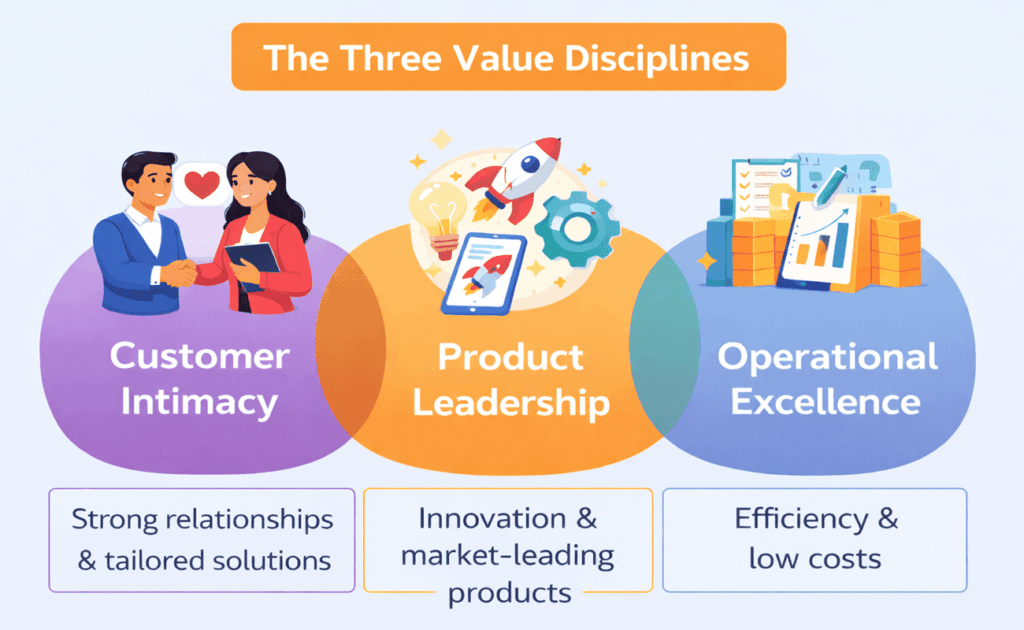
These areas are:
Customer Intimacy
Customer intimacy means building deep relationships with clients and tailoring solutions to their needs. Companies that follow this discipline prioritize service, retention and trust. A strong customer focus pays dividends: in 2025 the American Customer Satisfaction Index gave Amazon a score of 83 out of 100, tying for the highest among major online retailers. That score reflects Amazon’s emphasis on easy returns and fast delivery — key elements of customer intimacy.
Recent research highlights why this focus matters. PwC’s 2025 Customer Experience Survey found that 52 % of consumers stopped buying from a brand after a bad product or service experience, and 29 % switched due to poor customer experience. Businesses that ignore customer needs risk losing more than half of their audience.
Traits of Customer‑Intimate Firms
- They listen closely to customer feedback and use it to improve products and services.
- They personalize solutions and offer tailored support (e.g., dedicated account managers or loyalty programs).
- They invest in long‑term relationships rather than quick transactions.
Well‑known examples include Ritz‑Carlton hotels, which empower employees to spend to resolve guest issues quickly, and USAA, whose insurance and banking services are designed for military families. These companies put the customer first and treat service as a strategic asset.
Product Leadership
Product leadership centers on innovation, cutting‑edge design and an ability to bring breakthroughs to market. Firms that follow this discipline thrive by continually developing new products and setting trends.
According to an EY study, the top 500 companies worldwide increased their research and development spending by 6% in 2024 while revenue grew only 3%. This gap shows that leading companies invest heavily in innovation even when sales are flat. The same report notes that Amazon spent nearly €82 billion on innovation in 2024, keeping it ahead of rivals. Such investment underscores how product leadership depends on bold research budgets.
Traits of Product‑Leading Firms
- They encourage creativity and experimentation across all departments.
- They convert ideas into commercial offerings quickly and market them aggressively.
- They reward teams for innovations that become products or services.
Tech giants illustrate product leadership. Apple revolutionizes mobile devices and personal computing; Tesla pushes the boundaries of electric vehicles and autonomous driving; SpaceX makes private space travel a reality. Smaller examples include Dyson, known for continuously improving everyday appliances.
Operational Excellence
Operational excellence focuses on delivering products and services at the lowest total cost while maintaining reliability and convenience. This discipline revolves around efficiency, automation and streamlined processes.
In retail, Walmart typifies operational excellence. It offers everyday low prices by leveraging scale, optimized supply chains and strict cost controls. IKEA applies similar principles with flat‑pack furniture, self‑service warehouses and standardized designs that reduce manufacturing and logistics costs.
Traits of Operationally Excellent Firms
- They design systems for efficiency and consistency at scale.
- They prioritize automation, standardization and waste reduction.
- They measure success through costs and throughput, not novelty.
Why You Can’t Excel at Everything
Treacy and Wiersema argue that no organization can lead in all three disciplines at once. Trying to be the most innovative, most efficient and most customer‑focused stretches resources thin and creates conflicting priorities. For example, Amazon leads in customer intimacy and operational excellence; its attempts at product leadership — such as the Fire Phone — flopped. Even though the company continues to acquire studios and invest in streaming, these ventures remain secondary to its core strengths.
Instead of spreading yourself thin, choose one discipline as your primary focus and aim for acceptable performance in the other two. This strategy helps align resources, culture and decision‑making around a clear value proposition.
Tools for Choosing Your Value Discipline
Before picking a discipline, assess your market, capabilities and competitors. Several analytical tools can help:
- Porter’s Five Forces – Evaluate industry competition, supplier bargaining power, buyer power, threat of substitutes and threat of new entrants. Knowing these forces helps you see whether operational excellence or differentiation will create more value. Learn more about Porter’s Five Forces.
- Four Corners Analysis – Assess competitors’ motivations and capabilities to anticipate their strategic moves. This tool shows which disciplines competitors excel in and where gaps exist.
- Porter’s Value Chain – Map each activity in your business (inbound logistics, operations, outbound logistics, marketing, service) to identify where you create value and where you need improvement. A strong value chain analysis supports both product leadership and operational excellence. Learn more about the value chain.
- VRIO Model – Evaluate your resources and capabilities based on whether they are Valuable, Rare, Inimitable and Organized. This tool determines if you have the foundation to pursue customer intimacy, product leadership or operational excellence.
Using these frameworks together provides a holistic picture of your strengths and opportunities.
How to Apply the Value Disciplines Model
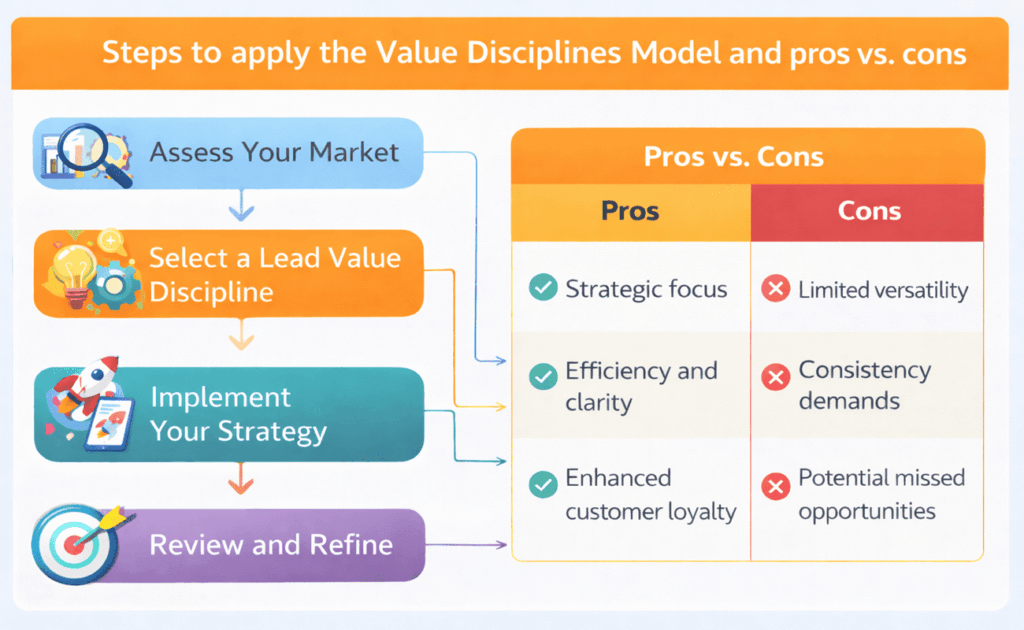
Choosing a discipline is only the start. To put your strategy into practice:
- Analyze your market and competitors. Use the tools above to understand competitive pressure, customer expectations and the positions of major players. Identify gaps where you can stand out.
- Select a core value discipline. Decide whether customer intimacy, product leadership or operational excellence aligns with your capabilities and market opportunities. Make this choice a guiding principle across the organization.
- Align core values and culture. Communicate the chosen discipline throughout the business. Encourage behaviors and processes that support it, whether that means deeper customer engagement, innovative thinking or relentless efficiency.
- Invest in supporting resources. If you choose product leadership, allocate budgets to R&D and creative talent. For customer intimacy, invest in support teams and data analytics. For operational excellence, focus on automation and supply‑chain optimization.
- Maintain minimum standards in the other disciplines. Being mediocre in customer experience or innovation can still hurt your reputation. Ensure your non‑primary disciplines meet industry norms so customers don’t leave.
- Measure performance and adjust. Use key metrics (customer satisfaction, innovation pipeline, cost per unit) to monitor progress. Adjust strategy as markets evolve.
Advantages of the Model
- Clarity of purpose. The model forces you to define your unique value proposition and avoid conflicting priorities.
- Strategic focus. By choosing one discipline, you concentrate resources and talent where they matter most.
- Flexibility across industries. Whether you sell software or run a hotel, the framework adapts to different products and life‑cycle stages.
- Simple to communicate. Employees understand the chosen focus and can align their work accordingly.
Disadvantages of the Model
- Requires other analyses. The model alone doesn’t provide data; you still need tools like SWOT or market research to make informed decisions.
- Not predictive. It guides positioning but doesn’t forecast market trends or customer behavior.
- Balance is tricky. Under‑investing in non‑primary disciplines risks customer churn or outdated products. Over‑investing dilutes your core focus.
Alternatives to the Value Disciplines Model
Other frameworks can help businesses develop competitive strategies:
- Bowman’s Strategy Clock – Describes eight generic strategies based on price and perceived value. This clock helps businesses position themselves from low cost to hybrid or differentiation strategies. It doesn’t focus on organizational values but complements the disciplines model.
- Porter’s Generic Strategies – Outlines three basic competitive strategies: cost leadership, differentiation and focus. Many firms use these strategies alongside the value disciplines to refine positioning. Learn more about Porter’s generic strategies.
FAQs
Q1. What are the three value disciplines?
They are customer intimacy, product leadership and operational excellence. Each represents a different way of creating value for customers.
Q2. How do I choose the right discipline for my business?
Assess your strengths, market conditions and customer expectations. Use analytical tools such as Porter’s Five Forces and the VRIO model to see where you can create the most value.
Q3. Can a company excel in all three value disciplines?
Not realistically. Most successful companies focus on one discipline and maintain adequate performance in the other two. Spreading resources across all three tends to dilute results.
Q4. Do small businesses need a value discipline?
Yes. Clear focus helps small firms compete against larger rivals. Even a niche retailer benefits from choosing customer intimacy and delivering exceptional service.
Q5. Is customer intimacy more important than price?
For many consumers, yes. Price influences buying decisions, but bad experiences drive customers away. A strong relationship often trumps a small price difference.
Conclusion
The Value Disciplines Model remains a powerful way to define how your business delivers value. Whether you choose customer intimacy, product leadership or operational excellence, success requires focus, investment and consistent execution. The latest data shows that customer experience, innovation spending and efficiency still drive loyalty and growth. Use the tools and steps outlined here to decide where your competitive edge lies — and then commit to it. Ready to explore further? Check out our in‑depth guide to Porter’s Five Forces or learn how the VRIO model can help you evaluate your resources.