
The red ocean strategy remains one of the most discussed competitive market strategies today. In a red ocean, companies battle for market share in crowded industries instead of creating new spaces. Consider what happened in 2025 when global smartphone shipments climbed just 2%, yet Apple still captured 20% of the market while Samsung and Xiaomi trailed closely behind. Or look at the Indian telecom sector where Jio held 39% of wireless subscribers while Airtel claimed 30%, leaving little room for smaller players.
These figures show how intense competition turns markets into “red oceans.” Have you ever wondered how firms can survive in such environments?
This guide explores what a red ocean strategy involves, how it differs from a blue ocean approach, and why some businesses thrive in crowded markets.
What is a Red Ocean Strategy?
A red ocean strategy focuses on competing in an existing market where many firms offer similar products or services. The term “red” suggests blood in the water as rivals fight for customers. Unlike disruptive strategies that create new demand, red ocean tactics seek to carve out a larger share of what already exists. Businesses operating in a red ocean choose between competing on price or offering better value. The goal is not to reinvent the wheel but to outperform competitors by improving quality, service or efficiency.
Importance of Red Ocean Strategy
In 2024, India had about 1.14 billion wireless subscribers, and just three carriers — Jio, Airtel and Vi — served 88% of them. Similarly, in Europe, Ryanair carried 197 million passengers in 2024, far ahead of Lufthansa’s 131 million. These statistics reveal how a few players dominate huge markets. For smaller or new companies, entering such spaces means adopting a strategy that lets them survive against bigger rivals. Red ocean strategies provide a framework for this survival.
Red Ocean Vs Blue Ocean: Key Differences
You might hear people suggest that you should avoid red oceans entirely and instead seek blue oceans — markets with little or no competition. While this sounds appealing, creating new demand is expensive and risky.
The table below summarizes the main differences:
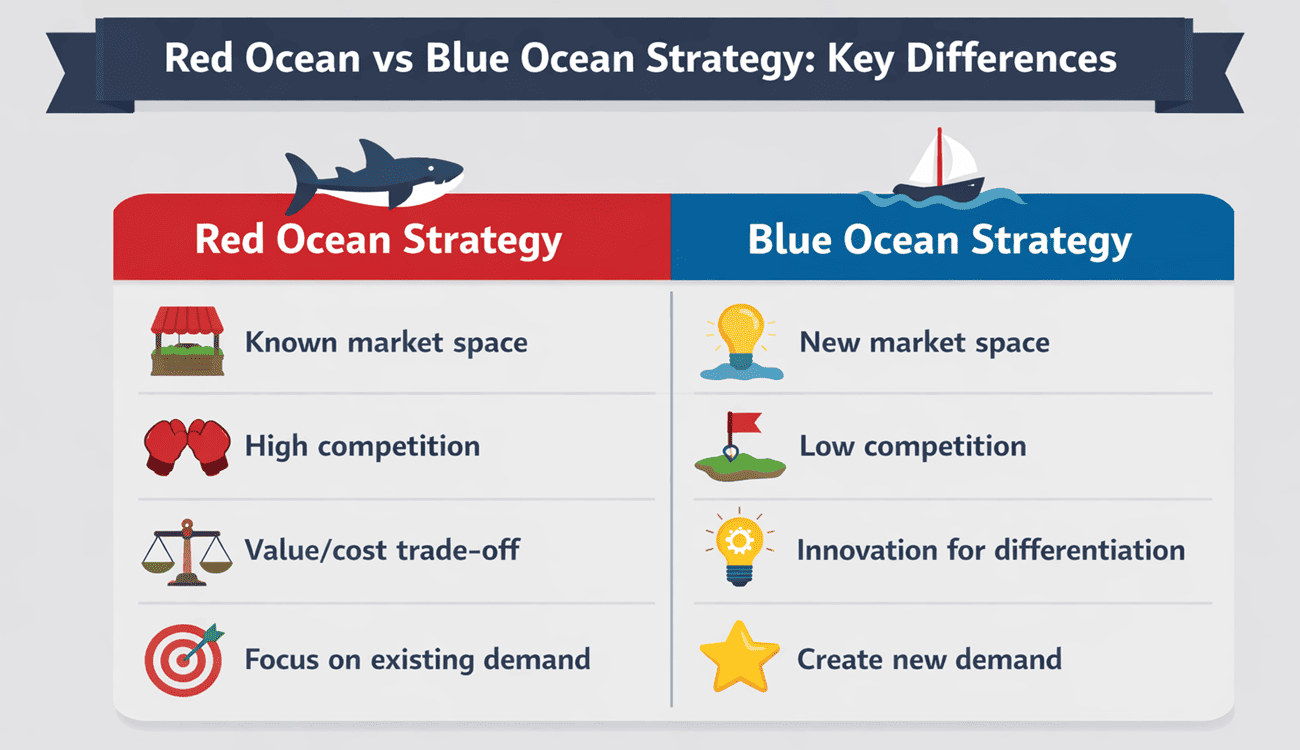
Understanding these contrasts helps a company decide whether to compete head‑to‑head or pioneer new territory. Many firms choose red oceans because they already have resources aligned with current markets. Still, they must adopt tactics that make them stand out.
Real‑World Examples of Red Ocean Strategy
Telecom Battles in India
The Indian telecom sector illustrates how fierce competition shapes strategies. By the end of fiscal 2023, Jio accounted for 39% of India’s wireless subscribers, averaging 447 million users, while Airtel held 30% with 339 million users. Vi lagged with 223 million subscribers. Together these three operators served 88% of all wireless customers. To gain share in this crowded arena, Jio slashed prices and offered free data during its launch. Airtel responded by improving network quality and pushing premium post‑paid plans. Both strategies align with red ocean principles: fight for existing demand through value and efficiency.
Low‑Cost Airlines in Europe
Another example comes from aviation. Ryanair carried 197 million passengers in 2024, 66 million more than second‑place Lufthansa. The gap was bigger than the total annual traffic of most other carriers. In response, rivals such as easyJet, Vueling and Wizz Air tried to cut costs and offer more routes to close the distance. Rather than inventing new travel modes, airlines battle over price, capacity and service — classic red ocean behavior.
Smartphones: A Global Arena
The global smartphone market is also a red ocean. In 2025, shipments rose by 2% year‑on‑year, yet the top positions barely changed; Apple captured 20% of the market, while Samsung held 19% and Xiaomi 13%. Most brands fight for incremental gains by releasing new models, adjusting prices and enhancing features. Because the market is mature, growth comes mainly from taking share from rivals rather than creating new consumers. That is why marketing, branding and innovation become survival tools in red oceans.
Other Familiar Cases
Low‑cost carriers such as SpiceJet in India or budget supermarkets in Europe follow similar tactics. They focus on reducing operational expenses to offer lower prices. Meanwhile, telecom giants like Jio or Verizon invest in network upgrades to provide better service at a competitive rate. Even streaming platforms like Netflix and Disney+ battle over subscribers by adjusting subscription tiers and adding original content. All these examples show that competition is constant and companies must keep improving to stay relevant.
How to Compete in a Red Ocean
Thriving in a cut‑throat market demands a deliberate plan. The following steps can help a business improve its position:
- Create a Disturbance. Instead of entering quietly, make a splash that grabs attention. Jio, for instance, offered free data to lure millions of users at launch. You might use a bold promotion, an unusual feature or a creative marketing campaign.
- Innovate on Value. Innovation doesn’t always mean inventing a new product. It can be as simple as bundling services or improving customer support. Airtel grew revenue by encouraging users to switch to premium plans and by simplifying its offerings.
- Provide Tangible Value. Customers will switch only if they see clear benefits. Low‑cost airlines cut fares, but they also streamline boarding and optimize flight schedules. Your business might focus on quality, convenience or personalized service.
- Understand the Target Audience. Look for segments competitors overlook. For example, some telecom firms cater to rural consumers who need affordable data. Others target urban professionals with premium packages. Identify a group whose needs are unmet and tailor your offer accordingly.
- Adjust Pricing Strategically. Price wars can erode profits, so use pricing as a tool rather than a weapon. Offer introductory rates or bundles, but ensure long‑term sustainability. This can also discourage low‑margin competitors from entering your space.
- Develop Skills and Culture. Skilled employees fuel innovation. Invest in training and encourage teams to suggest improvements. Building a culture of continuous improvement helps you respond quickly to competitors.
- Advertise Wisely. Even the best product fails if nobody knows about it. Craft a clear message that highlights your unique value. Use channels where your audience spends time, whether online platforms, local events or industry magazines.
Advantages of Red Ocean Strategy
Operating in a crowded market offers surprising benefits:
- Predictability. Companies have a clear sense of customer needs and competitor moves. This clarity reduces risk and allows managers to plan with confidence.
- Established Demand. You don’t need to educate people about a new product. Instead, you tap into existing demand, which often results in faster revenue.
- Efficient Resource Use. Because processes and supply chains are already in place, you can focus resources on incremental improvements rather than building everything from scratch.
- Shorter Learning Curve. New entrants can learn from rivals’ successes and mistakes. They can quickly refine their offerings by observing what works.
Disadvantages of Red Ocean Strategy
Despite its merits, this approach carries risks:
- Intense Competition. Rivalry can lead to price wars and shrinking margins. The airline and smartphone examples show how tough it is to maintain profits when everyone is fighting for the same customers.
- Limited Growth Potential. Once markets saturate, growth comes mostly from taking share from others. This limits expansion and can stifle innovation.
- Copycat Behavior. Competitors often imitate each other. Unique features rarely stay unique for long, making it harder to keep an edge.
- Risk of Complacency. Focusing on current competitors might blind a firm to emerging technologies or shifts in consumer preferences. Companies must stay alert to avoid being disrupted by a blue ocean player.
Characteristics of a Red Ocean Strategy
Red ocean strategies share a few common traits:
- Firms operate within known market boundaries and fight for existing customers.
- They compete on price or value, often balancing costs against perceived benefits.
- They exploit current demand, targeting customers who already understand the product or service.
- Success comes from execution, including efficient operations, strong marketing and responsive customer service.
Checklist for Success in a Red Ocean
To assess whether your business is following the right path, consider these questions:
- Are you competing in an established market rather than creating a new one?
- Does your offering deliver value at a price customers accept?
- Have you identified clear advantages over competitors, such as better service, lower cost or improved quality?
- Do you understand your customers’ needs and adjust your strategy based on feedback?
- Are your operations efficient enough to support competitive pricing?
FAQs
Q1. How Can Companies Adopt a Red Ocean Strategy?
A company should analyze competitors, understand customer needs and then offer a compelling solution. This requires research, clear branding, efficient operations and targeted marketing. Focus on value and differentiation while keeping costs in check.
Q2. Is a Red Ocean Strategy Risky?
It carries risk because intense competition can erode profits. However, operating in a known market offers predictability. Success depends on how well you execute and differentiate.
Q3. What Industries Use Red Ocean Strategies?
Almost every mature industry does — from airlines and telecom to retail and streaming. Whenever multiple firms fight over the same customers, they are in a red ocean.
Q4. How Do You Decide Between Red and Blue Ocean Strategies?
Consider resources, industry maturity and risk tolerance. Entering a blue ocean demands innovation and investment. Competing in a red ocean requires operational excellence. Your choice depends on where your strengths lie.
Q5. Can a Business Shift from Red Ocean to Blue Ocean?
Yes, many firms start in crowded markets and later create new products or services. For example, a telecom company might introduce enterprise cloud solutions to reach a new audience. Moving to a blue ocean requires creativity and courage.
Conclusion
A red ocean strategy isn’t about endless price wars; it’s about smart competition. By understanding market dynamics, delivering real value and staying agile, businesses can thrive even when the waters run red. The examples of Indian telecom, European airlines and global smartphones show that success comes from constant improvement rather than radical change. As a reader, think about your own market: are you fighting the right battles, or could a slight adjustment in strategy improve your position?