
A whitepaper is one of the most trusted tools for sharing deep knowledge, research, and expert insight. Organizations, governments, and businesses use a whitepaper to explain complex topics, present solutions, and guide informed decisions.
Unlike short blog posts, a whitepaper focuses on facts, analysis, and clear reasoning. It helps readers understand a problem before offering a practical solution. In today’s competitive digital space, whitepapers also play a key role in building credibility and authority.
This blog post explains what a whitepaper is, why it matters, its main types, real-world examples, and how to create one that delivers real value.
What is a Whitepaper?
A whitepaper is an informational document that presents research, expert analysis and an organization’s insight into a topic or solution. Companies and not‑for‑profit organizations use whitepapers to highlight the features of a product, service or methodology and to persuade readers to act. Unlike blog posts or case studies, whitepapers are technical and in‑depth. They rely on research, statistics and analysis to provide objective information and thought leadership. Many institutions — from startups to governments and universities — use whitepapers to educate their audiences and establish authority.
Whitepapers serve both marketing and policy purposes. A technology vendor may publish a whitepaper to explain how its solution addresses a specific problem and to generate sales leads. A government agency might issue a whitepaper to outline a policy problem and propose solutions. Either way, the document focuses on facts and analysis rather than overt promotion. Whitepapers usually run at least 2,500 words and include references, citations and sometimes data visualizations.
Why Whitepapers Matter
Whitepapers build trust because they present educational information backed by research. They can generate leads and nurture prospective customers by giving them valuable insights before any sales conversation begins. Within content marketing, long‑form assets such as whitepapers remain popular. A survey of B2B marketers found that 51% used e‑books or whitepapers, ranking them among the top long‑form content types. In the same survey, 45% of respondents said e‑books or whitepapers were among the most effective formats for engaging audiences. These numbers show that decision makers still value well‑researched documents when evaluating products and policies.
Whitepapers also help organizations nurture leads. They enable potential customers to learn about a complex problem, frame internal discussions and reduce uncertainty before contacting sales teams. In the public sector, whitepapers provide policymakers with clear descriptions of issues and offer well‑supported solutions. The objective tone and thorough research expected in whitepapers ensure that readers can trust the information.
Main Types of Whitepapers
Whitepapers are not one‑size‑fits‑all. The format you choose depends on your goal and audience.
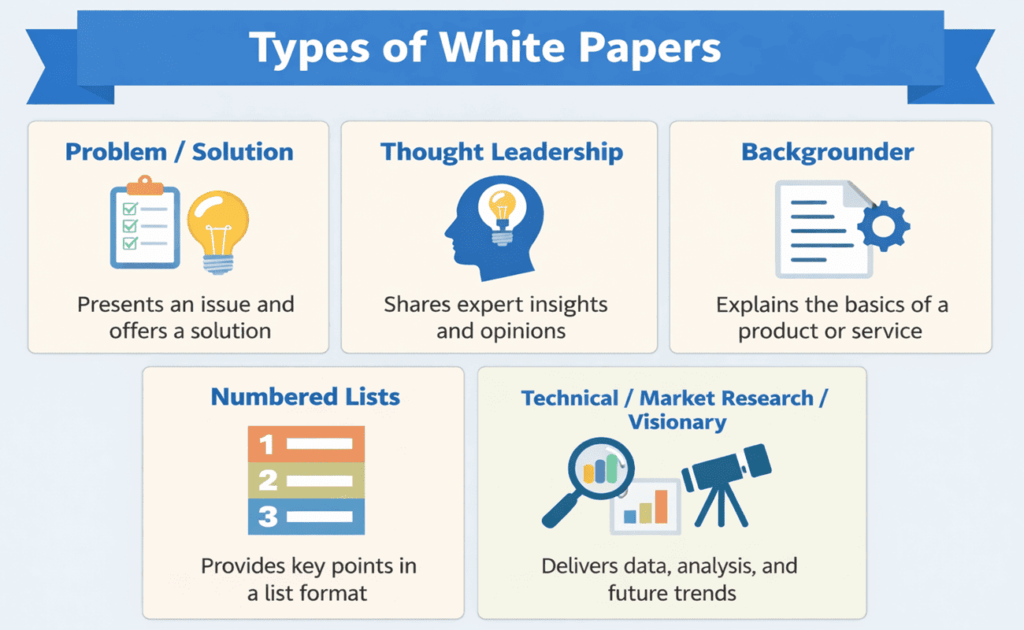
The most common categories include:
- Problem/Solution whitepapers – These documents define a specific problem faced by the target audience and propose a data‑driven solution. They are ideal when you want to show how your product or policy addresses a pressing issue.
- Backgrounders – A backgrounder explains the technical features of a product or service. It simplifies complex information and provides context for evaluation.
- Numbered lists – Also known as listicles, these papers highlight key takeaways or questions related to a product or topic. They are easy to scan and often use headings such as “3 Things You Need to Know”.
- Thought leadership papers – These whitepapers aim to position the organization as a visionary leader. They explore current debates or emerging trends and provide analysis, often without promoting a specific product.
- Technical or market research papers – These long documents present new research findings, technical analyses or market data. They are common in industries with complex products or services and can demonstrate expertise.
Which Type Should You Choose?
The right type depends on your audience’s needs. If your readers struggle with a well‑defined problem, a problem/solution paper makes sense. When you need to explain complicated technology, a backgrounder helps by breaking down jargon. Thought leadership pieces work well when you want to start a conversation around a broader issue. Numbered lists are good for readers who prefer quick takeaways. Always consider the stage of the buyer’s journey and the decision makers you want to reach.
Real‑World Examples of Whitepapers
Examples help make abstract concepts real. Here are some well‑known whitepapers from different sectors:
- Cisco: Networking and Your Competitive Edge – Cisco published this whitepaper to explain networking challenges and solutions for businesses. It highlights how robust networking and security solutions can create a competitive advantage. The document targets business leaders and includes technical explanations alongside strategic recommendations.
- HSBC: Are Equities Overvalued? – In this whitepaper, HSBC urges investors to diversify their portfolios instead of relying solely on equities. The paper provides analysis of market conditions and offers guidance on asset allocation. Its goal is to help investors make informed decisions.
- Google: Cloud Security and Compliance – Google uses this whitepaper to demonstrate how its cloud platform secures data and complies with industry regulations. The document combines technical details with case studies, showing how customers can trust their data to Google Cloud.
- Bitcoin: A Peer‑to‑Peer Electronic Cash System – The famous Bitcoin whitepaper introduced the concept of a decentralized digital currency in 2008. It outlined how blockchain technology could enable secure, peer‑to‑peer transactions without financial intermediaries. This whitepaper sparked an entire industry of cryptocurrencies and remains a classic example of a problem/solution paper.
These examples show that whitepapers can support marketing efforts, guide investment strategies, promote products and even launch new technologies. You might have heard of other examples in your industry. Which whitepapers have influenced your decisions?
How to Write a Whitepaper: A Simple Guide
Writing a whitepaper may seem daunting, but breaking the process into manageable steps makes it achievable. Based on best practices from experts, here is a straightforward approach:
- Define your audience – Identify who will read your whitepaper. Are they business executives, policymakers or consumers? Understanding their needs and questions ensures your paper stays relevant and clear.
- Select a relevant topic – Choose a problem or subject that matters to your audience. For a technology company, cybersecurity or data privacy might be timely topics. For a nonprofit organization, a policy issue like food security could be appropriate.
- Conduct thorough research – Gather data, case studies and expert opinions. Whitepapers must present information that readers cannot find through a quick search. Use primary sources, credible studies and statistics from the last few years.
- Create an outline – Map out your sections before writing. A typical structure includes a title, executive summary, introduction, problem description, solutions, conclusion and references.
- Write the draft – Use clear, direct language. Start with an engaging introduction, explain the problem, present evidence and then propose your solution. Keep sentences short and vary their length to maintain interest. Avoid jargon unless you define it.
- Review and refine – Revise for clarity, structure and tone. Check that your paper flows logically and that the references support your claims. Ask colleagues or subject‑matter experts to review the paper and provide feedback.
Key Sections of a Whitepaper
While there is flexibility in format, most whitepapers include the following sections:
- Title and abstract – A descriptive title and a brief summary set expectations and help readers decide whether to read on.
- Executive summary – In a few paragraphs, outline the problem, your solution and the main takeaways.
- Introduction or background – Provide context and explain why the problem matters. This might include historical data, legal frameworks or market conditions.
- Problem description – Detail the problem in a logical way. Identify its causes and impacts. Use data and examples to make it concrete.
- Solutions – Present one or more solutions. Explain how each solution addresses the problem and discuss its advantages and limitations. Support your points with evidence.
- Conclusion – Sum up your findings and emphasize the next steps. Encourage readers to take action, whether that means adopting your recommendation, contacting you for more information or reading related material.
- References – List the sources you cited. Proper citations enhance credibility and allow readers to verify your claims.
Whitepapers Vs Other Content Types
Whitepapers differ from blog posts, case studies and eBooks in several ways. They are longer and more detailed than most blog posts or articles. Case studies focus on a single example or customer success story, while whitepapers address broader problems with research and analysis. eBooks may cover a topic in depth but often have a more conversational tone and may not include citations or formal structure.
Because of their depth, whitepapers require a larger investment of time and resources. However, the payoff can be significant: they showcase expertise, generate quality leads and position your organization as a thought leader. When combined with a strong content strategy, whitepapers can complement shorter content types and nurture prospects throughout the buyer’s journey.
FAQs
Q1. What makes a whitepaper credible?
A credible whitepaper relies on recent data, cites sources and maintains an objective tone. Avoid unsupported claims and provide references for every fact.
Q2. How long should a whitepaper be?
Most whitepapers are at least 2,500 words. Length should be driven by the complexity of the topic and the depth of analysis needed.
Q3. Can small businesses use whitepapers?
Yes. Small companies can benefit from whitepapers by educating potential customers about a niche solution or establishing authority in a specialized field.
Q4. Do whitepapers always need citations?
Citations are essential in whitepapers because they support your claims and show readers where to find more information. Even internal data should be referenced.
Q5. Are whitepapers still relevant?
Absolutely. The continued use and effectiveness of whitepapers in B2B marketing shows that organizations and readers value detailed, well‑researched documents when making decisions.
Conclusion
White papers remain a powerful way to share knowledge, build trust, and guide informed decisions. When written well, they explain complex ideas in a clear and credible manner. By understanding the different types of white papers and following a structured writing process, organizations can communicate value without sounding promotional. Whether used for education, policy guidance, or marketing, a strong white paper supports long-term authority, improves engagement, and helps readers move forward with confidence and clarity.