
Have you ever wondered why some teams feel more structured than others? In every company you’ll find groups that are officially set up by management to get specific work done. These are called formal groups and understanding how they function can help leaders and employees work smarter.
This blog post explores what formal groups are, why they exist, how they are classified and how to manage them effectively.
What is a Formal Group?
A formal group is a work unit prescribed by an organization to accomplish a particular task or goal. According to the OpenStax text on organizational behavior, formal groups are “work units that are prescribed by the organization” and include departments, committees or project task forces. When the group is permanent it is often called a command group or functional group, such as the sales department. When it is temporary, it is usually referred to as a task group, such as a special project team.
Formal groups differ from informal groups because they are deliberately created by management rather than evolving naturally from employee friendships. They have defined roles, rules and procedures. Members know who their leader is, what the group’s objective is and how decisions are made.
Key Features of Formal Groups
- Clear objectives: Formal groups are formed for a specific purpose, whether to run a department, complete a project or address a policy issue.
- Defined roles: Each member has a designated role and responsibility. Hierarchical reporting lines are common.
- Set procedures and rules: There are rules for how meetings are run, how decisions are made and how resources are used.
- Official leadership: A manager or chairperson guides the group and ensures tasks align with organizational goals.
- Accountability: Because the group is sanctioned by management, members are accountable for results and may be evaluated on their performance.
These features help formal groups achieve their tasks efficiently, but they can also lead to bureaucracy if they are not designed thoughtfully.
Types of Formal Groups
Formal groups can be categorized based on permanence and function.
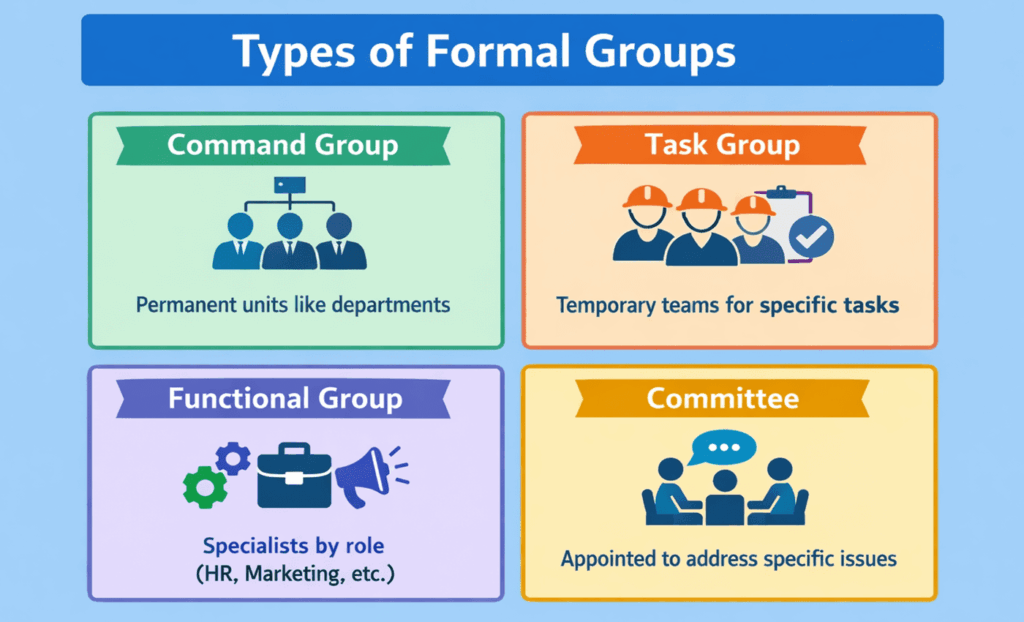
The main types are:
1. Command (Permanent) Groups
These are permanent units such as departments or divisions. Examples include the finance department, the marketing team or the customer support unit. These groups have ongoing responsibilities and are essential to the organization’s daily operations. A command group has a hierarchical structure: a department head leads subordinates who share similar functions. Because these groups are long‑term, they often develop their own culture and norms.
2. Functional Groups
Functional groups are similar to command groups but are defined by specialized roles. For instance, an IT department handles technical infrastructure, while a human resources team manages recruitment and employee relations. These groups provide deep expertise and ensure that complex tasks are handled by skilled professionals.
3. Task (Temporary) Groups
Task groups are temporary teams formed to accomplish a specific project or solve a particular problem. Once the objective is met, the group disbands. A corporate task force assigned to implement a new software system is a good example. Task groups encourage collaboration across departments but can suffer from unclear authority if leadership isn’t defined.
4. Committees
Committees consist of members appointed to discuss, review or decide on specific issues. They may be permanent (for example, a safety committee) or temporary (a hiring panel). Committees often draw members from different departments to ensure diverse perspectives. The formal structure helps prevent decisions from being made unilaterally.
Why Organizations Create Formal Groups
Organizations use formal groups to coordinate complex work and maintain accountability. Here are several reasons:
- Division of labor: By assigning specific tasks to dedicated teams, managers ensure that work is completed efficiently. Functional groups like IT or finance keep specialized knowledge in one place.
- Clarity and control: Clear reporting lines and defined responsibilities reduce confusion. When everyone knows their role, the risk of duplicated work or missed steps drops.
- Goal alignment: Formal groups help align individual efforts with organizational objectives. Sales teams know their revenue targets, while committees have clear decision mandates.
- Accountability: Because formal groups report to managers or leaders, it’s easier to track progress and hold people responsible for results.
- Resource management: Leaders can allocate budgets, personnel and tools efficiently when groups are structured.
The Human Side: Benefits and Challenges
While formal groups bring structure, they also affect employee wellbeing.
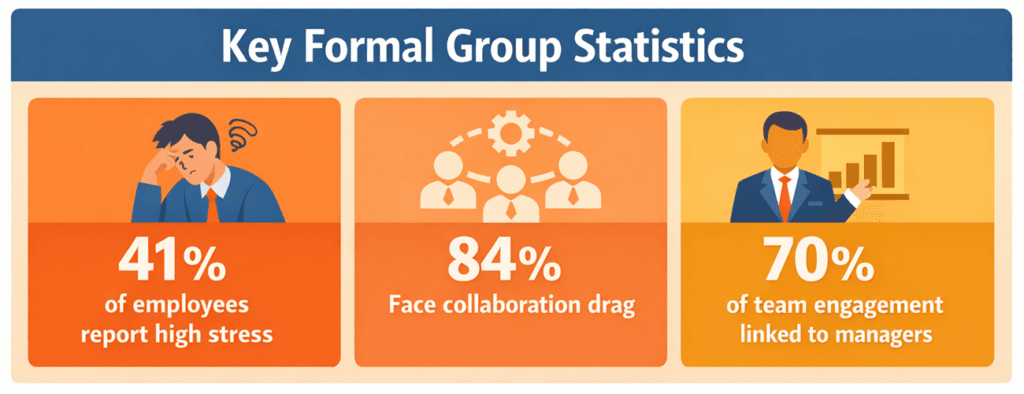
Recent research reveals important insights:
- A 2024 Gallup study found that 41% of employees report experiencing “a lot of stress,” and workers under bad management practices are nearly 60% more likely to be stressed compared with employees in well‑managed groups. Better management can reduce stress and improve outcomes.
- At the same time, Gallup notes that managers account for 70% of the variance in team engagement, countries with engaged managers are twice as likely to have engaged employees. Effective leaders, therefore, play a major role in how formal groups perform and how employees feel.
- A May 2024 Gartner survey reported that 84% of marketing leaders and employees experience “collaboration drag,” too many meetings, excessive feedback and unclear decision authority when working across functions. Organizations with high collaboration drag were 37% less likely to meet revenue goals.
These statistics highlight both the benefits and the challenges of formal groups. Clear structures can improve productivity, yet poor management can lead to stress, burnout and inefficiency. Strong leadership and thoughtful design are crucial.
Best Practices for Managing Formal Groups
- Define goals and roles early. Set a clear objective and assign roles before the group starts work. A written charter helps members understand their responsibilities.
- Appoint an engaged leader. Choose a manager or chairperson who communicates well, provides feedback and encourages participation. Research shows that engaged managers drive higher team engagement.
- Establish decision procedures. Determine how decisions will be made, by consensus, majority vote or leader decision. Clear authority reduces collaboration drag.
- Keep meetings purposeful. Limit meeting frequency and length. Use agendas and assign action items to avoid wasted time.
- Encourage cross‑department collaboration. When forming task groups or committees, include diverse perspectives, but clarify who has the final say.
- Monitor stress and workload. Regularly check in with group members to ensure workloads are manageable. Offer resources and adjust assignments when necessary.
- Celebrate achievements. Recognize milestones and successes to boost morale and maintain engagement.
FAQs
Q1. What distinguishes a formal group from an informal group?
A formal group is deliberately created by an organization with defined roles and objectives, whereas informal groups arise naturally from friendships or shared interests and have no official structure.
Q2. Are committees always permanent?
No. Some committees are temporary, formed to address a short‑term issue, while others (like safety or ethics committees) are ongoing.
Q3. Can a formal group be creative?
Yes. Clear rules and goals provide a foundation for creative ideas. When members know their roles, they can focus on innovation rather than logistics.
Q4. How can I improve collaboration in a task group?
Clarify decision authority, keep meetings short and purposeful, and assign a project leader who removes roadblocks. Regular updates and transparent communication help everyone stays aligned.
Q5. Does formal group structure apply in small businesses?
Absolutely. Even a small firm benefits from clearly defined teams, such as a finance group or a marketing task force. The structure should be sized to the business but still provide clarity.
Conclusion
Formal groups give structure to how work gets done inside organizations. They define roles, set clear goals, and guide behavior through rules and authority. When designed well, formal groups improve coordination, accountability, and decision making. They help team members stay focused and aligned with organizational goals. Understanding the types of formal groups and how they function allows leaders and employees to work more effectively. Strong formal groups do not limit people. They create clarity, stability, and better results across the organization.
it is excellent work