Every workplace wants employees to thrive. Yet even the most talented people can struggle when expectations are unclear or support is lacking. A well‑designed performance improvement plan (PIP) can turn that around. It offers a structured path to improvement and shows that management cares about helping people grow.
Recent research shows why these matters: global employee engagement slipped to just 21% in 2024, costing the world economy an estimated $438 billion in lost productivity. Only 27% of managers worldwide describe themselves as engaged. When the people in charge are disengaged, their teams suffer too. A thoughtful PIP can re‑energize employees and managers alike.
This post explains what a PIP is, why it matters, how to create one, and how to respond if you receive one. It blends proven practices with up‑to‑date data and real‑world examples. The goal is to give you a clear, supportive framework that benefits both employees and organizations.
What Is a Performance Improvement Plan?
A performance improvement plan is a formal roadmap that helps an under‑performing employee meet clear job expectations. Unlike an informal chat, a PIP documents the current performance problem, sets specific goals, outlines support from management, and establishes a timeline for improvement. It is not a prelude to firing. When used well, a PIP signals that the organization values the employee and wants to see them succeed.
According to the Chartered Institute of Personnel and Development (CIPD), helping employees perform well is a core role of managers and people professionals. People create the greatest value in an organization, so managing performance is critical. Employees need to understand what’s expected of them and must be given the skills, resources, and support they need. A PIP brings these elements together into a single document.
It often includes:
- Problem statement: A concise description of the performance issues with specific examples.
- SMART goals: Objectives that are Specific, Measurable, Achievable, Relevant, and Time‑bound.
- Support plan: Training, coaching, or resources that the manager will provide.
- Timeline: A clear period for improvement, usually between 30 and 90 days, with checkpoints.
- Consequences: What will happen if the goals are not met.
When employees know the expectations and feel supported, they are more likely to improve. A PIP turns vague complaints into constructive steps and fosters accountability on both sides.
Why Do Performance Improvement Plans Matter?
Performance improvement plans help businesses grow and people develop. They matter for several reasons:
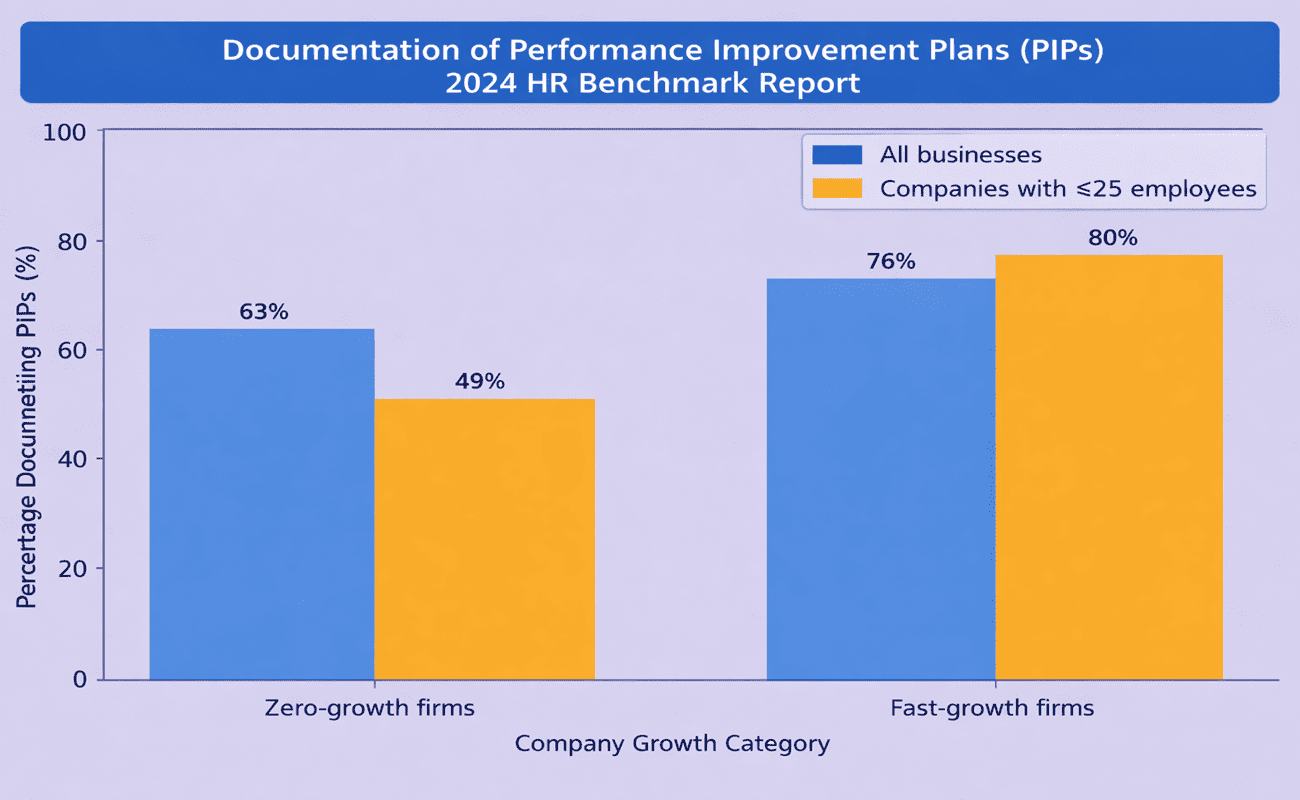
- Retention and growth: A recent survey of 1,065 small businesses found that 76% of fast‑growth firms documented PIPs for under‑performing workers, compared with 63% of zero‑growth firms. For companies with 25 or fewer employees, the gap was even wider: 80% of fast‑growth firms and only 49% of zero‑growth firms documented PIPs. This strong correlation suggests that using PIPs effectively can support business growth and retain talent.
- Transparency and fairness: A written plan removes ambiguity. It lays out exactly what is wrong and what success looks like. Transparency reduces the sense of unfairness that often accompanies poor reviews.
- Engagement and productivity: Gallup’s report found that disengaged employees cost the global economy hundreds of billions in lost output and that only 27% of managers feel engaged. When managers work closely with struggling employees through a PIP, engagement often improves. Engaged teams produce better outcomes.
- Documentation: In regulated industries or union environments, documenting performance issues is necessary before disciplinary action. A PIP creates a paper trail that protects both employee and employer.
PIP Documentation Rates by Company Growth
The HR Benchmark Report uncovered interesting differences in how businesses use PIPs. The graphic below illustrates the percentage of firms that document performance improvement plans for under‑performing employees. It compares zero‑growth and fast‑growth companies, both overall and among small firms with 25 or fewer employees. Fast‑growth companies are much more likely to formalize these plans, hinting at a link between clear performance management and business expansion.
Real‑World Examples of PIPs
Example 1: Data Entry Clerk
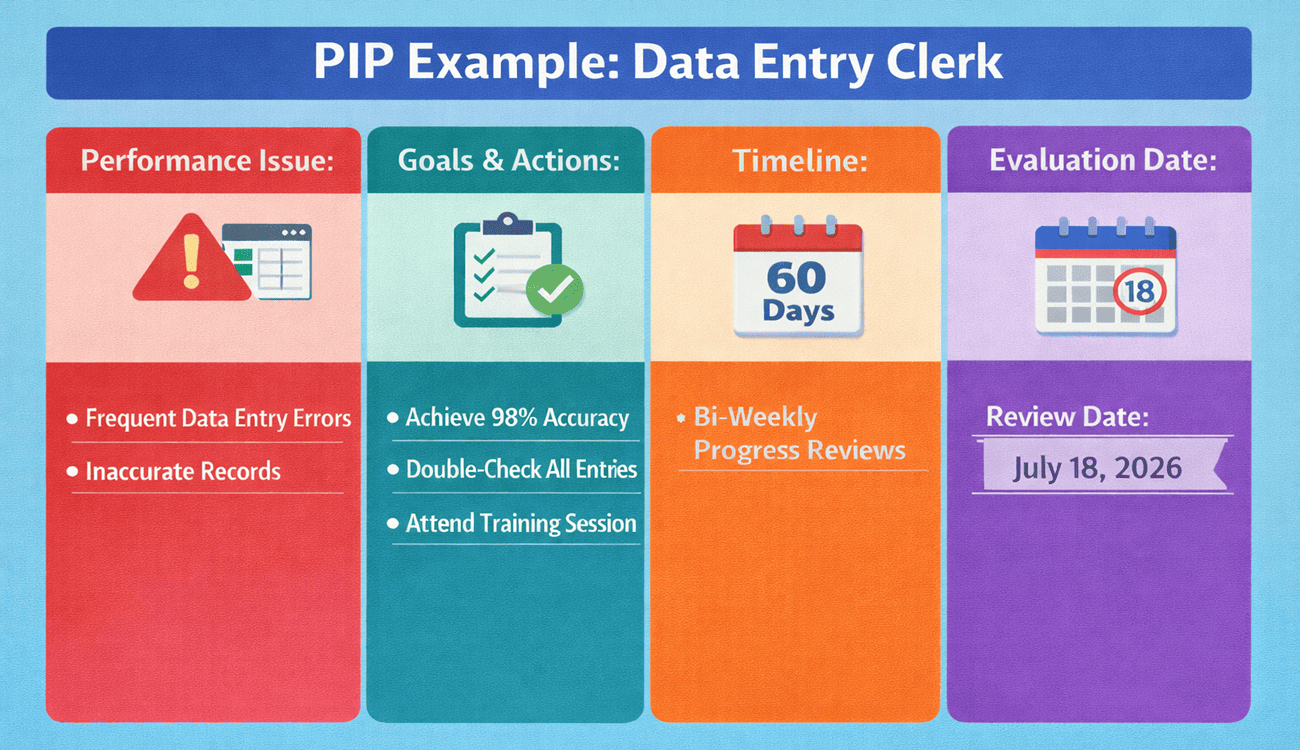
Mary Ann is a data entry clerk who has made repeated mistakes. On April 10 she entered incorrect data, and on May 18 she left out a variable, leading to misleading visualizations. Her manager decided to issue a PIP. The plan clearly defines the issue (frequent data entry errors and inaccurate records) and sets goals to achieve at least 98 % accuracy. Actions include double‑checking entries, having a peer review her work, completing a training session on best practices for statistical software, and attending weekly progress reviews. The plan runs for two months, with a final evaluation scheduled for July 18.
Example 2: Content Writer
John is a content writer who promised 10 articles last month but delivered only five. He missed several deadlines, which delayed publication and created extra work for editors. John’s PIP begins by detailing these problems. The plan asks him to work with his manager to set realistic monthly targets, update editors daily on his progress, limit drafting time to three hours per 1,000 words, and submit work at least one hour before deadlines. The plan lasts 60 days with weekly check‑ins. A final review will occur three months later.
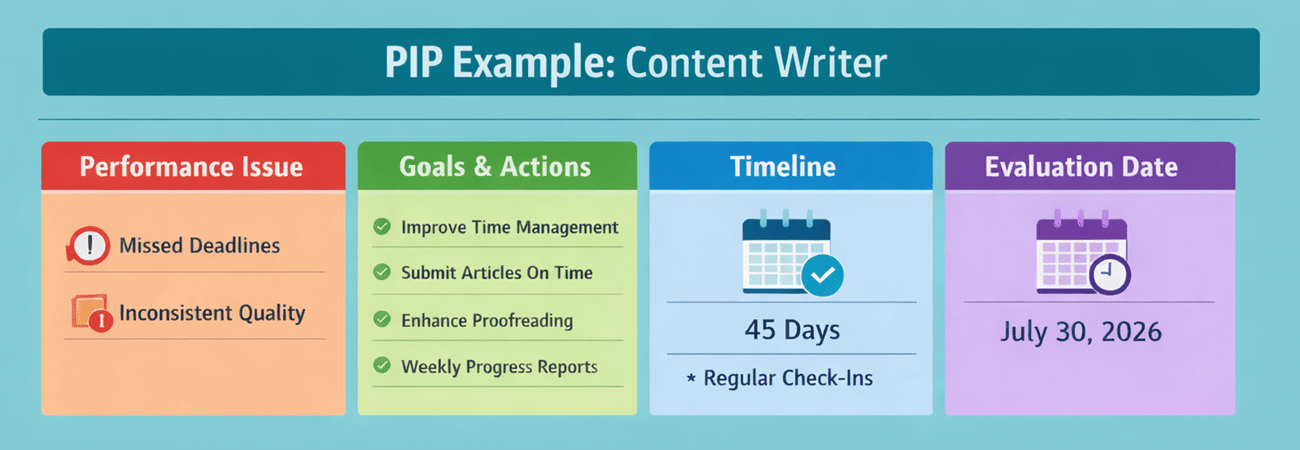
These examples show that a PIP should describe the problem, outline clear steps, and give the employee reasonable time to improve. Each plan is tailored to the role and includes measurable goals, specific actions, and a deadline.
How to Create an Effective Performance Improvement Plan
Crafting a good PIP involves collaboration between manager and employee. Follow these steps to build a plan that supports growth:
- Define the issue: Identify the performance problem with specific examples. Discuss facts rather than feelings. Employees need clarity about what is expected of them.
- Set SMART goals: Agree on measurable objectives that challenge the employee but are achievable. Goals should be tied to business needs and include dates and numbers. For complex jobs, it can be more effective to focus on learning outcomes or behaviours rather than just numbers
- Provide support and monitor progress: Offer training, tools, and regular feedback. Regular check‑ins allow managers to coach and employees to ask questions. Continuous feedback makes it easier to self‑correct before the final evaluation.
- Clarify consequences: Explain what will happen if the employee fails to meet the goals. Consequences could include demotion, transfer, or termination. While this may be uncomfortable, being upfront avoids surprises later.
Tips for Managers
- Keep it positive: Emphasize that the plan exists to help the employee succeed. A positive tone fosters cooperation.
- Be realistic: Overly ambitious goals will demoralize employees and reinforce fears that the plan is just a termination step. Use attainable benchmarks.
- Document support: Write down the resources you will provide—training sessions, mentorship, job aids, or schedule adjustments.
- Follow up consistently: Don’t wait until the end of the timeline. Schedule regular meetings to discuss progress, answer questions, and provide coaching.
How to Respond if You Receive a PIP
Being placed on a PIP can feel unsettling, but it is also a chance to reset. If you receive one:
- Stay calm and ask questions. A PIP is not a notice of termination; it is an opportunity. Clarify anything you don’t understand and avoid arguing. The goal is to understand expectations so you can meet them.
- Approach the plan with optimism. Managers often use PIPs because they see potential in the employee. Take it as a sign that they want you to succeed.
- Take ownership. Admit where you’ve fallen short and commit to change. Work with your manager to identify the root causes of the problem. Was there a lack of training? Were expectations unclear? Was something in your personal life interfering? Understanding the cause will help you address it.
- Communicate proactively. Provide regular updates on your progress. If you anticipate missing a deadline or goal, let your manager know before it becomes a problem. Sending a short daily or weekly summary can build trust.
- Seek feedback and support. Don’t wait for formal meetings. If you are struggling with an action item, ask for help.
- Plan for all outcomes. Even with effort, you might decide the role isn’t a good fit. Use the PIP period to build skills and strengthen your résumé. Whether you stay or move on, you’ll be better prepared.
Surviving and Thriving During a PIP
If you want to not only survive but grow during a PIP, try these strategies:
- Reflect on internal and external factors. What personal habits or external circumstances contributed to the performance dip? Identifying them helps you address root causes rather than symptoms.
- Communicate openly. Keep the lines of communication open with your manager and HR. Honest dialogue ensures you receive guidance and shows you are serious about improvement.
- Be honest about training needs. If you haven’t received adequate training or need refresher courses, say so. Ask for specific resources.
- Focus on clarity. If duties and responsibilities were ambiguous, ask for a written outline. If you lacked the tools needed to succeed, request them.
- Demonstrate commitment. Show through your actions that you are invested in staying with the company and completing the PIP. Do the work during the allotted time and let your results speak for themselves.
- Monitor progress. Track your performance metrics and ask for feedback to ensure you are meeting the plan’s targets. Celebrate small wins to maintain motivation.
Performance Improvement Plan Vs Personal Development Plan
While both PIPs and personal development plans aim to improve performance, they serve different audiences and purposes. The table below summarizes the key differences. Short phrases keep it concise.
| Plan Type | Focus | Audience | Purpose |
| Performance Improvement Plan | Fix specific performance issues | Under‑performing employees | Help employees meet minimum job requirements and avoid negative consequences |
| Personal Development Plan | Enhance skills and career growth | Employees meeting or exceeding expectations | Encourage continuous learning and advancement |
Personal development plans are proactive, whereas PIPs are reactive. Both rely on clear objectives, feedback, and support, but a personal development plan is an aspirational roadmap rather than a remedial measure.
FAQs
Q1. What happens if I fail a performance improvement plan?
Failing a PIP can lead to demotion, transfer, or termination. Consequences should be clearly stated in the plan so there are no surprises. However, failing a PIP can also be a sign that the role isn’t a good fit. Use it as a learning experience to find work that aligns with your strengths.
Q2. How long does a performance improvement plan last?
Most PIPs last between 30 and 90 days. The timeline depends on the complexity of the job and the severity of the performance gap. The plan should allow enough time for meaningful improvement while maintaining accountability.
Q3. Can I negotiate the terms of a PIP?
Yes. A PIP should be a collaborative document. If a goal seems unrealistic or you believe additional support is needed, discuss it with your manager. Agreeing on reasonable objectives and resources increases the likelihood of success.
Summary
A well-designed performance improvement plan is more than a corrective tool. It is a structured way to align expectations, build skills, and support employee growth. When used with clarity, fairness, and regular feedback, a PIP can restore confidence, improve results, and strengthen trust between managers and employees. By focusing on clear goals, practical support, and measurable outcomes, organizations can turn performance challenges into learning opportunities and create a more accountable, high-performing workplace.