
Every project manager faces the reality of limited resources. Whether you’re overseeing a software rollout or building a highway, the money, time, and people available are finite. Recognizing this limitation early helps you plan realistically and avoid unpleasant surprises later.
In this blog post, you’ll learn what budget constraints mean in a project setting and how to work within those limits to deliver high‑quality results.
What Are Budget Constraints in Project Management?
Budget constraints describe the financial limits that a project cannot exceed. They are a central part of the broader project constraints framework, which also includes time and scope. A cost constraint means a team “is limited to a specific project budget, while a time constraint means the project must be completed within a specified timeframe”. These constraints influence one another: expanding the project timeline or scope usually increases costs. Understanding this relationship is the first step in planning realistic budgets.
Budget constraints aren’t only about money. They also encompass human resources, tools, and materials. When a project lacks skilled personnel or vital equipment, those shortages become financial problems because they often require additional spending to fix. Recognizing these interdependencies early keeps surprises to a minimum.
Why Are Budget Constraints Important?
- Encourage prioritization: When funds are limited, teams must focus on delivering the highest‑value components first. A report cited by Unboxed Technology notes that projects that focus spending on high‑impact components are twice as likely to succeed. By prioritizing essential work and delaying nice‑to‑have features, you protect the core outcomes.
- Improve efficiency: Integrating digital tools into workflows can reduce project costs by 20%. Budget constraints push teams toward lean operations, automation, and continuous improvement. Lean project management, for example, can lower costs by 15% on average.
- Support accountability: Strict budgets require clear tracking of planned versus actual spend. Transparent reporting aligns teams and stakeholders, ensuring everyone understands how resources are being used.
- Reduce waste: When money is tight, there is little tolerance for unnecessary rework or uncontrolled scope expansion. Embracing budget constraints encourages teams to plan carefully and avoid wasteful practices.
The Budget Constraint Equation
A basic formula helps illustrate how budget constraints work. Suppose you have two types of tasks with different costs and quantities. Let C₁ and C₂ represent the costs of each task, and Q₁ and Q₂ represent the quantities you want to complete. Your total budget B must satisfy:
C₁ × Q₁ + C₂ × Q₂ = B
In practice, your project may involve dozens of cost categories (salaries, software licenses, materials), but the principle is the same: the sum of all cost elements must not exceed the available funds.
Example: Imagine a project with a budget of $100,000. You estimate that software licenses cost $10,000 per batch and hardware purchases cost $5,000 per unit. You need at least three batches of software and eight units of hardware. The equation becomes 10,000 × 3 + 5,000 × 8 = 30,000 + 40,000 = $70,000. With $30,000 remaining, you can allocate funds to training, testing, or contingencies. Charting different combinations helps teams visualize trade‑offs.
Related Concepts: Opportunity Cost and Sunk Cost
Opportunity cost is the value of the best alternative you give up when choosing one option. If you have two initiatives, Project A with a potential return of $100,000 and Project B with $150,000, but can only fund one, selecting Project B implies an opportunity cost of $100,000. Recognizing this hidden cost helps you make informed decisions.
Sunk cost refers to money already spent that can’t be recovered. For example, if a team invests $20,000 in a technology prototype and later discovers that the technology is obsolete, that $20,000 becomes a sunk cost. Budget constraints force managers to ignore sunk costs and base decisions on future benefits.
Triple Constraints: Time, Cost and Scope
The triple constraints model describes how time, cost, and scope interact. These three elements affect each other; adjusting one often requires changing at least one of the others.
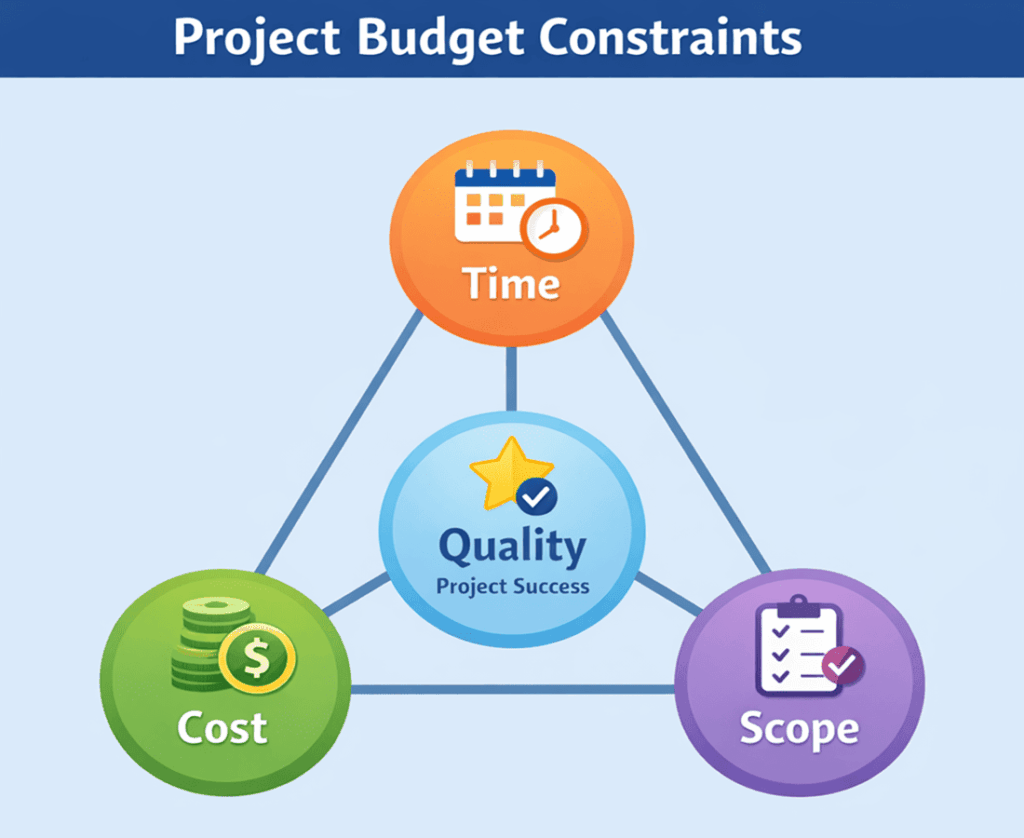
Here’s a quick summary:
- Time: Deadlines, working hours, and the number of project phases all contribute to the schedule. Extending or compressing timelines impacts budget and scope.
- Cost: Budgets include direct expenses such as salaries, equipment, and materials. Underestimating any of these items can lead to overruns.
- Scope: The total work required, measured by quality and detail, expands or contracts based on budget and time. Scope creep happens when new requirements appear without corresponding increases in time and budget.
Balancing these constraints is central to successful project management. Visualizing them as a triangle helps teams understand that changes in one corner reverberate through the others.
How to Plan Projects Under Budget Constraints
Budget constraints can feel restrictive, but they also encourage thoughtful planning. The following seven steps synthesize guidance from project management experts and recent industry research:
- Lock the budget: Confirm the total approved amount and any phase‑wise limits. Agree on contingency rules so everyone understands how additional funds (if any) will be requested and approved. This clarity reduces misunderstandings down the line.
- Define minimum viable outcomes: Identify the essential deliverables your project must achieve to be considered successful. Anything beyond this list can be negotiated or removed if costs rise.
- Break work into costed components: Decompose your project into smaller tasks and assign realistic costs to each. This exercise reveals which parts of your budget carry the highest price tags.
- Prioritize using cost versus value: Evaluate each task’s business impact relative to its cost. Remove low‑value, high‑cost items first. This step aligns with research showing that prioritizing high‑impact components improves success rates.
- Build a budget‑aligned schedule: Sequence work intelligently. When budgets are fixed, predictable execution usually costs less than aggressive timelines. Avoid compressing the schedule unless you have extra funds to support overtime or additional resources.
- Optimize resources before expanding them: Improve utilization by reallocating underused resources or automating repetitive work. Since personnel often represent the largest cost, maximizing their effectiveness reduces the need for new hires.
- Create smart contingency buffers: Attach contingency funds to specific risks. Release the buffer gradually as uncertainties decrease. Project Management Institute research indicates that projects with contingency reserves experience fewer disruptions.
Strategies for Managing Budget Constraints
To make budgets go further, project managers can adopt several evidence‑based strategies:
Prioritize high‑impact work: Identify features or tasks that deliver the greatest value and tackle those first. Use cost–benefit matrices to rank tasks. Delay or drop low‑value items until more funds are available.
Leverage technology: Cloud‑based project management tools streamline scheduling, resource allocation, and collaboration. Integrating digital tools into workflows can help reduce the project cost. Automation reduces manual reporting and helps teams stay within budget.
Adopt Lean practices: Lean project management focuses on minimizing waste and maximizing value. Companies implementing Lean principles cut project costs significantly. Techniques like value stream mapping and continuous improvement keep budgets under control.
Encourage collaborative problem‑solving: Teams that brainstorm cost‑saving measures collectively see better results. Collaborative approaches to resource management generally increases cost savings. Regular team meetings encourage idea sharing and early detection of issues.
Negotiate with vendors: Work with suppliers to secure discounts, extended payment terms, or bundled pricing. Organizations can achieve a 5–10% cost reduction through vendor negotiations are more likely to stay within budget.
Conduct regular budget reviews: Frequent check‑ins, monthly for complex projects and weekly for smaller ones allow teams to adjust spending in real time. This proactive monitoring helps prevent small overruns from becoming serious problems.
Plan for contingencies: Allocate a small percentage of the budget for unexpected costs and release it carefully. Projects with contingency funds experience fewer disruptions and finish on time more often.
Common Mistakes to Avoid
- Ignoring indirect costs: Overlooking hidden expenses like rework, training, and downtime can lead to underestimating the budget.
- Cutting quality safeguards: Reducing testing or compliance to save money often backfires.
- Assuming finance will handle budget control alone: Project teams must own the budget, not just the finance department.
- Waiting too long to track spending: Infrequent updates make it hard to course‑correct.
FAQs
Q1. How do budget constraints affect the project schedule?
Limited funds often extend timelines because teams can only allocate a certain number of hours or resources per month. Conversely, when you try to shorten timelines, costs usually rise due to overtime or additional help.
Q2. Can project scope increase without increasing the budget?
Expanding scope almost always increases costs unless you remove other tasks or find efficiencies elsewhere. Using a lean approach to eliminate low‑value work can offset some costs.
Q3. What tools help manage budget constraints?
Project management software such as Asana, Trello, and Monday.com facilitate resource tracking and collaboration, which can reduce costs by 20%. Spreadsheet templates and cost comparison tools also help evaluate options and track expenditures.
Q4. How much contingency should I include in my budget?
While there’s no universal formula, many project managers allocate 5–15% of the total budget for contingencies. The exact amount depends on project complexity and risk. Research shows that projects with contingency reserves experience fewer disruptions and are more likely to finish on time.
Q5. How can I explain budget constraints to stakeholders?
Use the triple constraint model to show how changes in scope, time, or cost affect each other. Present clear scenarios and emphasize that prioritizing high‑value work ensures the project meets its main goals.
Conclusion
Managing projects within a fixed budget isn’t a limitation, it’s a discipline that drives smarter decisions and better outcomes. By understanding how budget constraints interact with time and scope, decomposing work into costed components, and applying strategies such as prioritization, lean practices, and collaboration, project managers can deliver successful projects even when resources are scarce. Embrace the challenge, plan with intention, and turn financial limits into an opportunity to deliver value.
Learn how to manage project budget constraints with practical steps, lean strategies, and collaborative tips. Deliver success within your financial limits.