
Estimating project costs often feels like balancing on a tightrope. You need numbers early enough to justify a project, yet you also need accuracy to avoid nasty surprises later. That’s why project managers distinguish between broad strokes and fine-tuned forecasts.
Understanding the rough order of magnitude (ROM) and the definitive estimate helps you pick the right tool at the right time.
This blog post explains ROM and definitive estimates and shows you how they fit into modern project management.
Let’s get started.
What is a Rough Order of Magnitude Estimate?
A rough order of magnitude (ROM) estimate gives you a ballpark figure when you know only the broad outlines of your project. Think of it as a preliminary budget sketch used during feasibility studies or early business cases. ROM estimates have a wide range: they usually span from -25% to +75% of the eventual cost. This wide range means your final cost could be significantly lower or much higher than your initial estimate.
These wide boundaries exist because ROM estimates rely on limited information. You might know the project’s general scope but not the detailed tasks or risks. For example, an IT team assessing whether to build a new customer portal might produce a ROM estimate of $100 000, acknowledging that actual costs could range from $75 000 to $175 000. This rough approach helps stakeholders decide whether to proceed without committing to an exact budget.
Over time, ROM estimates get replaced by more accurate classes as the project scope becomes clearer. Progressive elaboration means updating initial numbers as you learn more. It is a crucial concept in project management.
What is a Definitive Estimate?
A definitive estimate sits at the other end of the accuracy spectrum. It applies once the project has been planned in detail and you have enough data to make a realistic forecast. Definitive estimates have a much narrower range: they usually span from -5% to +10%. Because this range is much tighter, stakeholders can use definitive estimates for budget baselines, contract negotiations, and performance measurement.
Developing a definitive estimate requires more work. You break down the project into granular tasks, identify resources and risks, and often employ detailed estimating techniques like bottom‑up estimating. For example, once the IT team finalizes the features of that customer portal, they can price each module, design, and testing phase. A definitive estimate might place the cost between $190 000 and $210 000, giving management a solid budget to approve.
Other Classes: Preliminary, Budget, and Final Estimates
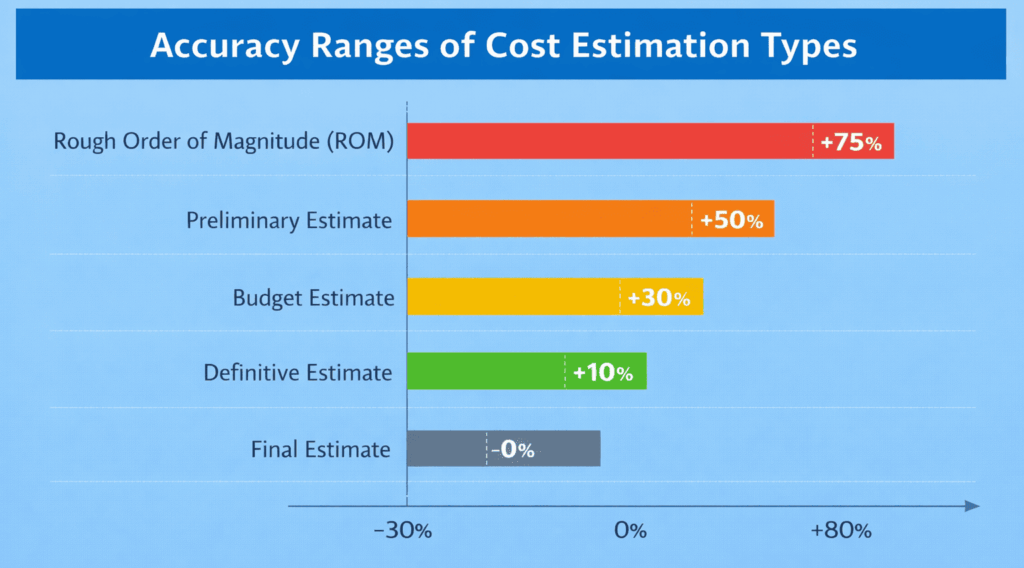
Between ROM and definitive estimates lie other classes that help refine your forecast. A preliminary estimate narrows the range to -15% to +50%. You might produce this after rough planning but before detailed design. A budget estimate is more precise, often between -10% and +25%. This class is useful when allocating funds across a work breakdown structure or seeking external funding.
A final estimate represents a zero variance; it matches the actual cost at completion. Final estimates appear when you reforecast near the end of the project or when all uncertainties have been resolved.
The following infographic summarizes the accuracy ranges of the main estimate types:
How Are These Estimates Developed?
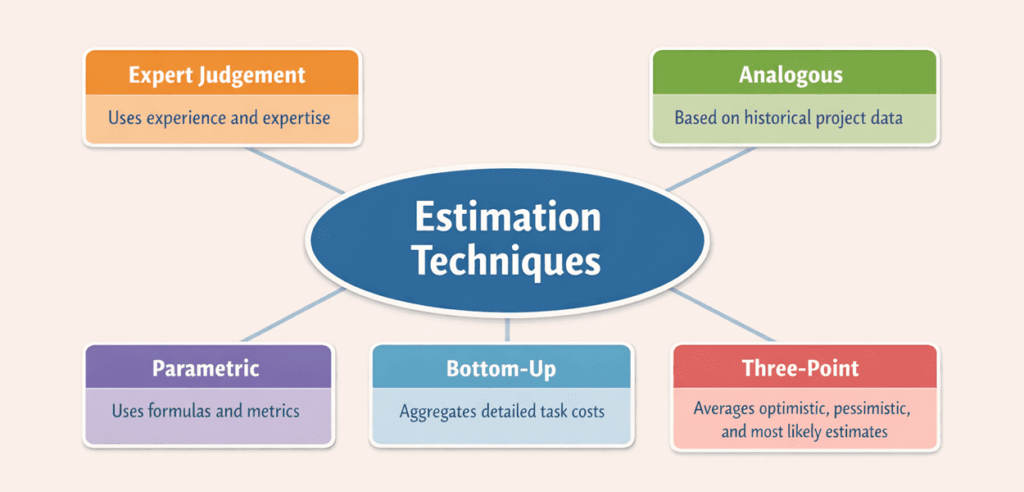
Choosing the right estimation technique matters as much as selecting the estimate class. The following are the main methods you’ll encounter:
- Expert judgement relies on the insight of experienced professionals. It’s fast and inexpensive but subjective. Use it when similar projects exist, and experts are available.
- Analogous estimating uses historical data from comparable projects. It’s useful for ROM or preliminary estimates when you lack detailed information.
- Parametric estimating applies to statistical relationships or formulas. For instance, costing software development per line of code or construction per square meter. It provides consistent results if you have reliable metrics.
- Bottom‑up estimating breaks the work into small tasks, estimates each, and aggregates the totals. This method is time‑consuming but ideal for definitive estimates because it captures every component.
- Three‑point estimating considers optimistic, pessimistic, and most likely values and calculates an expected cost using distributions (such as PERT). It reduces the impact of extreme outcomes and is suitable for any class of estimates.
The infographic below illustrates these techniques visually:
Why Accurate Estimating Matters
Accurate estimating matters because it directly affects project success, cost control, and stakeholder trust. When estimates are realistic, organizations can approve appropriate budgets, allocate resources effectively, and set achievable timelines. Poor estimates often lead to cost overruns, delays, and scope changes, which reduce confidence in project teams.
Accurate estimates also support better risk management by highlighting uncertainties early, enabling teams to plan responses rather than react to problems later. From a business perspective, reliable estimates improve decision-making, investment justification, and contract negotiations. They help leaders compare options, prioritize projects, and objectively measure performance.
Over time, consistent estimating accuracy strengthens planning discipline, improves accountability, and increases the likelihood that projects deliver their intended business value.
ROM Vs Definitive Estimate
| Parameter | ROM (Rough Order of Magnitude) Estimate | Definitive Estimate |
| Purpose | Quick “ballpark” figure to decide if a project is worth exploring | High-confidence figure used to approve budgets and control costs |
| When used | Very early (idea, feasibility, initial business case) | Later (after detailed planning and a defined scope) |
| Info available | Limited details; many assumptions | Detailed scope, WBS, resources, risks, and requirements are clearer |
| Typical accuracy range | -25% to +75% | -5% to +10% |
| Effort required | Low effort, fast to create | High effort, takes more time and analysis |
| Estimation methods used | Expert judgment, analogous estimating, rough parametric | Bottom-up estimating, detailed parametric, three-point, with better inputs |
| Best for decisions | Go / no-go decisions, early funding discussions | Budget baseline, vendor bids, contracts, performance tracking |
| Risk of change | High (will change as scope becomes clear) | Lower (still updated, but changes are more controlled) |
| Output detail | Broad total cost range | Detailed cost breakdown by work packages or activities |
| Example (if estimate is $100,000) | Could end up roughly $75,000 to $175,000 | Could end up roughly $95,000 to $110,000 |
FAQs
Q1. What does ROM mean in project management?
A rough order of magnitude (ROM) is an early cost or time estimate with a wide range of accuracy, typically -25% to +75%, used for initial planning.
Q2. When should I use a definitive estimate?
Use a definitive estimate once the project scope is detailed and stable, usually during planning. It supports budgeting, contracting, and performance measurement because its range is tight.
Q3. Are preliminary and budget estimates part of the PMBOK Guide?
Preliminary and budget estimates aren’t explicitly defined in the latest PMBOK Guide, but many organizations use them to bridge the gap between ROM and definitive estimates.
Q4. How can I improve my estimating accuracy?
Break work into small tasks, use multiple techniques (analogous, parametric, three‑point), consult experts, and update your estimates regularly as more information becomes available. Training and mentoring programs can boost performance.
Summary
Understanding the difference between a Rough Order of Magnitude (ROM) estimate and a definitive estimate helps project managers make better decisions at every stage of a project. ROM estimates support early discussions when information is limited, while definitive estimates provide the accuracy needed for budget approval and cost control. Using the right estimate at the right time reduces financial risk, improves stakeholder confidence, and strengthens planning discipline. As project details evolve, refining estimates helps better align expectations, scope, and actual project outcomes.
I not only do I do it, I also teach Program Control techniques an Earned Value Management method that aids in managing projects. Reply and I will send you an Introduction Slide Deck presentation. Course guide to follow upon your request. RMandel@PramsCo.com
Hello Roger,
You can send me your presentation at fahad@pmsprout.com
Thanks.
I not only do I do it, I also teach Program Control techniques an Earned Value Management method that aids in managing projects. Reply and I will send you an Introduction Slide Deck presentation. Course guide to follow upon your request. RMandel@PramsCo.com
Hello Roger,
You can send me your presentation at fahad@pmsprout.com
Thanks.
I like using these lessons or publications as reviews of what I studied and learned when I was preparing for my PMP. Since the work I do now is not always in PM, this keeps me fresh.
Well said Jose.
I like using these lessons or publications as reviews of what I studied and learned when I was preparing for my PMP. Since the work I do now is not always in PM, this keeps me fresh.
Well said Jose.
Please adjust the phrase “you compare the cost the project” to ” you compare the cost of the project”.
Thank you,
Thanks Saad for letting me know about it.
Corrected.
Please adjust the phrase “you compare the cost the project” to ” you compare the cost of the project”.
Thank you,
Thanks Saad for letting me know about it.
Corrected.
Would you mind please to add some examples differentiating & explaining Analogous Estimation, Parametric Estimation, Three Point Estimation, and Bottom Up Estimation.
Although it is easy to remember which one is more accurate to others.
Nice and digestible article though.
Thanks for sharing!
Hello Kamboh,
This is a big topic, in future I will try to write a blog post on it.
Would you mind please to add some examples differentiating & explaining Analogous Estimation, Parametric Estimation, Three Point Estimation, and Bottom Up Estimation.
Although it is easy to remember which one is more accurate to others.
Nice and digestible article though.
Thanks for sharing!
Hello Kamboh,
This is a big topic, in future I will try to write a blog post on it.
Fahad, thanks for your post.
Fahad, thanks for your post.
Thanks for sharing
You are welcome Emenike.
Thanks for sharing
You are welcome Emenike.