
Every business faces a choice: stay with what you know or reach for something new. The Ansoff Matrix, created by Igor Ansoff in 1957, offers a simple framework for deciding how to grow. It plots products on one axis and markets on the other, forming four quadrants that represent different growth strategies.
In this blog poste, we revisit the matrix through a modern lens. I have added fresh data from recent surveys, provide deeper examples, and answer common questions. My goal is to help you decide which path makes sense for your company’s next move.
Grab a cup of coffee and let’s dive in.
Why the Ansoff Matrix Matters
Changes in technology and customer expectations make product development faster than ever. A Protolabs survey reports that 62% of respondents say consumer demand drives faster turnaround times; 65% are developing products faster; and 58% believe economic uncertainty hasn’t slowed development.
This rapid pace means companies must choose growth strategies wisely. Meanwhile, Deloitte’s consumer products outlook found 86% of profitable growers prioritize introducing new products, versus 46% of other companies. These numbers show that forward‑thinking businesses invest in new products and markets even during uncertain times. With these insights, the Ansoff Matrix is more relevant than ever.
Understanding the Ansoff Matrix
The matrix looks like a simple two‑by‑two grid. The vertical axis represents existing versus new products, while the horizontal axis represents existing versus new markets. Each quadrant suggests a different strategy:
- Market Penetration (existing products, existing markets)
- Market Development (existing products, new markets)
- Product Development (new products, existing markets)
- Diversification (new products, new markets)
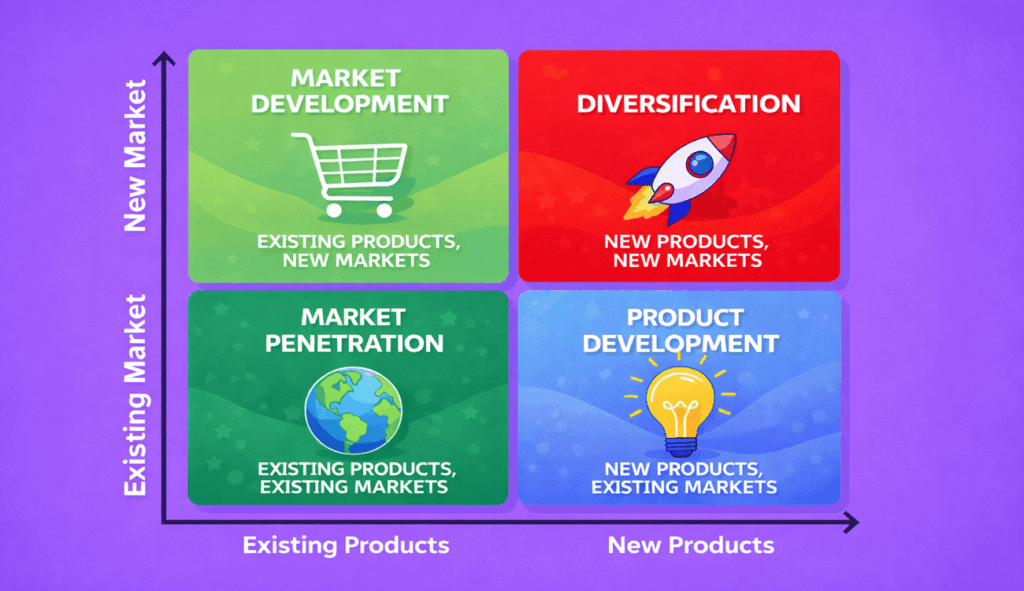
Figure 1: Our custom Ansoff Matrix diagram helps visualize the four growth strategies.
Let’s explore each quadrant in detail and consider how a modern business might use it.
Market Penetration
In this lowest‑risk strategy, companies seek growth by selling more of their existing products to their current customers. They may:
- Increase Usage: A streaming service might encourage subscribers to watch more by adding personalized recommendations.
- Win Competitors’ Customers: A local café might offer loyalty discounts to attract patrons from nearby coffee shops.
- Adjust Pricing: A software company could lower subscription costs to gain market share.
Example: Imagine a gym in Kuwait City. It introduces flexible membership plans and runs targeted social media campaigns to encourage current members to visit more often. By engaging existing clients and converting drop‑ins to regulars, the gym boosts revenue without launching new services.
Market Development
Market development involves taking existing products into new geographical regions or customer segments. This approach carries moderate risk because while the product is familiar, the market is not. Strategies include:
- Geographic Expansion: A Kuwaiti fashion brand opens stores in Dubai and Riyadh.
- New Demographics: A toy company starts marketing to adults interested in collectibles.
- Alternative Uses: A cleaning product is promoted as a stain remover for car interiors.
Example: Kuwait’s desalination equipment manufacturers, who already serve local governments, might partner with African municipalities seeking water solutions. By leveraging their proven technology in new regions, they tap into a broader customer base.
Product Development
Here, businesses create new products for their existing customers. The risk is moderate to high because developing new offerings requires investment and research. Firms often:
- Enhance Existing Products: Add features or variations to meet specific needs.
- Introduce New Categories: A smartphone maker launches an accessory line.
- Leverage Customer Feedback: Use surveys to identify unmet needs and design solutions.
Example: A popular Kuwaiti bakery known for traditional baklava adds gluten‑free desserts to its menu. By responding to health‑conscious customers, the bakery keeps loyal patrons happy while attracting new ones with similar dietary preferences.
These efforts align with the Protolabs survey results: nearly two‑thirds of companies’ report accelerating product development to satisfy customer demands. Businesses that invest in innovation tend to outperform those that don’t.
Diversification
Diversification is the riskiest quadrant because it involves launching new products in unfamiliar markets. Businesses may diversify either related (leveraging existing capabilities) or unrelated (entering entirely different sectors). Tactics include:
- Mergers and Acquisitions: Buy a company in a different industry to gain expertise.
- Joint Ventures: Partner with local firms to mitigate risk and share knowledge.
- Organic Diversification: Develop new technology internally and test it in pilot markets.
Example: A Kuwaiti oil and gas firm invests in renewable energy. It partners with a solar company to develop photovoltaic farms outside Kuwait. By diversifying into clean energy, the firm reduces reliance on fossil fuels and positions itself for long‑term sustainability.
How to Use the Ansoff Matrix
Here’s a step‑by‑step approach to applying the matrix in your business planning:
- Assess Your Current Position: Analyze your core products and primary markets. Gather data on customer satisfaction, market share and competitor performance.
- Define Goals: Decide whether you want rapid growth, increased market share or innovation leadership. Clear objectives help you choose the right quadrant.
- Evaluate Risk Tolerance: Market penetration is safest, diversification is riskiest. Align your choice with financial resources and appetite for risk.
- Brainstorm Strategies: Generate ideas for each quadrant with your leadership team. Use customer feedback, trend reports and competitor analysis.
- Select and Execute: Choose the strategy that fits your goals and resources. Develop an action plan, allocate budgets and set milestones.
- Monitor and Adapt: Track key performance indicators (KPIs) and be ready to adjust your strategy if conditions change.
Benefits and Challenges
Benefits: The Ansoff Matrix offers a clear visual tool for discussing growth options. It encourages teams to think beyond incremental improvements and consider bolder moves like diversification. Using it fosters alignment between marketing, product and leadership teams. When combined with recent data—such as how 86% of profitable companies prioritize product innovation—the matrix helps justify investment in new ideas.
Challenges: No model fits every situation. The matrix simplifies complex decisions, and real‑world scenarios often cross quadrants. Diversification, for example, can strain resources and requires careful risk management. Market development might face legal or cultural barriers when entering foreign markets. Product development can falter if customer insights are weak, leading to unsuccessful launches.
FAQs
Q1. What are the four strategies in the Ansoff Matrix?
The matrix includes market penetration, market development, product development and diversification. Each combines existing or new products with existing or new markets.
Q2. Is diversification always risky?
Diversification carries higher risk because it combines new products and new markets. However, related diversification (building on existing strengths) can reduce the risk.
Q3. How often should businesses revisit the Ansoff Matrix?
Review your growth strategy annually or whenever market conditions change significantly—such as shifts in consumer demand or technological advances.
Q4. Can small businesses use the Ansoff Matrix?
Yes. The framework scales to any size. Small businesses can apply it when deciding to expand locally, launch new services, or enter online markets.
Q5. What does recent research say about product development?
Recent surveys show that 62% of companies say consumer demand drives faster product turnaround, 65% report speeding up development and 58 % believe economic uncertainty hasn’t slowed product innovation.
Conclusion
The Ansoff Matrix remains a helpful starting point when planning how to grow. It invites you to ask: Do we double down on what works, or explore something new? In today’s fast‑moving market, the answer often involves a mix of strategies. Look at your resources, examine customer feedback and decide whether to penetrate, develop, innovate or diversify. By combining clear goals with data‑driven insights—and using tools like the matrix—you can position your business for sustainable growth.