Have you ever wondered what makes Starbucks, the corner grocery store or a software startup a company? A company is a legal entity created by individuals or groups to carry out economic activities. People join forces to pursue a shared goal—usually profit—and the law treats this entity separately from its owners in many cases. Companies may be private or public, small or large, for‑profit or nonprofit. Getting the basics right helps you choose the right structure and understand how companies shape our world.
Understanding the Meaning of a Company
A company exists to do business. It can buy property, hire people, sign contracts and, in many cases, outlive its founders. The original article defined a company as an association formed by people or groups to engage in commercial activities. That definition still holds, but there is more to the story:
- Legal status: Most companies are “legal persons” separate from their owners. This means they can sue and be sued, own assets and incur liabilities. Sole proprietors and partners are personally liable for business debts, while corporations and limited liability companies (LLCs) generally shield owners from personal liability.
- Shared purpose: Whether the purpose is making sandwiches or developing software, every company is formed to achieve shared objectives. Owners invest time, money or expertise and share in the profits and losses.
- Tax treatment: The structure of a company affects how taxes are paid. A corporation is treated as a separate taxpayer. An LLC may be taxed like a partnership, corporation or disregarded entity depending on elections and number of members.
Why Companies Matter: Statistics and Economic Impact
Companies power the economy. Small businesses in particular drive growth and employment in the United States. According to the U.S. Small Business Administration, there were 36.2 million small businesses in the country in 2025—99.9 percent of all businesses. These firms employed 62.3 million people, or 45.9 percent of the private workforce. Between March 2023 and March 2024, small businesses opened 1.1 million establishments and closed 982,940, adding a net 1.2 million jobs.
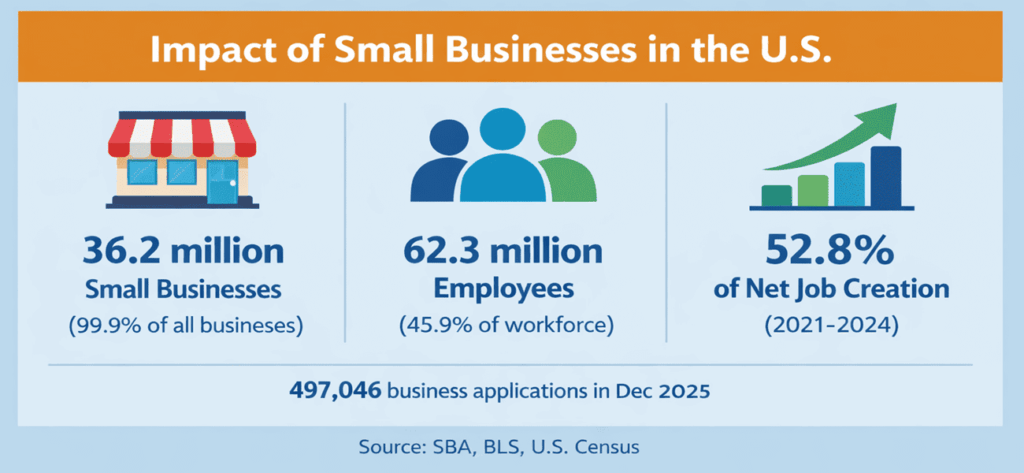
The Bureau of Labor Statistics reports that small firms (those with fewer than 250 employees) accounted for 52.8 percent of total net job creation between the first quarter of 2021 and the second quarter of 2024. These numbers underscore how vital companies are for employment and innovation.
Business formation is also dynamic. The U.S. Census Bureau’s Business Formation Statistics show that there were 497,046 business applications filed in December 2025, a 7.3 percent decrease from November. Understanding these trends helps entrepreneurs decide when and how to start a company.
Examples of Companies
Companies come in all shapes and sizes. Some operate worldwide, while others serve a local community. Here are a few well‑known companies and the type of structure they use:
- Amazon (Corporation): A multinational corporation that sells products and services online. It issues shares, is publicly traded and must comply with stringent reporting requirements.
- McDonald’s (Franchise Corporation): Operates as a corporation with many franchisees who run individual restaurants under licensing agreements.
- PepsiCo (Corporation): A large corporation producing beverages and snacks under various brands.
- Starbucks (Public Corporation): A publicly traded corporation that sells coffee and related products worldwide.
- Local bakery (Sole Proprietorship or LLC): Many small shops operate under a sole proprietorship or LLC where the owner controls daily operations.
These examples illustrate the diversity of companies and remind us that the right structure depends on size, ownership and goals.
Types of Companies
Choosing a business structure influences liability, taxes and management.
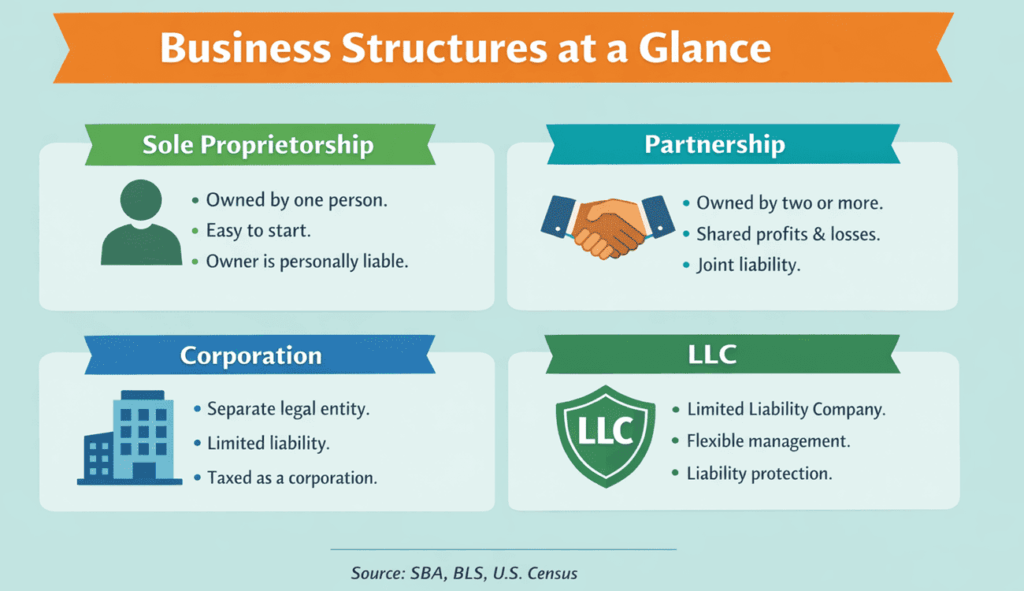
Below are common types of companies in the United States.
Sole Proprietorship
A sole proprietorship is the simplest form of business. One person owns and runs it. According to the IRS, a sole proprietor is someone who owns an unincorporated business by themselves. There is no legal distinction between the owner and the business, so the owner is personally liable for debts and obligations. A sole proprietorship is easy and inexpensive to start, but it offers no liability protection.
Partnership
A partnership is a business relationship between two or more people who join to conduct trade or business. Each partner contributes money, property, labor or skill and shares in the profits and losses. Partnerships are flexible; partners can create a partnership agreement to outline roles, profit shares and decision‑making. However, partners are generally personally liable for the business’s debts. Variations include general partnerships, limited partnerships (LPs) and limited liability partnerships (LLPs).
Limited Liability Company (LLC)
An LLC is a hybrid structure that combines elements of partnerships and corporations. Owners of an LLC are called members. Most states allow unlimited members, and these can include individuals, corporations and other LLCs. A single‑member LLC is also possible. An LLC offers liability protection like a corporation but provides flexible tax options. By default, a multi‑member LLC is taxed as a partnership, and a single‑member LLC is treated as part of its owner’s tax return unless the company elects corporate taxation.
Corporation (C Corporation)
A corporation is a separate legal entity. Prospective shareholders exchange money or property for stock, and the corporation, not the owners, is responsible for debts and obligations. Corporations take the same deductions as a sole proprietorship but can also claim certain special deductions. Corporate profits may face double taxation: the corporation pays income tax on its earnings, and shareholders pay tax again on dividends. In return, shareholders enjoy limited liability and ease of transferring ownership.
S Corporation
An S corporation is a special type of corporation designed for smaller companies that want the benefits of pass‑through taxation with corporate liability protection. It avoids double taxation by passing income, losses, deductions and credits to shareholders. To qualify, a company must meet certain IRS requirements, including limits on the number and type of shareholders.
Nonprofit Organization
A nonprofit company (often called a not‑for‑profit organization) exists to pursue charitable, educational or social missions. Profits must be reinvested in the mission rather than distributed to owners or shareholders. Many nonprofits obtain tax‑exempt status under Internal Revenue Code section 501(c)(3).
Cooperative
A cooperative (co‑op) is owned and democratically controlled by the people who use its services or products. Members typically contribute capital and share in the profits or benefits. Co‑ops are common in agriculture, housing and retail.
Benefit Corporation (B Corp)
A benefit corporation is a for‑profit company that commits to social or environmental goals alongside profit. It must consider the impact of decisions on workers, customers, communities and the environment. Many states have enacted B corporation statutes, and some B corps obtain additional certification from the nonprofit B Lab.
Public Vs Private Companies
Companies can be private or public. A private company is owned by a small group of investors—often the founders, family members or private equity firms. Its shares are not traded on public stock exchanges, and it has fewer reporting obligations. Examples include many small LLCs and closely held corporations.
A public company issues stock to the general public on a stock exchange. It must register with the Securities and Exchange Commission (SEC) and disclose financial information regularly. Public companies can raise large amounts of capital by selling shares, but they face more regulatory scrutiny and must answer to a broad base of shareholders.
Choosing the Right Business Structure
Selecting a structure depends on liability, taxation, funding needs and growth plans. Ask yourself:
- How much personal risk can you tolerate? Sole proprietorships and partnerships expose owners to unlimited liability. Corporations and LLCs limit personal liability.
- How will profits be taxed? Pass‑through entities (sole proprietorships, partnerships, LLCs and S corps) avoid corporate tax but require owners to report profits on personal returns. C corps face double taxation but may qualify for certain deductions.
- How many owners are involved? Single founders may prefer a sole proprietorship or single‑member LLC, while multiple founders might choose a partnership, multi‑member LLC or corporation.
- Do you need to raise capital? Corporations can issue stock and attract outside investors more easily. LLCs and partnerships may find it harder to raise funds from venture capital or public markets.
Your choice is not permanent. Many businesses evolve. A sole proprietor might convert to an LLC for liability protection or to a corporation to attract investors. Consult legal and tax professionals to make the best decision.
FAQs
Q1. What is the difference between an LLC and a corporation?
An LLC offers liability protection like a corporation but is more flexible in management and taxation. Corporations have stricter formalities and may face double taxation.
Q2. How do I form a sole proprietorship?
You simply start doing business. No formal filings are required, but you may need permits or a business license depending on your state.
Q3. Can a single person form a partnership?
No. Partnerships require at least two owners who share profits and losses. If you want liability protection as a solo owner, consider an LLC instead.
Q4. Do nonprofits make money?
Yes, nonprofits can generate revenue, but they must reinvest earnings in their mission rather than distribute them to owners or shareholders.
Q5. When should a company go public?
A company typically goes public when it needs substantial capital to expand and is ready to meet SEC reporting requirements and public scrutiny.
Summary
Companies are essential building blocks of the economy. They come in many forms, from a sole proprietor’s side hustle to a global corporation. Understanding the differences between sole proprietorships, partnerships, LLCs, corporations and other structures helps entrepreneurs choose wisely. Small businesses dominate the U.S. landscape and drive job creation and innovation. Choosing the right structure can protect your personal assets, reduce taxes and position your business for growth.