
Have you ever felt unsure of how to interact with a colleague from another country? In today’s interconnected world, managers and teams engage with people from diverse backgrounds every day. A basic understanding of cultural differences helps avoid misunderstandings and builds stronger working relationships.
One of the most influential frameworks for exploring these differences is Hofstede’s Cultural Dimensions Theory. Developed in the late 1970s by Dutch social psychologist Geert Hofstede, the model initially drew on surveys of IBM employees from more than fifty countries. It introduced a method for comparing national cultures across several key value dimensions.
Over forty years later, the framework remains widely used, although researchers and practitioners now recognize that it is only a starting point and must be adapted to contemporary contexts.
This blog post explains each dimension of Hofstede’s Cultural Theory, discusses its strengths and limitations, offers updated insights from recent research, and provides practical tips for leaders navigating cross-cultural interactions.
Background and Evolution of Hofstede’s Model
Geert Hofstede designed his framework after analyzing tens of thousands of employee surveys. The aim was to understand how national values affect workplace behaviour. The original version presented four cultural dimensions; later studies added two more, bringing the total to six. Scholars expanded the model by conducting further surveys and refining definitions.
While its influence is unquestioned, critics note that the original dataset was limited to employees of a single company. MindTools points out that the model “was developed decades ago, primarily focusing on IBM employees,” and that it should serve as a flexible guide rather than a strict rulebook. This observation reminds us that culture is dynamic. People interact through digital platforms, global supply chains, and remote work in ways that were unimaginable when Hofstede conducted his surveys. As a result, it is essential to integrate the model with contemporary research and tailor its use to individual contexts.
Recent cross-cultural studies have also tested the framework’s validity at the individual level. A 2023 analysis found that only Indulgence vs. Restraint and Long-Term vs. Short-Term Orientation remain reliable predictors of personal behavior. Researchers recommend combining Hofstede’s dimensions with other sociological and psychological tools, including cultural intelligence assessments and participatory methods, to capture nuanced local realities.
Keeping these caveats in mind, the following sections explain each dimension and illustrate how they can inform decision-making in business and policy.
The Hofstede’s Cultural Dimensions
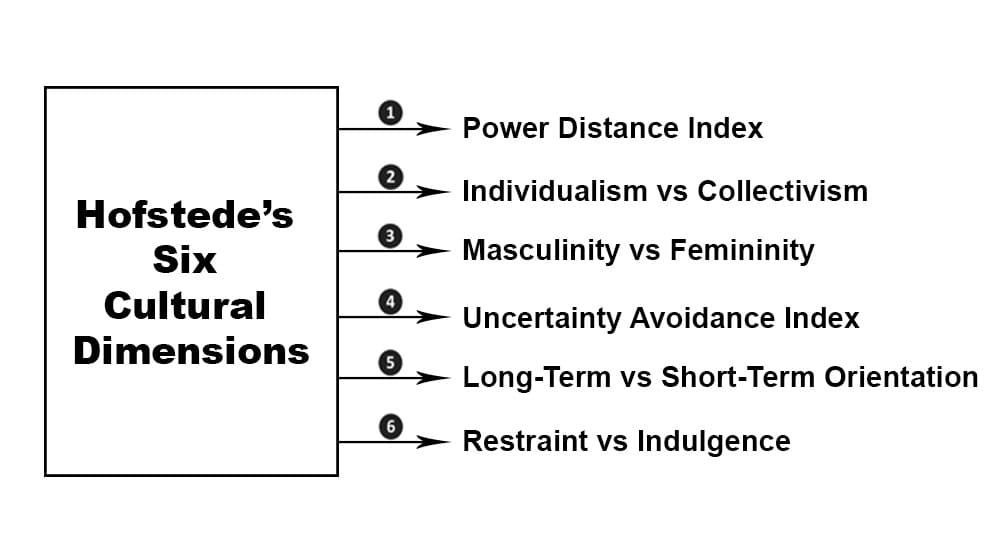
Below is an overview of Hofstede’s six cultural dimensions. Each subsection describes a high- and a low-scoring case and provides specific examples to illustrate how national values influence workplace behaviour.
1. Power Distance Index (PDI)
PDI measures how a society handles inequalities between people with more and less power. In high-PDI societies, hierarchical structures are accepted; employees expect leaders to make decisions and maintain clear authority. In low-PDI cultures, power is more evenly distributed, and teams prefer participative management.
- High PDI Characteristics: centralized organizations; large gaps in status and pay; deference to authority; decision-making flows from the top.
- Low PDI Characteristics: flatter organizations; employees expect to be consulted; supervisors and subordinates interact as near equals.
A comparative example highlights these differences. According to cross-cultural research, Germany’s PDI score sits at 35, indicating moderate acceptance of hierarchy. By contrast, many Arab countries score around 80, showing a strong tolerance for unequal power distribution. The United States scores 40, reflecting a preference for equality but still acknowledging some hierarchical structure.
2. Individualism Vs Collectivism (IDV)
This dimension examines whether a society emphasises personal achievements or loyalty to a group. In individualistic cultures, people prioritize personal goals, autonomy, and independence. Collectivist societies stress interdependence, loyalty to family or community, and group harmony.
- High IDV Characteristics: respect for privacy; emphasis on individual achievements; freedom and personal time valued; rewards based on individual performance.
- Low IDV Characteristics (collectivist): group harmony and loyalty valued over personal ambition; strong extended families or clans; decision-making considers group interests.
For example, the United States has a high IDV score (91), showing a strong emphasis on individual rights and personal success. Countries such as Guatemala and Panama score low, indicating that group loyalty and consensus carry greater weight in social and business settings.
3. Masculinity Vs Femininity (MAS)
Masculinity refers to a society’s emphasis on assertiveness, competition, and material success. Femininity emphasises cooperation, nurturing, and quality of life. These labels do not measure gender equality; instead, they indicate values associated with ‘hard’ (competitive) versus ‘soft’ (caring) approaches.
- High MAS Characteristics: clear distinction between gender roles; competitiveness rewarded; success and achievement celebrated; ambition and performance are important.
- Low MAS Characteristics: emphasis on relationship-building; caring for the vulnerable; modesty valued; cooperative decision-making.
For instance, Japan scores very high on the MAS scale (95). Such societies often admire competitiveness and risk-taking. Conversely, Sweden scores low on MAS (5), indicating a preference for consensus and a strong social support system.
4. Uncertainty Avoidance Index (UAI)
UAI gauges how comfortable a society is with ambiguity and uncertainty. High-UAI cultures prefer clear rules, formal procedures, and structured environments. Low-UAI societies tolerate ambiguity and adapt easily to unexpected situations.
- High UAI characteristics: strict codes of conduct; resistance to rapid change; formal processes; limited tolerance for unconventional ideas.
- Low UAI characteristics: flexibility in rules; openness to new ideas and innovation; relaxed attitudes toward time and deadlines.
Greece exhibits one of the highest UAI scores (approaching 100), suggesting a strong desire for predictability and risk avoidance. Singapore’s low UAI (approximately 8) indicates a culture that is comfortable with change and encourages experimentation and innovation.
5. Long-Term Vs Short-Term Orientation (LTO)
This dimension reflects a society’s time horizon. Long-term-oriented cultures emphasize future rewards, perseverance, and thrift. Short-term-oriented cultures value traditions, social obligations, and quick results.
- Long-Term Orientation Characteristics: persistence, adaptability, saving and investment, emphasis on education, and continuous improvement.
- Short-Term Orientation Characteristics: respect for tradition; focus on social obligations; desire for immediate results; emphasis on maintaining ‘face.’
China, with its deep cultural roots in Confucian thought, scores high on LTO (118), reflecting patience and a strategic outlook. The United States scores much lower (29), indicating a stronger emphasis on short-term gains and immediate results.
6. Indulgence Vs Restraint (IVR)
The final dimension assesses how societies manage gratification of desires. Indulgent cultures permit relatively free expression of emotions and enjoyment of life, whereas restrained societies suppress gratification and enforce social norms.
- Indulgent Characteristics: optimism; prioritization of leisure and fun; high importance on freedom of speech; flexible social norms.
- Restrained Characteristics: rigid social rules; controlled behaviour; pessimistic outlook; less emphasis on leisure.
Examples illustrate this contrast. The United States is often described as an indulgent society in which personal freedom and enjoyment are celebrated. In contrast, China leans toward restraint, with social norms emphasising discipline and self-control. While numerical scores for IVR vary across sources, recognising the high/low contrast is valuable when designing workplace policies and marketing strategies.
Strengths and Benefits of the Model
Hofstede’s framework offers several advantages for businesses, educators, and policymakers:
- Self-Reflection and Awareness: It encourages individuals to reflect on their own cultural assumptions and biases. Recognising that norms vary across societies helps avoid ethnocentric judgments.
- Practical Application: Companies use the model to design marketing campaigns, negotiate across borders, and manage multicultural teams. For example, marketers may emphasise safety features in countries with high uncertainty avoidance, because consumers there value clear rules and risk mitigation.
- Educational Tool: Universities and training programs employ the dimensions to teach cross-cultural communication and international management.
- Research Foundation: Scholars use the dimensions as a baseline for comparative studies, and the scores provide a common language for discussing cultural differences.
Limitations and Critiques
Despite its usefulness, the model has notable shortcomings:
- Outdated Sample: Hofstede’s original research relied on IBM employees in the 1970s. The model may overgeneralize and was developed decades ago, with a primary focus on IBM employees.
- Overgeneralisation: National scores represent averages. They do not capture regional, ethnic, or individual differences within a country. Using the model to predict how any specific person will behave can be misleading.
- Static View of Culture: Culture evolves. Digital connectivity, migration, and globalisation mean that values shift over time. A score from several decades ago may not reflect current realities.
- Limited Individual Validity: Recent research shows that only two dimensions (Indulgence vs. Restraint and Long-Term vs. Short-Term Orientation) reliably predict individual behaviour. Other dimensions are better understood as broad societal tendencies.
Because of these limitations, leaders should treat the model as a heuristic rather than a prescriptive tool. Combining it with situational awareness, empathy, and ongoing dialogue yields more effective cross-cultural strategies.
Recent Developments and Alternative Approaches
Cross-cultural research has advanced significantly since Hofstede’s initial surveys. Scholars now recommend blending the dimensions with additional frameworks:
- Cultural Intelligence (CQ): CQ assesses an individual’s ability to function effectively in multicultural situations. It emphasises curiosity, mindfulness, and adaptive skills.
- Participatory Methods: Involving local communities in decision-making – through methods such as community-based participatory research – captures nuanced cultural insights. This approach ensures that interventions are relevant and respectful.
- Value-Based Theories: Models such as Jonathan Haidt’s moral foundations theory link cultural values (e.g., fairness, loyalty, authority) to policy acceptance. Integrating these theories helps tailor messages to the moral priorities of different societies.
- Dynamic Data Collection: Leveraging real-time data from surveys and social media can reveal emerging cultural shifts. Updated profiles enable more accurate and localized strategies.
Michael Minkov’s recalibration of the model, based on surveys of more than 53,000 people across 54 countries, further refines the understanding of how cultural values influence adaptability and norm adherence. By incorporating these modern insights, organisations can move beyond broad national stereotypes toward more flexible and inclusive decision-making.
Comparing Countries: Example Scores
The table below compares three countries across Hofstede’s dimensions. The scores are derived from published cultural datasets and illustrate how nations differ. Higher numbers indicate stronger tendencies in the indicated direction. For Indulgence vs. Restraint (IVR), qualitative descriptors (“High” or “Low”) are provided because reliable numeric scores vary by source.
| Country | Power Distance (PDI) | Individualism (IDV) | Masculinity (MAS) | Uncertainty Avoidance (UAI) | Long-Term Orientation (LTO) | Indulgence Vs Restraint (IVR) |
| United States | 40 | 91 | 62 | 46 | 29 | High (indulgent) |
| China | 80 | 20 | 66 | 40 | 118 | Low (restrained) |
| Sweden | 31 | 71 | 5 | 29 | 33 | High (indulgent) |
These contrasts help illustrate why management styles that work well in one country may fail in another. For example, American teams value independence and reward individual performance, while Chinese teams may prefer clear hierarchies and long-term planning. Swedish organisations emphasise egalitarianism and consensus, discouraging overt competition.
Case Study: Tailoring a Product Launch
Imagine a technology company preparing to launch a new electric vehicle in both Germany and Malaysia. Germany’s moderate PDI and high individualism suggest that buyers appreciate engineering quality and personal innovation, while Malaysia’s very high PDI and moderate collectivism indicate respect for authority and group norms. To succeed:
- In Germany, highlight technical features, sustainability, and empower consumers to customise their cars. Marketing campaigns should appeal to personal freedom and innovation.
- In Malaysia, emphasis is placed on reliability, safety, and endorsements from respected leaders. Offer group purchasing programs or community test-drive events to appeal to collectivist values.
By adjusting messaging and sales strategies to local cultural profiles, companies increase trust and engagement. This example illustrates how the six dimensions can guide marketing, communication, and customer service.
FAQs
Q1. What are Hofstede’s six cultural dimensions?
The model identifies Power Distance, Individualism vs. Collectivism, Masculinity vs. Femininity, Uncertainty Avoidance, Long-Term vs. Short-Term Orientation, and Indulgence vs. Restraint as core cultural values.
Q2. Is Hofstede’s model still relevant in 2025?
Yes. It remains a useful starting point for understanding cultural differences, especially when combined with cultural intelligence and updated research. However, it should not be used to stereotype individuals.
Q3. Can the model predict individual behavior?
Not entirely. Recent research shows that only two dimensions (Indulgence vs. Restraint and Long-Term vs. Short-Term Orientation) reliably predict individual behavior. Treat other dimensions as societal tendencies rather than personal traits.
Conclusion
Geert Hofstede’s cultural dimensions provide a valuable framework for exploring national differences and anticipating cross-cultural challenges. Understanding where a society falls on each dimension helps leaders adapt communication, policies, and marketing strategies to local values. Nonetheless, the model is not perfect. It is based on historical data and national averages, and it may overgeneralise.
This model should be used as a flexible guide rather than a rulebook. Modern cross-cultural research suggests combining Hofstede’s dimensions with other tools and updated data. By approaching cultural analysis with humility, curiosity, and a willingness to learn, organisations can build meaningful relationships and succeed in our globalised world.
– Pay attention the the phenomena your are dealing with – and try to avoind Hofstede’s crass simplifications.
– Never use Hofstede’s dimensjons as anything but a resorce for generating hypothesis – and better still, disregard them and pay attention to the phenomena instead.
– When interacting with individuals, never assume that Hofstedes dimensions are valid.
– When dealing with larger groups or cagtegories – pay attention to the phenomena etc