
Have you ever wondered how giant brands like Coca‑Cola manage dozens of product lines without losing focus? Many organizations rely on strategic business units (SBUs) — semi‑autonomous divisions with their own vision and goals — to stay agile and competitive.
This guide explains what an SBU is, how it works and why it matters in today’s rapidly changing business environment.
Understanding Strategic Business Units
A strategic business unit (SBU) is a fully independent operating unit within a larger company. It has its own vision, strategy and set of goals, but still reports to the head office. This arrangement allows each unit to focus on a specific product, market or geographic region. Because SBUs are large enough to handle their own marketing, human resources and training functions, they can respond quickly to changes in their markets. The parent company monitors performance and aligns the SBU’s actions with the organization’s overall strategy.
Although an SBU operates independently, it benefits from being part of a larger group. For example, LG’s home‑appliance division runs like an SBU: it designs, produces and markets refrigerators and washing machines while sharing the reputation, research and capital of the broader corporation. This arrangement lets each product line control its costs and revenue, making it easier to measure profitability. When a unit is labelled as an SBU, it gains freedom over decisions, investments and budgets.
SBU Vs Divisions
It is easy to confuse SBUs with traditional divisions. Both structures divide a company into smaller pieces, but divisions remain under tighter control from the head office. Divisions often share support functions and follow identical processes, whereas SBUs operate like small businesses. Divisions focus on internal efficiency; SBUs look outward to the market. Because each SBU crafts its own strategy, it can quickly seize opportunities without waiting for approval from the corporate center.
Why Companies Use SBUs
Large businesses adopt SBUs to keep their strategies clear and adaptable. When a conglomerate offers diverse products across many regions, a single corporate strategy can become unwieldy. SBUs bring focus by giving managers autonomy over a specific market segment. They allow leaders to make faster decisions, experiment with new products and align resources with local needs.
SBUs are also a way to reduce risk. If one unit struggles, the parent company can adjust resources without jeopardizing its other businesses. Because each unit’s performance is measured separately, it is easier to identify which products or regions are generating profits. This clear accountability helps companies allocate capital more effectively.
Many corporations find that SBUs support innovation. Teams working within an SBU are closer to customers and can test ideas quickly. When a new product takes off, the parent company can scale it across other units. By balancing independence with oversight, SBUs help large organizations stay nimble in competitive markets.
Challenges of the SBU Structure
While the SBU model offers flexibility, it is not without drawbacks. Managing multiple autonomous units can increase costs because each unit may duplicate systems or staff. Coordination across units becomes harder; information may stay within a single SBU instead of flowing across the organization. Mitsubishi Heavy Industries (MHI), for example, notes that its SBU structure allows each unit to formulate and execute its own strategy, but it can weaken horizontal collaboration such as sharing information and resources. Without proper mechanisms for sharing best practices, SBUs might compete for resources instead of working together.
Another risk is strategic misalignment. If each SBU focuses solely on its own goals, the overall corporate vision may become fragmented. Companies need strong governance to ensure that each unit’s strategy supports the broader mission. A central planning or strategy team can help align budgets and performance measures across units.
The Modern Context: Transformation and SBUs
Today’s business environment is characterized by rapid technological and economic change. Continuous reinvention has become the norm: according to KPMG’s 2024 global transformation survey, 80 percent of large enterprises are now pursuing two or more organizational transformations at once, and about the same percentage of senior leaders say they are moderately to fully satisfied with the progress of these efforts. These transformations often involve digital tools, advanced analytics and new ways of working. SBUs play a crucial role here because they allow companies to pilot innovations in one unit before scaling them across the organization.
The need for agility also highlights the importance of cross‑unit coordination. KPMG’s survey included more than 480 C‑suite executives and business unit heads, emphasizing that transformation is now a continuous process. To succeed, companies must encourage SBUs to share data, platforms and insights. This collaboration requires robust communication channels and shared objectives, something the SBU model does not guarantee by default. Strong leadership is therefore essential to balance autonomy with cooperation.
Levels of a Strategic Business Unit
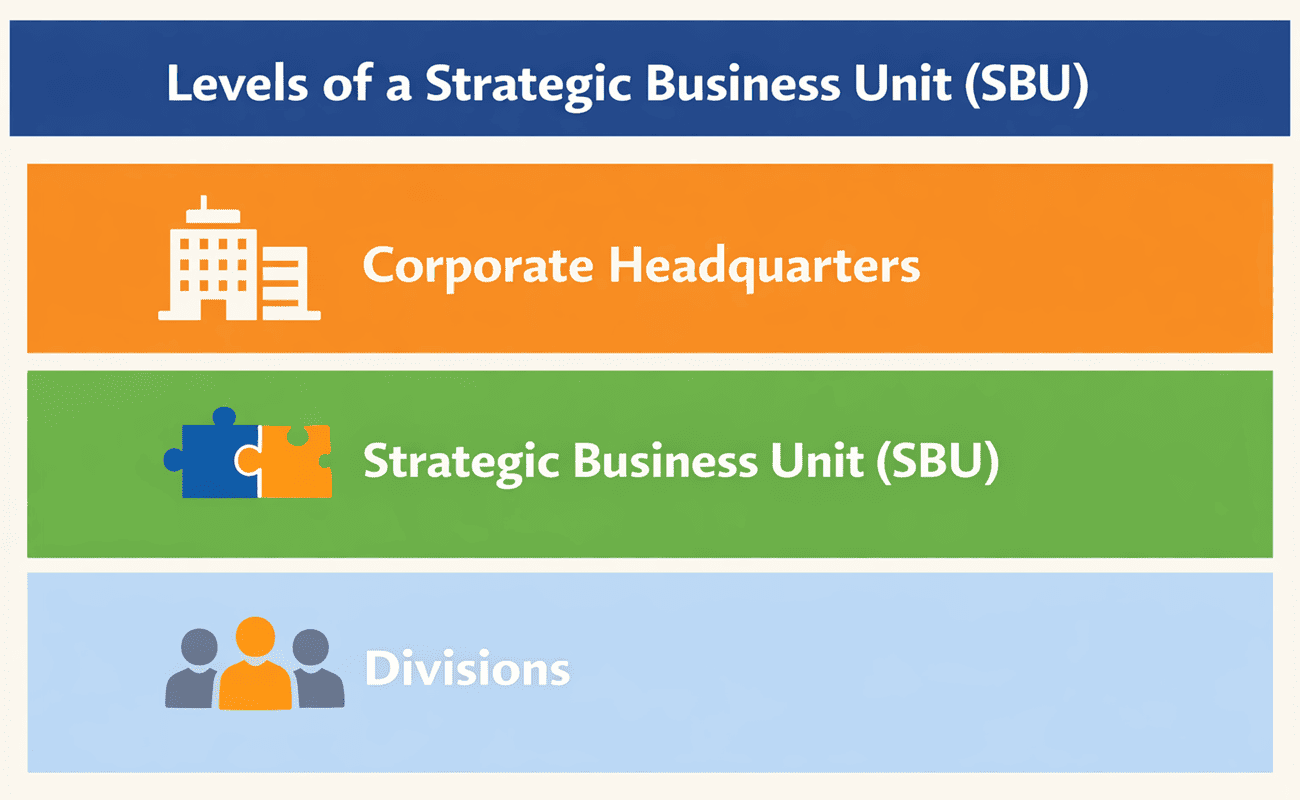
An SBU typically operates within a three‑tier hierarchy:
- Corporate headquarters – sets the overall mission and allocates resources. It monitors each SBU’s performance and ensures that the units support the company’s long‑term goals.
- Strategic business unit – defines its own vision, strategy and budget. It is responsible for profitability, product development and market positioning within its target segment.
- Divisions or departments – carry out specialized functions like marketing, sales, production and customer service for the SBU. They manage day‑to‑day operations and report to the SBU management team.
Benefits of SBUs
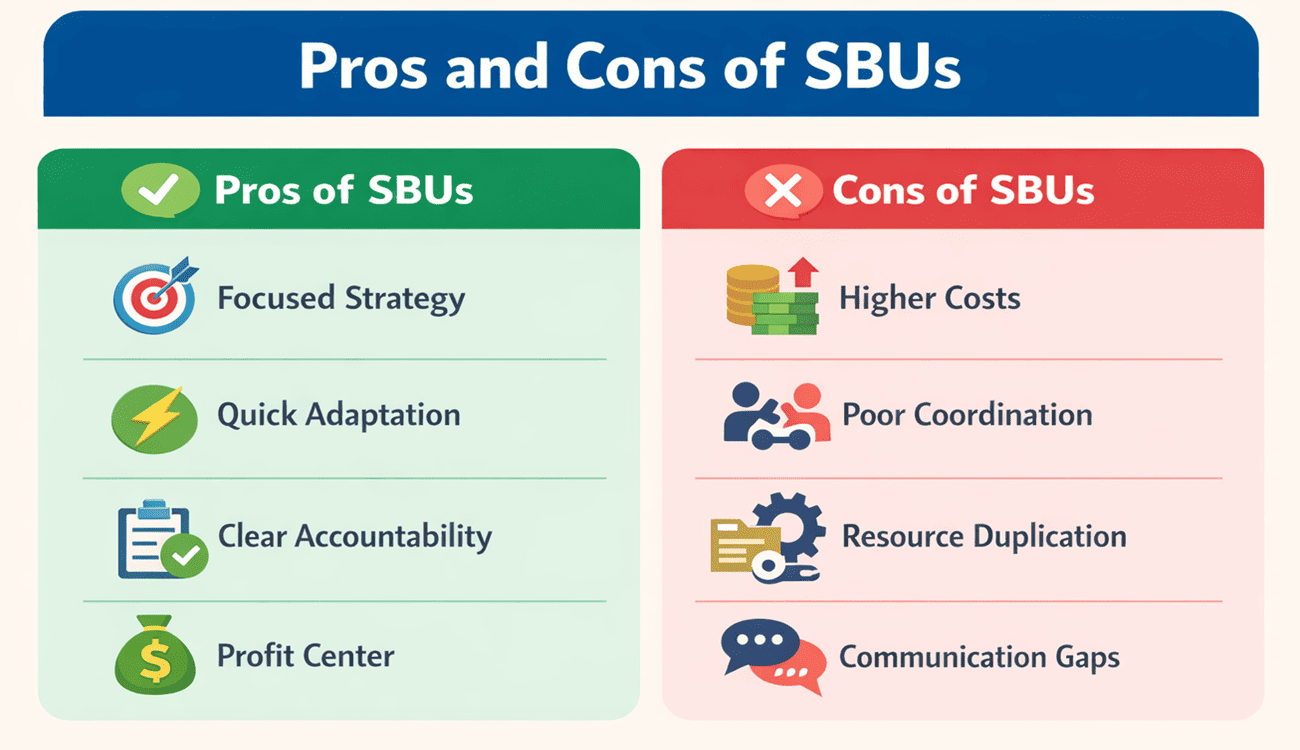
Enhanced focus and customer orientation. SBUs allow managers to concentrate on a specific market or product. By narrowing their scope, teams can tailor products, marketing and service to meet customer needs more precisely. This focus often leads to higher customer satisfaction and stronger brand loyalty.
Faster decision making. Because each SBU controls its own resources and strategy, it can respond quickly to market changes. When consumer preferences shift or a new competitor enters the market, SBU managers do not need to wait for approval from a distant headquarters. This speed can be a decisive advantage.
Accountability and performance tracking. SBUs operate like small businesses. Revenues and costs are clearly associated with each unit, making it easier to identify successful products and spot underperforming areas. Transparent metrics encourage responsible management and provide insight into where to allocate investment.
Innovation and entrepreneurship. Employees working in SBUs often experience a start‑up‑like environment. They can experiment with new ideas without the constraints of large corporate bureaucracies. If an experiment succeeds, the innovation can be scaled across the group; if it fails, the impact is confined to one unit.
Risk diversification. Separating operations into distinct units shields the broader company from volatility. A downturn in one business line does not drag down unrelated units. Investors often favor companies with multiple SBUs because it signals diversified revenue streams.
The pros and cons of SBUs are summarized in the following graphic:
Drawbacks and How to Overcome Them
Higher costs. Running multiple autonomous units can increase administrative expenses. Each unit may need its own finance, HR and IT systems. To mitigate duplication, companies can share certain platforms or negotiate group contracts with vendors.
Coordination challenges. Without strong cross‑unit communication, SBUs might pursue conflicting strategies or miss synergies. MHI observes that while its SBUs formulate and execute their own strategies, this independence can weaken horizontal collaboration and resource sharing. Establishing cross‑functional committees, shared knowledge repositories and joint projects can improve cooperation.
Risk of strategic drift. Each SBU might focus only on short‑term targets, neglecting the company’s long‑term vision. A central strategy team or corporate planning office should review each unit’s plans to ensure alignment with overarching goals. Regular strategy reviews and shared performance indicators help keep units on course.
Unequal resource allocation. Units in fast‑growing markets may require more capital than those in mature segments. Companies should adopt dynamic budgeting, reallocating funds and talent based on performance and market opportunities. The KPMG survey notes that continuous transformation requires agile resource allocation, emphasizing that rigid budgets can hamper progress.
Setting Up a Strategic Business Unit
Creating an SBU involves careful planning. Here is a step‑by‑step approach:
- Identify a distinct market or product. SBUs work best when they target a specific customer segment or technology. Analyze your company’s portfolio to find groups of products or services that share customers or capabilities.
- Assess feasibility. Evaluate whether the unit can operate independently. Consider whether it has enough revenue potential to justify separate management and whether it can support its own marketing, research and support functions.
- Define vision and goals. Craft a clear mission for the SBU. This should align with the parent company’s mission but provide a distinct direction. Set measurable objectives for growth, profitability and market share.
- Allocate resources. Provide the unit with its own budget, assets and staff. Establish governance policies for hiring, procurement and financial control. Decide which systems (like IT or HR) will be shared with the parent company and which will be independent.
- Appoint leadership. Choose a head for the SBU who has experience in the target market. A strong leader can balance autonomy with accountability and maintain communication with the corporate center.
- Implement performance measurement. Use key performance indicators (KPIs) that reflect both financial results and strategic progress. Regular reviews help identify issues early and allow the parent company to provide support or intervene when necessary.
- Encourage collaboration. To prevent silos, create structures such as cross‑unit committees, shared innovation labs or joint marketing programs. Encourage leaders to share lessons learned and coordinate on procurement and technology decisions.
Real‑World Examples
Coca‑Cola’s product diversification. When Coca‑Cola expanded into iced tea and fruit juices, it launched SBUs to develop and market brands like Nestea and Fanta. These units operated with separate leadership and marketing teams, enabling them to focus on new customer segments without distracting from Coca‑Cola’s core soda business.
LG’s consumer electronics. LG organizes its wide range of products into independent business units. The company’s home‑appliance and mobile‑device units each manage their own research, design, manufacturing and marketing while sharing corporate resources for finance and branding.
Mitsubishi Heavy Industries’ diverse portfolio. MHI uses an SBU structure to manage complex businesses spanning energy systems, infrastructure, logistics and aerospace. Each unit formulates its own strategy and executes it, but the company acknowledges that this autonomy can reduce horizontal collaboration. To address this, MHI is investing in digital platforms that allow real‑time data sharing across units and centralizing certain functions like procurement.
Tech giants and product lines. Several technology companies structure themselves into product‑focused SBUs. For example, a company might have separate units for cloud services, hardware devices and gaming platforms. Each unit develops products, manages revenue and interacts with customers while drawing on the parent company’s brand and infrastructure.
Aligning SBUs With Digital Transformation
Digital technologies are reshaping markets at an unprecedented pace. Artificial intelligence, data analytics and cloud computing enable new business models and disrupt existing ones. Most large enterprises now run multiple transformation programs concurrently, making continuous change a necessity rather than an exception. SBUs can be a powerful mechanism for managing this change.
Because SBUs operate independently, they are ideal environments for experimenting with new technologies. A single unit can pilot a digital twin for manufacturing or adopt generative AI in customer service without exposing the entire company to risk. If the experiment delivers value, the model can be replicated across other units. Meanwhile, the parent company can provide shared infrastructure such as cloud platforms, cybersecurity protocols and data governance frameworks.
However, the fast pace of transformation also requires coordination. Data must flow freely between units, and lessons from one experiment should inform others. Leadership should create communities of practice, hold regular cross‑unit reviews and celebrate collaborative successes. Shared dashboards and integrated planning tools can highlight overlaps and reveal opportunities to combine resources. In this way, SBUs become both laboratories for innovation and building blocks of enterprise‑wide change.
FAQs
Q1. What is the main purpose of a strategic business unit?
An SBU allows a company to manage a specific product or market independently, improving focus and agility while still aligning with corporate strategy.
Q2. How does an SBU differ from a division?
Unlike a division, an SBU has its own vision and strategy. It reports to headquarters but controls its own budgets, investments and marketing, making it more autonomous.
Q3. Are SBUs only for large corporations?
No. Medium‑sized firms with diverse product lines can benefit from SBUs. The structure works whenever a business wants to separate responsibility and track performance independently.
Q4. Can a company have several SBUs?
Yes. Many conglomerates run multiple SBUs. Each unit focuses on a different product line or region and reports its results separately to the corporate center.
Q5. What are common challenges when managing SBUs?
High costs, coordination difficulties and strategic misalignment are common hurdles. Clear governance, shared platforms and regular communication can overcome these issues.
Conclusion
Strategic business units help large organizations stay flexible, focused and innovative. By granting autonomy to distinct product or market teams, companies can experiment quickly and respond to shifting customer needs. At the same time, they must manage the risks of fragmentation and duplication. Strong leadership and smart governance allow SBUs to thrive without losing sight of the company’s larger mission.
If your organization offers diverse products or serves multiple markets, consider whether an SBU structure could unlock growth. Ask yourself: Do my teams need more autonomy to innovate? Are we missing opportunities because decisions move too slowly? By examining these questions, you can determine whether creating or refining SBUs could lead to better focus and faster progress.
To explore related strategic frameworks, see our guides on the BCG Matrix and the GE McKinsey Matrix. These tools help businesses evaluate products, prioritize investments and align resources with strategic goals.