
Every successful company knows why it exists, where it’s going and how it will get there. Those three ideas—purpose, vision and mission—are the foundation of every strategic plan. A strategic mission answers the “how.” It translates your purpose into action, guiding decisions, rallying employees and signaling to customers what you stand for. Without a clear mission, even the best strategy falls flat.
What is a Strategic Mission?
A strategic mission is more than a slogan. It is a concise statement describing who you are, what you do and who you do it for. If your vision is the destination you aim to reach and your purpose is why you exist, your mission is the path you take to get there. It guides daily operations, shapes corporate culture and provides a framework for allocating resources.
To avoid confusion:
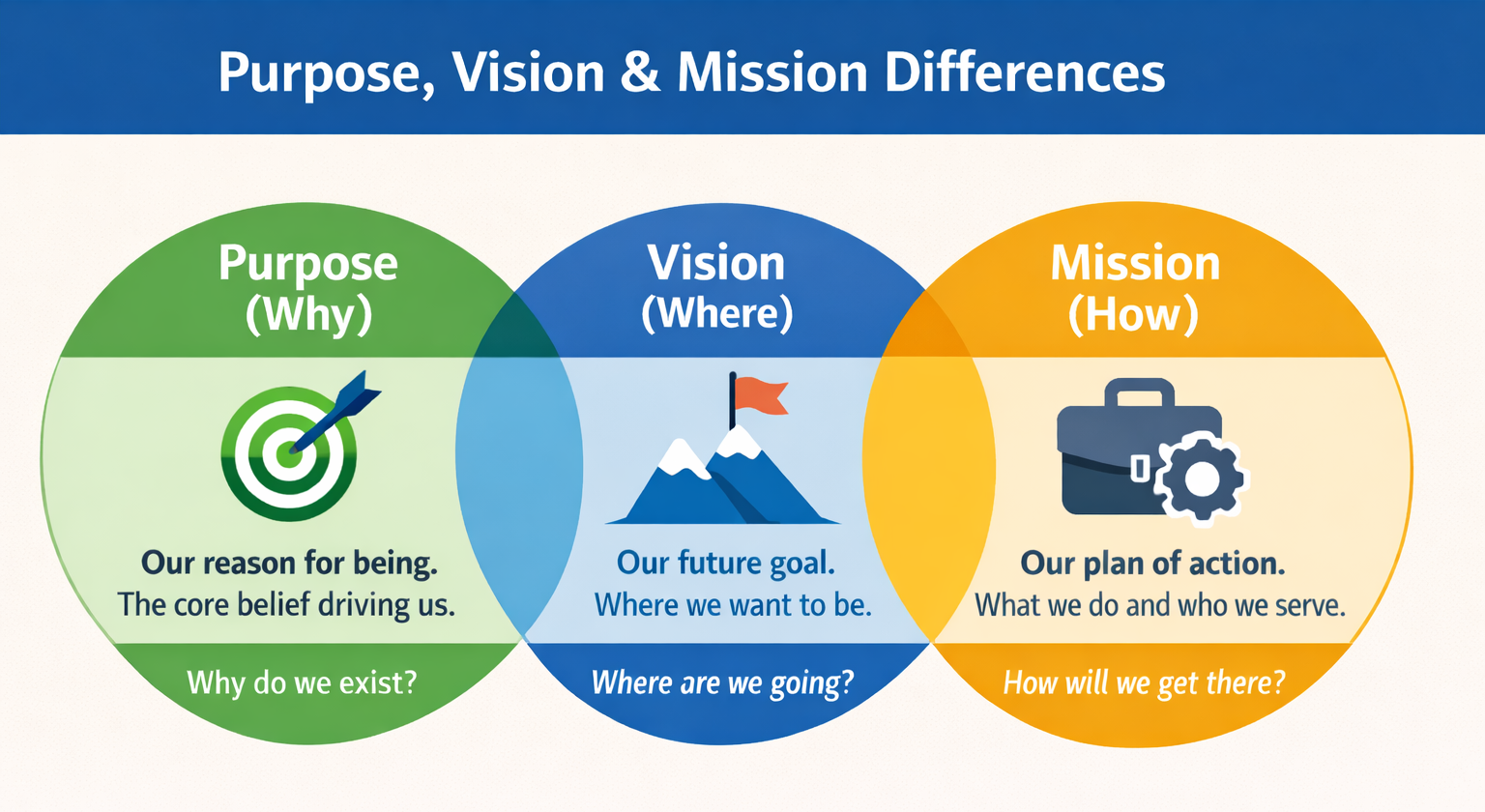
- Purpose (Why?): Your organization’s fundamental reason for existing. It goes beyond profit and answers the question “why do we exist?”.
- Vision (Where?): A future‑oriented statement that describes where the organization wants to go. It is aspirational and inspires teams to move in the same direction.
- Mission (How?): A practical statement that outlines how the organization will achieve its vision. It identifies the activities and value you provide.
Think of these three elements as the “Golden Circle” popularized by Simon Sinek—purpose is the core, vision is the outer layer and mission is the action plan.
Why a Strategic Mission Matters
A clear mission isn’t just a feel‑good statement. Research shows it drives real business outcomes. A Harvard Business Review article noted that purpose‑driven companies are 2.5 times better at driving innovation and transformation than their peers. The same piece highlighted Deloitte findings that mission‑led organizations report 30 percent higher levels of innovation and 40 percent higher workforce retention.
These data points make a strong case: a compelling mission fuels engagement, innovation and loyalty.
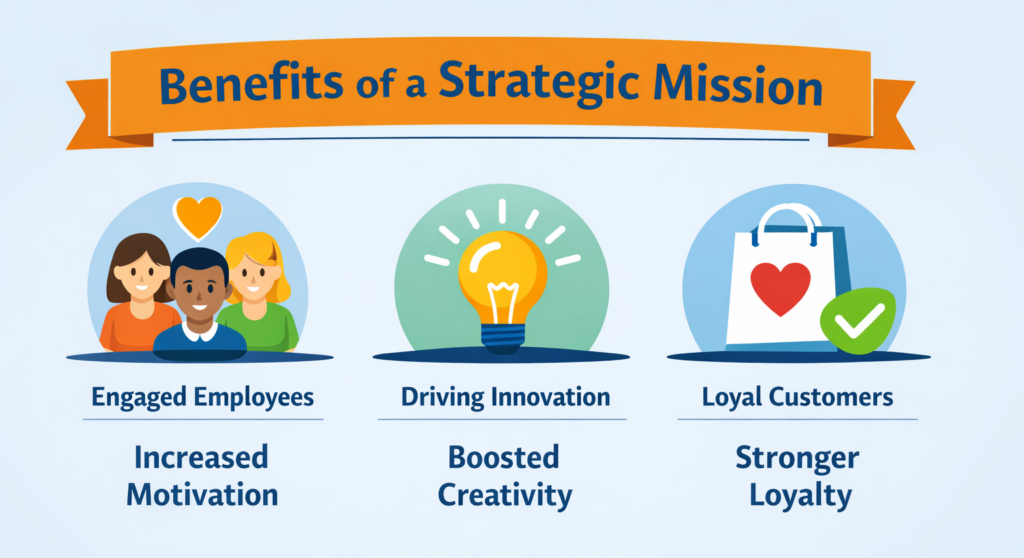
Beyond metrics, a strategic mission offers practical benefits:
- Motivates and aligns employees: When people know the mission, they see how their work contributes to something bigger, boosting morale and collaboration.
- Inspires customers and partners: A mission that resonates with stakeholders builds trust and fosters long‑term loyalty.
- Guides strategic decisions: A well‑crafted mission acts as a compass, helping leaders choose initiatives that support long‑term goals.
- Strengthens brand identity: Consistency between mission, communication and behavior differentiates you in a crowded market.
- Improves accountability: Clear expectations make it easier to measure progress and adjust strategies.
Components of an Effective Mission Statement
To write a mission that works, include these elements:
- Who you serve: Identify your target customers or communities. Avoid vague phrases like “everyone” and be specific.
- What you do: Describe the core product or service you offer. Use concrete language and avoid jargon.
- How you do it: Highlight what makes you unique—your values, methodology or promise.
- Why it matters: Connect your work to a broader purpose or impact. This link is what elevates a mission from a tagline to a strategic tool.
Keep your mission short—ideally one or two sentences—so everyone can remember it. Use the present tense and active voice (“We deliver reliable healthcare to underserved communities,” not “Reliable healthcare is delivered…”). Make sure your leadership team agrees on the meaning of every word.
How to Write a Strategic Mission Statement
Crafting a mission may feel daunting, but it becomes manageable when broken into steps:
- Clarify your purpose and vision: Start with why you exist and where you’re headed. Without this clarity, your mission may lack direction.
- Involve key stakeholders: Engage employees, customers and partners through surveys or workshops. Their insights ensure the mission reflects diverse perspectives.
- List what you do and who you serve: Focus on core activities and your primary audience. Ask yourself, “Who benefits most from our work?”
- Identify your differentiators: What sets you apart? It might be your technology, customer service or social impact. Capture this uniqueness in a word or two.
- Draft several versions: Write multiple statements, varying length and tone. Then test them with your stakeholders. Which one resonates most?
- Keep it simple: Use everyday language. If a fifth‑grader can’t understand it, rewrite it.
- Test for alignment: Check that the mission supports your vision and purpose. If it doesn’t, refine it until everything fits together.
- Communicate and live it: Once finalized, embed the mission everywhere—on your website, onboarding materials and team meetings. Leadership should model the mission in decisions and actions.
Examples of Inspiring Mission Statements
Below are mission statements from well‑known organizations. Notice how each uses simple language and captures the company’s essence.
- Amazon: “To be Earth’s most customer‑centric company, where customers can find and discover anything they might want to buy online, and endeavors to offer the lowest possible prices.”
- Microsoft: “To empower every person and every organization on the planet to achieve more.”
- Google: “To organize the world’s information and make it universally accessible and useful.”
- Patagonia: “We’re in business to save our home planet.”
- SpaceX: “To make humanity multiplanetary.”
- Starbucks: “To inspire and nurture the human spirit—one person, one cup and one neighborhood at a time.”
- Warby Parker: “To inspire and impact the world with vision, purpose and style.”
- Tesla: “To accelerate the world’s transition to sustainable energy.”
- Nike: “Bring inspiration and innovation to every athlete in the world. If you have a body, you are an athlete.”
- LinkedIn: “To connect the world’s professionals to make them more productive and successful.”
- Workday: “To put people at the center of enterprise software.”
Why do these statements work? Each clearly names the target audience (customers, professionals, athletes), states what the company does (connect, organize, save) and adds a unique spin. Patagonia’s mission stands out because it aligns profit with planetary stewardship, demonstrating how a mission can serve a broader purpose.
How a Strategic Mission Drives Business Success
When organizations anchor decisions around a clear mission, they see measurable benefits. Purpose‑driven companies are 2.5 times more innovative and achieve 30 percent more innovation with 40 percent greater retention than competitors. In real terms, this can translate to shorter product development cycles, higher customer satisfaction and lower turnover costs. Employees who feel connected to a mission are more engaged and produce better work. Engaged employees become brand ambassadors, creating positive word‑of‑mouth and improving recruitment.
Beyond quantitative gains, a strategic mission protects companies in turbulent times. During crises—like supply‑chain disruptions or economic downturns—a mission acts as a north star, helping leaders make consistent decisions. It also supports culture: when teams know why they exist and how their work matters, they can adapt without losing sight of the big picture.
Visualizing the Concepts
To make these ideas easier to grasp, the following infographics illustrate the difference between purpose, vision and mission, and the benefits of a strong mission. Feel free to share these visuals in presentations or workshops.
FAQs
Q1. How long should a mission statement be?
Aim for one or two sentences. Keep it simple and memorable so employees and customers can recall it easily.
Q2. Can a mission change over time?
Yes. Your mission should evolve as the organization grows, but any change should still align with your core purpose and values.
Q3. What is the difference between mission and vision?
The vision describes a future destination; the mission outlines how you will reach it.
Q4. Who should be involved in writing the mission?
Include leadership, employees and key stakeholders. Broad input ensures the mission reflects diverse perspectives and gains buy‑in.
Q5. Why do some mission statements fail?
Mission statements fail when they are too vague, focus only on profits or lack authenticity. Make sure yours resonates and aligns with everyday actions.
Conclusion
A clear strategic mission is a powerful tool for guiding decisions, motivating teams and communicating with the world. In an era where consumers and employees seek meaning and alignment, your mission can set you apart. Take time to revisit your company’s mission; involve your team, clarify your purpose and craft words that inspire action. Have questions about writing a mission statement? Share them in the comments or explore our guides on strategic vision and benchmarking linked below. Together we can build organizations that not only thrive but also make a positive impact.