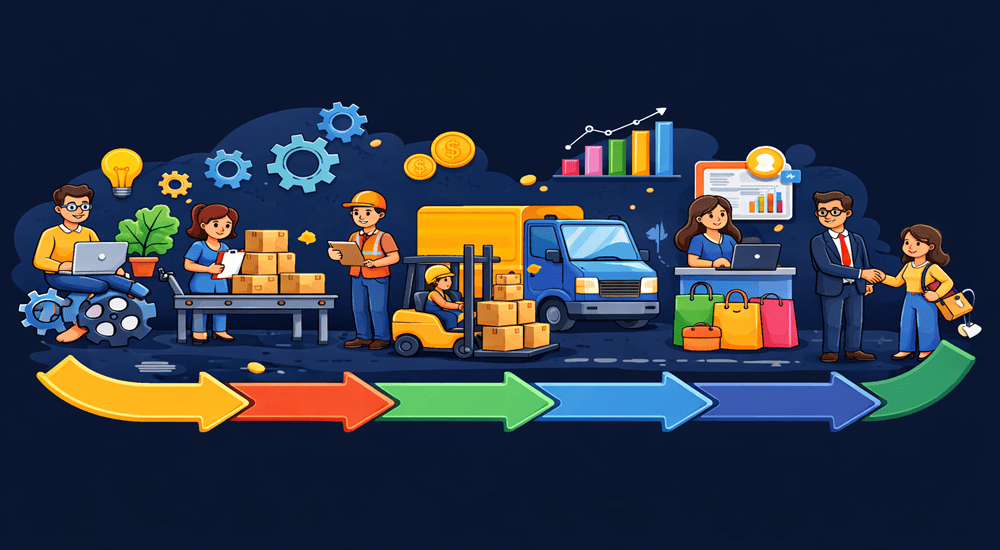
Every business needs to create more value than it spends. Value chain analysis helps leaders see how each activity — from sourcing raw materials to servicing customers — contributes to profit. The concept, introduced by Michael Porter in 1985, remains central to modern strategy. In a world of geopolitical shocks, rapid technological change and customer expectations rising year after year, understanding and improving your value chain is more important than ever.
According to a survey by the World Economic Forum, only 28 percent of senior operations executives plan to fully regionalize their supply chains by 2030 even though 92 percent see regionalization as a priority. This gap highlights how far companies still have to go in redesigning their value chains for resilience.
In this blog post, you will learn what a value chain is, why analysis matters, the steps involved, and how leading companies such as McDonald’s apply the framework.
Let’s dive in.
What is a Value Chain?
A value chain is the sequence of activities a firm performs to design, produce, market, deliver and support its products or services. These activities fall into two categories:
- Primary Activities: Directly involved in creating and delivering goods or services.
- Support Activities: Functions that enable the primary activities to run smoothly.
Porter’s model remains a useful map for dissecting where and how your business creates value. In today’s digital economy, the value chain also includes intangible elements such as data management and customer experience. When you see your operations through this lens, you can ask smarter questions. Which steps add value for the customer? Where do costs outweigh benefits? What changes would make your product stand out?
Why Value Chain Analysis Matters
Value chain analysis is more than an academic exercise — it is a path to better profits and deeper customer loyalty. Here are a few reasons why modern businesses invest time in this work:
- Cost Reduction: Breaking down activities helps identify inefficiencies and waste. An international chemicals company with about $12 billion in annual revenue cut costs by more than 10 percent after simplifying its value chain and redesigning its operating model.
- Strategic Differentiation: Understanding how each step creates value allows a firm to emphasise unique strengths. In a crowded market, differentiation keeps customers coming back.
- Resilience and Agility: Recent supply chain shocks proved that focusing purely on cost is risky. A World Economic Forum survey found that while 64 percent of executives believe artificial intelligence will improve supply chains, only 1 percent have eliminated manual work. Digital tools and regionalized sourcing can make your chain more resilient.
- Innovation and Growth: Value chain analysis uncovers opportunities to innovate. For example, a lean transformation at a large mining company increased production by 10 percent and saved $100 million within 18 months.
Components of the Value Chain
Porter grouped value‑creating activities into primary and support categories. The following table summarizes these activities. Use it as a quick reference when analyzing your own operations.
| Activity type | Key activities |
| Inbound logistics | Sourcing raw materials, receiving, warehousing, inventory control |
| Operations | Transforming inputs into finished products; manufacturing, assembly, testing |
| Outbound logistics | Distributing products to customers; order processing, shipping, delivery |
| Marketing and sales | Promoting products and persuading buyers; advertising, sales teams, pricing |
| Service | Maintaining value after the sale; customer support, warranties, training |
| Procurement | Acquiring inputs and negotiating with suppliers |
| Technology development | Research and development, process improvement, IT systems |
| Human resource management | Hiring, training, compensating staff |
Primary activities sit along the top row of the table, reflecting their direct link to production. Support activities run underneath and feed into every primary step. Think of them as the unseen gears that keep the machine running.
How to Conduct a Value Chain Analysis
Performing a value chain analysis involves a structured approach. The process can be adapted to any industry and company size, but the following five steps provide a reliable framework:
- Map all Activities: Begin by listing every primary and support activity. Include details such as suppliers, process owners and performance metrics. The more granular your map, the easier it is to find inefficiencies.
- Assign Costs: Estimate the cost of each activity. Don’t stop at direct expenses. Include indirect costs like overhead and the hidden cost of delays or poor quality.
- Identify Customer Value: Analyze what your customers truly value. Do they prioritise low price, fast delivery or premium features? Talk to customers, study reviews and examine purchasing data. Understanding perceived value helps you decide where to invest and where to cut.
- Benchmark Competitors: Compare your activities with those of competitors. Benchmarking can be strategic (reviewing high‑level positioning), process‑based (comparing how tasks are carried out) or performance‑driven (looking at results such as delivery times or customer satisfaction). Competitive benchmarking highlights areas where you lag.
- Choose Your Advantage: Decide whether to pursue cost leadership, differentiation or a niche focus. Cost leadership means producing similar quality at a lower price. Differentiation means offering unique attributes. A niche strategy targets a specific segment with specialized products or services. Your choice should align with your capabilities and market conditions.
Strategies Derived from Value Chain Analysis
Value chain analysis informs strategic decisions. There are three broad ways to turn insights into advantage:
- Cost Leadership: Streamline processes, automate tasks and negotiate better input prices to offer competitive prices. Remember that cost leadership can be challenging to sustain if competitors can easily match your cost cuts.
- Differentiation: Add features, improve quality or enhance the customer experience. Unique products justify higher prices. This approach relies on understanding what your buyers value.
- Focus (Niche Strategy): Tailor your products or services to a specific group of customers. By meeting the needs of a well‑defined segment better than anyone else, you can build loyalty and command premium prices.
Case Study: McDonald’s Value Chain
McDonald’s, the global quick‑service restaurant chain, offers a clear example of value chain analysis in action. The company uses a mix of company‑owned locations and franchises to deliver fast food at affordable prices. Below is a summary of how each activity contributes to its competitive advantage.
Primary Activities
- Inbound Logistics: McDonald’s sources ingredients from a network of approved suppliers that meet strict quality and cost requirements. Long‑term contracts and global scale give the company bargaining power. For example, it often sources potatoes and beef from regional suppliers to maintain freshness and control costs.
- Operations: McDonald’s restaurants operate on a franchise model. Standardized processes, detailed training and automated kitchen equipment ensure consistency across thousands of locations. Innovations like kiosks and mobile ordering apps help process orders quickly.
- Outbound Logistics: Quick service is crucial. Drive‑through lanes, curbside pickup and home delivery through partners ensure that food reaches customers promptly. Many stores track wait times and adjust staffing in real time.
- Marketing and Sales: The golden arches are one of the world’s most recognizable symbols. McDonald’s marketing strategy blends global themes with local flavors and promotions. According to the company’s annual reports, advertising costs totaled USD 82.9 million in 2021, USD 329.2 million in 2020 and USD 81.5 million in 2019. These figures underscore how important marketing is to the brand.
- Service: Customer service revolves around speed, cleanliness and friendliness. McDonald’s invests in staff training and offers perks like free Wi‑Fi, kids’ play areas and digital loyalty programs. While wages remain modest, additional benefits such as tuition assistance help reduce turnover.
Support Activities
- Procurement: The company uses a digital procurement platform to manage its global supplier network. Centralised purchasing and stringent quality checks reduce risk.
- Technology Development: Self‑order kiosks, mobile apps and digital menu boards enhance efficiency and allow for dynamic pricing. McDonald’s also experiments with AI‑based drive‑through ordering to speed up service.
- Human resource Management: The chain employs hundreds of thousands of people worldwide, many through franchises. It offers continuous training, college tuition assistance for hourly employees and clear career paths.
- Infrastructure: The corporate structure consists of regional hubs overseen by executives and zone presidents. Finance, legal, IT and quality assurance teams support restaurants around the world.
This combination of standardized operations, heavy marketing investment and streamlined logistics allows McDonald’s to serve millions of customers daily while maintaining profitability.
Trends Shaping Value Chains
Global value chains are evolving rapidly. Geopolitical tensions, climate change and new technologies continue to reshape how firms source, produce and deliver goods. Key trends include:
- Regionalization and Resilience: The COVID‑19 pandemic and trade disputes pushed many companies to shift production closer to customers. Yet the transition is slow. Only 28 percent of executives plan to fully regionalize their supply chains by 2030 despite widespread recognition of its importance.
- Digital Transformation: Artificial intelligence, machine learning and real‑time data analytics promise better visibility and decision‑making. Despite optimism, only 1 percent of surveyed firms have eliminated manual work in their supply chains, highlighting the implementation gap.
- Skills Gap: Technology adoption requires new skills. Many organizations struggle to retrain employees fast enough. The World Economic Forum warns that 60 percent of the global workforce needs significant upskilling by 2030.
- Sustainability: Customers and regulators demand environmentally responsible operations. Companies are redesigning processes to reduce emissions, cut waste and support circular economies. This push is becoming a core part of the value chain analysis process.
Understanding these trends will help you future‑proof your value chain. Ask yourself: Are you building regional resilience? How can you adopt digital tools while supporting your workforce? What sustainability metrics matter to your customers?
Common Challenges and How to Overcome Them
Value chain analysis is powerful, but it comes with hurdles. Here are common challenges and suggestions to tackle them:
- Incomplete Data: Without accurate data on costs and processes, it is hard to pinpoint inefficiencies. Start small by collecting reliable numbers on key activities. Use software tools to integrate data from different departments.
- Resistance to Change: Employees may fear that analysis will lead to job cuts. Communicate the purpose clearly and involve staff in identifying improvements. Celebrate wins to build momentum.
- Siloed Departments: When functions operate independently, opportunities for synergy are lost. Create cross‑functional teams to map the value chain. Encourage collaboration by aligning incentives across departments.
- Overlooking Intangible Value: Activities like customer experience, brand reputation and employee satisfaction also contribute to value. Include qualitative measures in your analysis.
FAQs
Q1. What is the difference between a value chain and a supply chain?
A value chain looks at everything a business does to add value for the customer, including marketing and support functions. A supply chain focuses on the flow of goods and materials between companies.
Q2. How does technology improve value chain analysis?
Digital tools such as data analytics, AI and process automation make it easier to measure performance, model scenarios and identify bottlenecks. Despite this promise, only a small fraction of companies have fully digitized their chains.
Q3. Can small businesses perform value chain analysis?
Yes. Start by listing key processes and assigning simple cost estimates. Even a basic map can reveal unexpected waste or opportunities for differentiation.
Q4. Does value chain analysis apply to services?
Absolutely. Service firms can examine client acquisition, project delivery and after‑sales support to find ways to increase value and reduce costs.
Q5. How often should a company revisit its value chain analysis?
Review your value chain whenever there is a major change — a new product launch, a shift in market conditions or a significant technology adoption. Regular reviews keep you ahead of competitors.
Conclusion
Value chain analysis remains an essential tool for competitive strategy. By breaking down every activity, assigning costs and understanding what customers value, you can identify improvements that increase profitability and delight buyers. Examples from industry giants show that even mature businesses can save millions and grow output by revisiting their value chains. Yet the process is not only for large corporations. Smaller firms benefit just as much by clarifying where they create value and where they do not.