
People rarely work or live in complete isolation. From families and school clubs to project teams and committees, we constantly join forces with others. Yet what makes a group different from a loose collection of people? How do groups help businesses achieve goals, and why do we choose to join them?
This blog post answers these questions in clear, simple language and offers real‑world examples. Keep reading to learn how healthy group dynamics can boost productivity and why people gravitate toward formal and informal groups.
What is a Group?
A group is two or more individuals who interact with one another and are interdependent. They come together to achieve a particular objective or share a common interest.
Definition: A group is a union of two or more people who come together for a common interest, interaction, or to achieve a common objective. A group can be formal or informal, and every organization has these groups to achieve its goals.
In the workplace, groups can be as small as a pair of coworkers or as large as an entire department. Groups differ from teams: while a team shares a single, collective goal and has mutual accountability, members of a group may work toward individual goals but still coordinate their efforts.
Key Characteristics of a Group
Healthy groups share several features:
- Size: at least two members are needed, but effective collaboration often occurs in smaller groups where communication is easier.
- Common goal: whether it’s finishing a project or sharing hobbies, members unite around a shared purpose.
- Defined roles: clear roles and responsibilities help members understand who does what.
- Norms and procedures: groups develop shared norms, rules, or procedures that govern behavior and decision‑making.
- Communication: open communication allows members to exchange ideas, resolve conflicts, and build trust.
Types of Groups
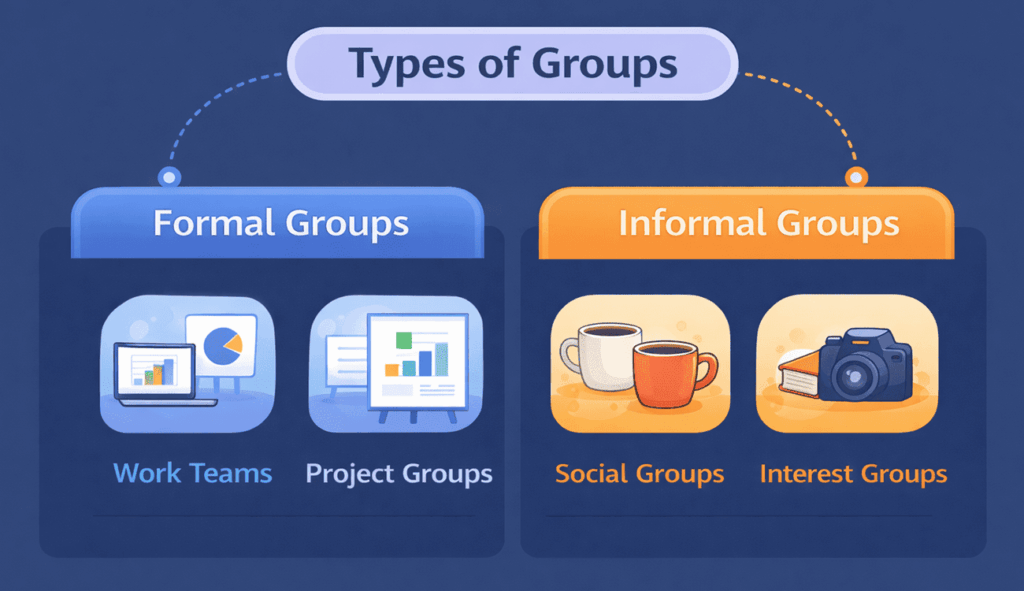
Groups are often classified as formal or informal:
Formal groups are created by an organization to accomplish a specific goal. They include command groups (e.g., finance department), task groups (temporary teams formed for projects), committees, and work groups. Formal groups have designated leaders and follow set procedures. Their structure reflects the organization’s hierarchy and helps coordinate work across departments.
Informal groups emerge naturally when people interact and share common interests or identities. These might be lunch groups, hobby clubs, cultural associations, or social circles at work. Informal groups operate democratically, with no formal leader, and often provide emotional support and a sense of belonging. Although not created by management, informal groups can influence morale and productivity.
Functions of Groups in Organizations
Groups play vital roles in organizations. They help complete tasks, share knowledge, and provide social support. When groups operate effectively, they can drive innovation and performance. Research from McKinsey & Company shows that three in four cross‑functional teams underperform on key metrics. This sobering statistic illustrates why leaders must pay attention to group dynamics. Conversely, companies whose senior leadership teams share a meaningful vision are almost twice as likely to achieve above‑median financial performance. Clearly, the way a group functions can make or break organizational success.
Some common functions of groups include:
- Achieving objectives: formal groups, such as project teams or departmental units, exist to accomplish organizational goals. They assign tasks, coordinate resources, and track progress. A finance group ensures budgets are met; a development group designs new products.
- Problem solving: groups bring diverse perspectives that help solve complex problems. Brainstorming sessions, quality circles, and cross‑functional task forces fall into this category.
- Social support and morale: informal groups create a sense of community. Shared lunches, interest clubs, or support groups reduce stress and enhance job satisfaction.
- Communication and feedback: groups provide channels for upward, downward, and horizontal communication. Employees can raise concerns, share ideas, and receive feedback.
- Learning and development: group membership exposes individuals to new skills and knowledge. Mentorship circles or study groups encourage continuous learning.
Global surveys underscore the impact of engagement on performance. A Gallup meta‑analysis of 183,000 businesses found that businesses with highly engaged teams see 18 percent more productivity and 23 percent more profitability. It also found that high‑turnover organizations with engaged employees experience an 18 percent reduction in turnover. These figures show that investing in group cohesion and engagement yields tangible benefits.
Why Do People Join Groups?
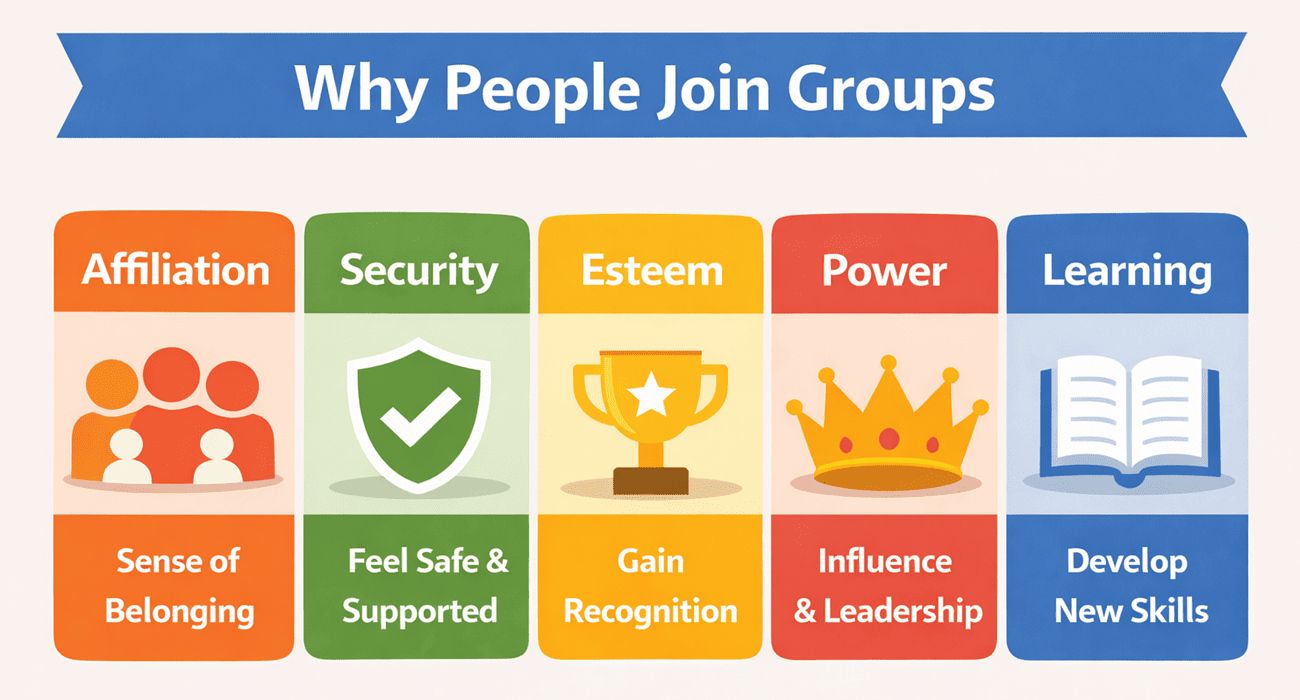
People join groups for many reasons. Understanding these motivations helps managers design effective teams and helps individuals choose groups that meet their needs. Common reasons include:
- Affiliation: humans are social beings. Joining a group satisfies our need for friendship and belonging. Informal lunch groups, interest clubs, and online communities all provide social connection.
- Security: being part of a group can make us feel safe. When facing new tasks or uncertain situations, individuals find comfort in the support of others.
- Esteem: membership in a respected group can boost self‑confidence. Joining a professional association or a leadership council provides status and recognition.
- Power: groups can grant influence. Elite committees or boards give members authority to make decisions and shape policy.
- Learning: groups allow us to acquire new skills and knowledge. Study groups, cross‑training circles, and communities of practice exemplify this motive.
The following infographic illustrates these reasons with simple icons and short descriptions.
Group Dynamics and Team Effectiveness
Group dynamics refer to the interactions and behaviors within a group. Poor dynamics can lead to conflict, low morale, and underperformance. For example, McKinsey research found that three out of four cross‑functional teams fall short of expectations. These failures often stem from unclear goals, lack of trust, and weak communication. On the other hand, the same research shows that teams with shared purpose and role clarity deliver better results.
Effective group dynamics hinge on four core areas: configuration, alignment, execution, and renewal. Configuration ensures the right mix of skills and perspectives. Alignment means members agree on the group’s direction. Execution concerns how well the group performs tasks. Renewal addresses long‑term sustainability through learning and adaptability. Leaders can improve dynamics by clarifying roles, encouraging open communication, and providing training.
Tips for Building Effective Groups
Whether you manage a formal project team or participate in an informal club, these practical tips can help:
- Define the mission early: write a clear purpose statement and share it with every member. This prevents confusion later.
- Clarify roles and expectations: assign responsibilities based on skills and interests. Clear roles minimize overlap and reduce conflict.
- Encourage psychological safety: create an environment where members can speak up without fear of ridicule. When people feel safe, they are more likely to share ideas.
- Promote diversity: invite members with different backgrounds and viewpoints. Diverse groups generate innovative solutions.
- Invest in team‑building activities: regular activities strengthen relationships. According to research summarizing Gallup’s findings, companies with engaged teams see significant gains in productivity and profitability.
- Use feedback loops: check in regularly to assess progress and address issues. Short weekly meetings or digital polls keep everyone aligned.
- Link to organizational goals: connect group tasks to broader objectives so members see how their work matters. For instance, learning about conflict theory can help a team anticipate and manage disagreements; readers can explore this concept in our detailed post on conflict theory.
Real‑World Examples of Groups
Community cleanup group: In a coastal town, residents form a group to clean beaches after storms. They organize monthly events, divide tasks (collecting debris, sorting recyclables), and collaborate with local authorities. The group’s clear mission, protecting the shoreline and keeps members motivated. Volunteers gain a sense of belonging and pride as they see their beaches restored.
Product development team: A startup assembles a cross‑functional team to design a new mobile app. The group includes designers, developers, and marketers. At first, roles overlap and deadlines slip. After clarifying responsibilities and setting a shared vision, productivity improves. The team adopts weekly retrospectives to discuss progress and challenges. Within six months, they launch the app on time and under budget.
Book club: Employees at a company start a lunchtime book club. This informal group meets twice a month to discuss novels and non‑fiction. Members join for affiliation and learning. The club fosters friendships across departments and gives participants a chance to practice public speaking. Discussions sometimes spark ideas for work projects.
FAQs
Q1. What is the minimum number of people required to form a group?
At least two people are required. A group can be as small as a pair of friends or coworkers.
Q2. What is the difference between a group and a team?
A group consists of individuals who coordinate their efforts but may have separate goals. A team shares a single purpose and has mutual accountability.
Q3. Why are formal groups important in organizations?
Formal groups perform defined tasks that help an organization reach its goals. Examples include departments, project teams, and committees.
Q4. How can managers reduce group turnover?
Engaging members through clear goals, supportive leadership, and team‑building activities can reduce turnover. Gallup’s research shows engaged teams have an 18 percent decrease in turnover.
Conclusion
Understanding groups helps explain how people work, interact, and achieve goals together. Formal groups, such as work teams and project groups, provide structure, clear roles, and accountability within organizations. Informal groups, including social and interest groups, grow naturally through shared connections and common interests. Both types play an important role in shaping behavior, communication, and performance. When organizations recognize and balance formal and informal groups, they can improve collaboration, motivation, and overall effectiveness.