
Does your business have a clear direction, or are you reacting to every new challenge? Many companies create beautiful plans and then watch them fail. Research shows that about two‑thirds of well‑formulated strategies fail because they’re poorly executed, while organizations with effective strategy management are 2.5 times more likely to lead their industries.
This blog post explains what strategic management is, why it matters, and how to execute it successfully.
What is Strategic Management?
Strategic management is the ongoing planning, monitoring, analysis and assessment of resources and processes an organization uses to meet its objectives. Unlike a single strategic plan, it is a continuous cycle that adapts to changing conditions. Strategic management turns a static plan into a living system by aligning resources and actions with mission, vision and strategy.
Effective strategic management offers several benefits:
- Clear Direction: It helps an organization define its mission, vision and long‑term goals and prioritize resources accordingly.
- Operational Improvement: Regularly analyzing operations and tracking successes leads to higher efficiency.
- Resource Optimization: Planned resource allocation prevents waste and improves utilization.
- Competitive Advantage and Sustainable Growth: Ongoing analysis of external forces helps firms respond quickly to threats and opportunities, increasing market share and ensuring long‑term growth.
Strategic management goes hand in hand with strategic planning. Planning defines the direction and priorities, while management coordinates ongoing activities to implement and adjust the plan. Without execution, even the best plan remains on paper.
Importance of Strategic Management
Strategies often fail because they are not implemented or monitored properly. Poor strategy management leads to market‑share loss, wasted resources, employee disengagement and even business failure. In contrast, organizations that manage their strategies well enjoy sustainable competitive advantages, accelerated growth and stronger alignment. A structured management process helps companies adapt quickly when the market changes, keep teams aligned and use resources wisely.
Five‑Step Strategic Management Process
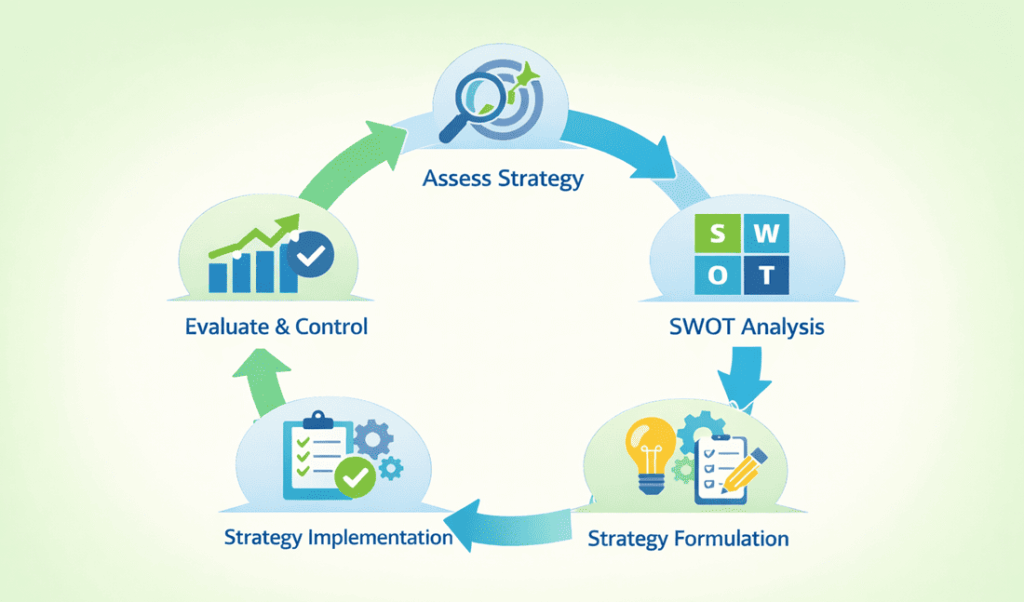
A widely accepted framework divides the strategic management process into five stages. The following table summarizes each step and key questions to ask:
| Step | Key Objective | Questions to Consider |
| 1. Assess the current direction | Identify mission, vision and long‑term goals. | What do we aim to achieve? Where do we want to be in five years? |
| 2. Analyze the environment | Use situational tools like SWOT to examine internal strengths and weaknesses and external opportunities and threats. | What are our core capabilities? What trends or competitors threaten us? |
| 3. Formulate the strategy | Create an action plan and performance metrics based on the analysis. | Which markets or products should we pursue? How will we measure success? |
| 4. Implement the strategy | Assign resources, communicate roles and execute plans. | Who will do what? Do we have the required skills and budget? |
| 5. Evaluate and control | Monitor results and adjust the strategy when needed. | Are we meeting our goals? What needs to change? |
Below is an infographic summarizing the five‑step cycle:
1. Assess the Existing Strategy
The journey begins by reviewing your current strategic direction. Define mission, vision and objectives. For example, a local restaurant might realize its mission is to “offer fresh, healthy meals,” its vision is to “be the community’s favorite dining spot,” and its objective is to open two new locations in three years. Without a clear direction, resources are often spread thin.
2. Conduct a Situational Analysis
A situational analysis compares internal capabilities with external conditions. The SWOT analysis remains a popular tool because it examines strengths, weaknesses, opportunities and threats. Strengths and weaknesses are internal (e.g., skilled staff, outdated equipment), while opportunities and threats are external (e.g., growing demand, new competitors). Complement SWOT with other methods:
- PESTEL Analysis: Review political, economic, social, technological, environmental and legal factors.
- Market and Competitor Analysis: Understand industry trends and rivals’ strategies.
- Balanced Scorecard Perspectives: Evaluate performance across financial, customer, internal process and learning dimensions.
The Balanced Scorecard Institute notes that strategic planning helps leaders clarify mission and vision, identify key priorities, develop measurable goals, align teams and track performance. These insights shape realistic strategies.
3. Formulate or Develop the Strategy
Once you understand your situation, craft a strategy to close the gap between where you are and where you want to be. At this stage:
- Set SMART Goals (Specific, Measurable, Achievable, Relevant, Time‑bound). The Balanced Scorecard framework advises that goals should be clear and measurable.
- Choose the Right Level of Strategy: At the corporate level, decide in which markets to compete. At the business level, determine how to compete (e.g., cost leadership, differentiation). At the functional level, align departments such as marketing, finance and HR.
- Identify Key Initiatives: Break goals into projects with timelines, budgets and responsible teams. For instance, a manufacturing firm might plan to adopt automation technologies to reduce costs.
4. Strategy Implementation
Execution brings the plan to life. This phase includes:
- Resource Allocation: Invest in people, technology and capital. Make sure budgets align with priorities.
- Communication and Leadership: Share the strategy with all stakeholders. Use simple language and regular meetings to keep everyone informed.
- Organizational Design and Culture: Structure teams, roles and incentives to support the strategy. A strong culture helps managers enforce plans and motivates employees to achieve goals.
A common pitfall is misalignment. When departments operate in silos, goals conflict and execution suffers. Consider creating a strategy map, a visual tool that shows how objectives in different areas connect and support the overall mission. It helps employees understand how their work contributes to the big picture.
5. Evaluate and Adjust
No strategy is perfect. Continuous evaluation ensures you stay on course:
- Monitor Performance: Use Key Performance Indicators (KPIs) to track progress. Examples include revenue growth, customer satisfaction scores and employee retention.
- Review Assumptions: External conditions change; revisit your SWOT and market analyses regularly.
- Learn and Adapt: When outcomes fall short, adjust goals, reallocate resources or modify tactics. This iterative process turns strategic management into a learning cycle.
The Role of Organizational Culture
Culture is the unwritten code that guides behaviour. It defines hierarchy, how tasks are assigned and how people interact. A strong culture aligns employees with the mission and makes it easier to enforce instructions.
For example, a company that values innovation will encourage risk‑taking and idea‑sharing, which supports a strategy of continuous product development. During strategy formulation, assess whether your culture supports the new direction. If not, plan initiatives—such as leadership training or new reward systems—to close the gap.
Best Practices for Successful Strategic Management
- Ensure top‑level commitment: Leadership must champion the strategy and model desired behaviours.
- Engage stakeholders early: Involving managers, employees and even customers builds buy‑in and surfaces practical insights.
- Keep it simple: Avoid jargon. Use clear language and visuals to communicate goals.
- Link incentives to strategy: Reward behaviours and outcomes that align with strategic objectives.
- Invest in data and analytics: Use dashboards to monitor KPIs and make evidence‑based decisions.
- Build adaptability: Encourage learning and allow teams to pivot when conditions change.
- Review regularly: Schedule quarterly or bi‑annual reviews to assess progress and adjust plans.
Common Pitfalls and How to Avoid Them
- Lack of clear ownership: Assign responsibility for each initiative. Without accountability, actions stall.
- Unrealistic goals: Overly ambitious targets demoralize teams. Ensure goals match resources and constraints.
- Poor communication: Keep everyone informed through regular updates and accessible documentation.
- Ignoring culture: If the culture resists change, strategies fail. Address culture early.
- Neglecting evaluation: Without monitoring, it’s impossible to know what’s working. Set up dashboards and review cycles.
Real‑World Examples of Strategic Management
- Netflix’s pivot to streaming: In the 2000s, Netflix recognized the shift from DVDs to online streaming. By assessing technological trends and customer preferences, it formulated a strategy to transform its business model. Investing in streaming infrastructure and content licensing allowed Netflix to become a global leader.
- Toyota’s lean manufacturing: Toyota’s strategy focuses on quality and continuous improvement. Techniques such as Kaizen empower employees to suggest improvements daily. By aligning culture, processes and goals, Toyota maintains operational excellence and adaptability.
- Local café expansion: A small café saw rising demand for vegan options. After analysing customer feedback (SWOT opportunity), it formulated a strategy to introduce a plant‑based menu and open a second location. Clear goals, proper funding and regular reviews helped ensure the expansion succeeded.
These examples illustrate that strategic management is not limited to multinational corporations. Even small organizations benefit when they align their mission with day‑to‑day operations and adapt to change.
FAQs
Q1. What is the difference between strategic management and strategic planning?
Strategic planning defines where a company wants to go and sets priorities. Strategic management executes and adapts that plan over time.
Q2. Why do strategies fail?
Many strategies fail because they aren’t executed or monitored. Common causes include unclear goals, poor communication and misaligned culture.
Q3. What is a Balanced Scorecard?
It’s a framework that links strategy to action by measuring performance across financial, customer, internal process and learning perspectives.
Q4. How often should we review our strategy?
At minimum, conduct a formal review annually. However, quarterly check‑ins help adapt to rapid changes and maintain momentum.
Q5. Can small businesses use strategic management?
Absolutely. Even a small shop benefits from setting a clear direction, analysing strengths and opportunities, and tracking progress.
Conclusion
Strategic management is more than a buzzword; it’s a disciplined way to steer your organization through uncertainty. By continuously assessing your direction, analyzing your environment, formulating smart strategies, implementing them effectively and evaluating results, you increase your chances of success. As you refine your process, remember that culture, communication and adaptability are just as important as the plan itself.