
The value net model was developed in the mid‑1990s by economists Adam Brandenburger and Barry Nalebuff to help firms look beyond head‑to‑head competition and map the relationships that shape their success. Instead of only asking how to beat rivals, the model encourages companies to look at customers, suppliers, competitors and complementors and ask, “Where can we work together to create value?”. This spirit of collaboration — sometimes called co‑opetition — has become even more relevant in today’s digital age.
In this blog post, we break down each player in the value net, explain the PARTS framework for applying it and show how real companies use co‑opetition to grow.
What is the Value Net Model?
The value net model helps you identify the interdependent relationships that influence your business. This model was introduced in the book Co‑Opetition and highlights how collaboration can move organizations away from a “kill or be killed” mentality.
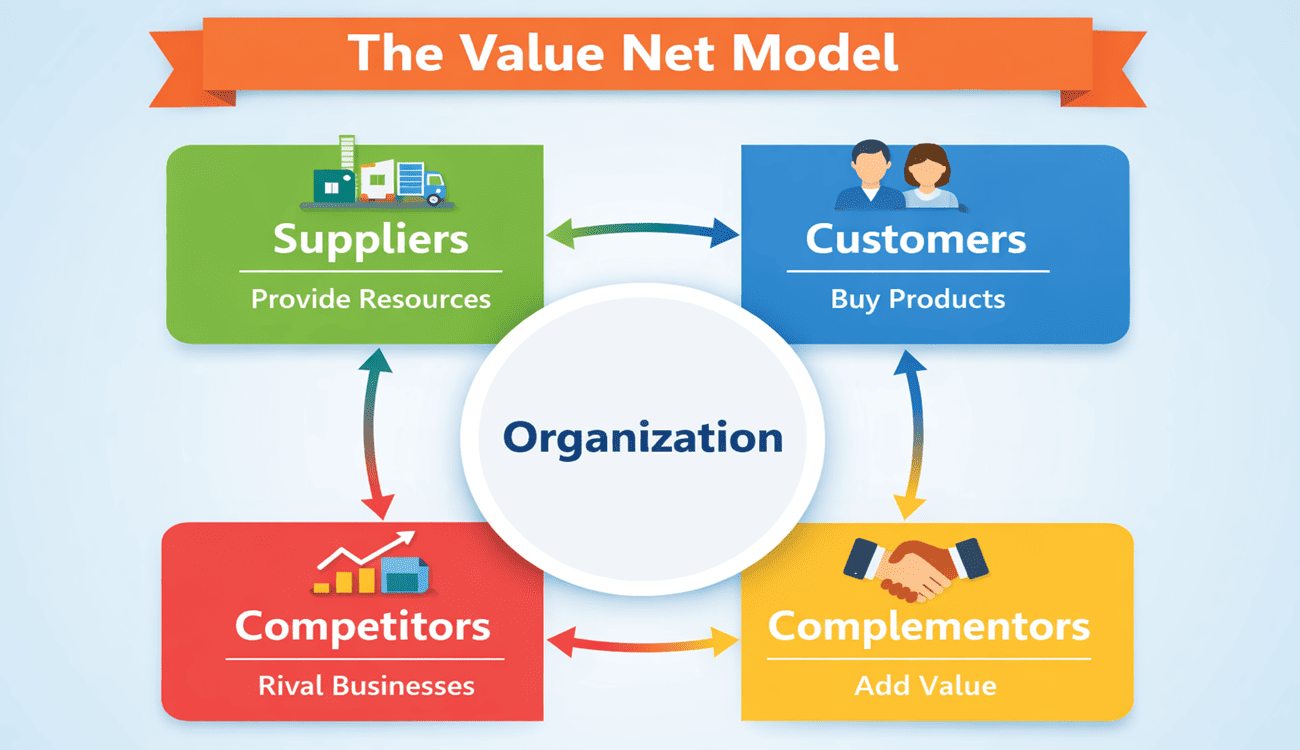
The framework positions your organization in the center of a network surrounded by four key players:
- Customers — People or organizations that buy your products or services.
- Suppliers — Firms or individuals who provide materials, labor or knowledge to create your offering.
- Competitors — Other businesses that offer similar solutions and vie for the same customers.
- Complementors — Businesses that produce products or services that enhance yours when combined, making both more attractive to customers.
Value net model challenges managers to look beyond obvious rivals and consider how suppliers and complementors can influence strategy. For example, a software company might treat a hardware manufacturer as a complementor rather than a rival. When you map these relationships, opportunities for cooperation become visible. The value net approach “transcends traditional competitive analyses” by focusing on both competitive and cooperative interactions, allowing firms to develop more robust strategies that promote sustainable business practices.
Understanding Each Player
Customers
Customers are the lifeblood of any business. They buy your product, use your service and provide feedback that should shape your roadmap. When applying the value net model, list different customer segments and think about what each group values. For instance, a streaming service may have budget‑conscious college students, families seeking kid‑friendly content and tech‑savvy cinephiles. Each segment interacts differently with your business, and understanding these nuances helps you tailor pricing, content and support.
Suppliers
Suppliers provide the raw materials, components or labor you need to create your offering. Their reliability, pricing and innovation can make or break your competitive edge. Many companies view suppliers as cost centers, but the value net framework reminds you that good supplier relationships are strategic assets. Partnering with suppliers on product design, forecasting and logistics can reduce costs, improve quality and speed up innovation. For example, smartphone manufacturers often involve chipmakers early in the design process to ensure components align with the product’s performance goals.
Competitors
Competitors are companies that offer similar products or services to the same customers. Traditional strategy teaches us to outperform them by being cheaper or better, yet the value net model invites a more nuanced view. Sometimes two rivals can cooperate to expand the market or share infrastructure. In the early days of electric vehicles, competing automakers collaborated on charging networks to accelerate adoption. Your analysis should identify where collaboration could create value for both sides without harming your differentiation.
Complementors
Complementors are often overlooked but can be a source of growth. They make your product more valuable by pairing it with their own. Think of the relationship between smartphone makers and app developers, or between coffee shops and book publishers. Aligning with complementors can expand your reach into new markets, provide bundled offers and increase customer loyalty. A personal example: I once partnered with a local bakery to offer coffee and pastry bundles at my bookstore. Sales jumped because customers enjoyed the convenience of two treats together, and both businesses gained new patrons.
Why the Value Net Model Matters
Building and maintaining a value net takes time, but the payoff can be substantial. Here are some reasons to invest in this approach:
- Expand your market through collaboration. By working with complementors and even competitors, you can create new bundles and cross‑promotions that reach audiences you could not access alone. Consider how ride‑sharing apps partnered with music streaming services to offer in‑car entertainment.
- Strengthen resilience and innovation. Supplier partnerships allow firms to co‑develop products and share knowledge. In 2020 Pfizer and BioNTech teamed up to accelerate vaccine development, a famous case of co‑opetition that delivered life‑saving results. Joint ventures in technology and pharmaceuticals often reduce risk and shorten time to market.
- Improve your odds of survival. A market report showed that small businesses engaging in strategic alliances are 30% more likely to survive their first five years. Alliances provide access to resources and customers that would otherwise be out of reach.
- Tap into a growing market. Strategic alliance services were valued at $7.5 billion in 2024 and are forecast to reach $12.3 billion by 2033, reflecting a 6.2 % annual growth rate. Demand for partnership expertise is rising, highlighting a broader business trend toward collaboration.
- Meet executive priorities. More than half of executives (61%) now list alliances as a top strategic focus. Aligning your strategy with this priority can attract investment and leadership support.
Challenges and Considerations
Co‑opetition is not without pitfalls. The term “coopetition” was popularized in the early 1990s and stems from game theory. It encourages firms to move beyond zero‑sum thinking, yet the same source notes several risks:
- Power imbalance: One partner may gain more than the other, leading to resentment and long‑term instability.
- Operational complexity: Coordinating with a rival or complementor can cause logistical problems or uneven workloads.
- Regulatory concerns: Joint activities might raise antitrust issues if they resemble collusion.
- Information leakage: Sharing too much can erode your competitive advantage.
These risks mean you should enter cooperative deals thoughtfully. A good rule of thumb is to start small, outline clear objectives and remain ready to walk away if the alliance no longer serves both parties.
Applying the PARTS Framework
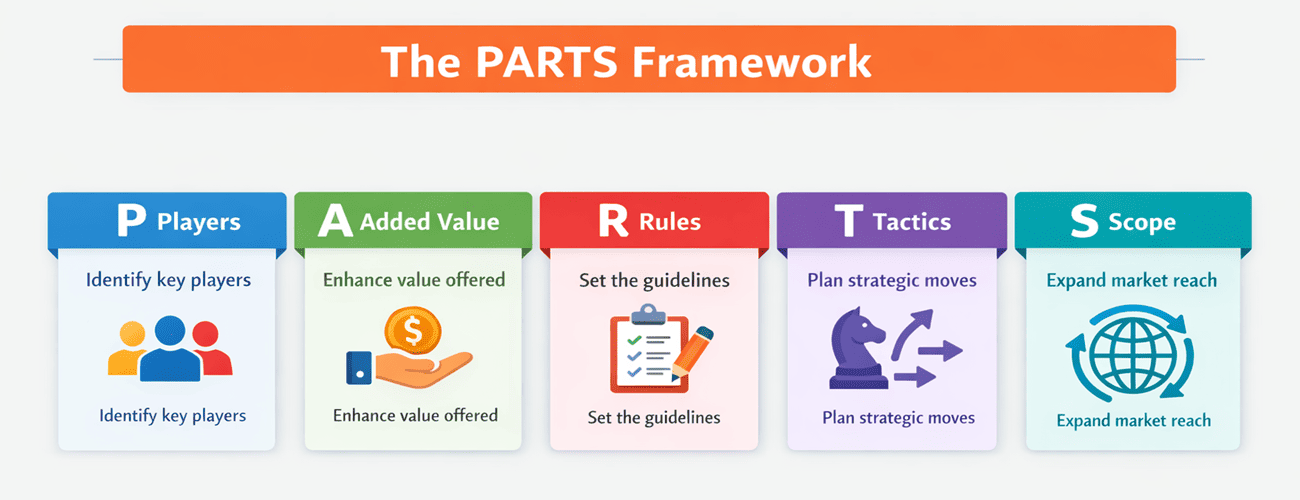
Brandenburger and Nalebuff recommend using the PARTS framework alongside the value net model. PARTS stands for Players, Added value, Rules, Tactics and Scope. It provides a structured way to evaluate and shape the network.
Players
List all individuals, groups and organizations that affect your business — not just customers but also suppliers, regulators, advocacy groups and even potential partners you’ve yet to meet. Draw them on your value net diagram and consider how each interacts with others. Ask yourself: Who could help me create more value? Who might block progress?
Added Value
Evaluate what each player brings to the table. Your added value is the difference between the value created when you are in the game and the value created when you are not. This step helps you see who holds the most power and where you can increase your own contribution. For example, if your product is the only one that solves a specific problem, your added value is high and you can negotiate from a position of strength. Conversely, if numerous alternatives exist, you may need to innovate or partner to increase your worth.
Rules
Rules are the formal and informal agreements that govern interactions. They include contracts, pricing policies, industry standards and social norms. Changing the rules can shift the balance of power. For instance, a software company might open‑source a platform to encourage third‑party development, altering the rules of engagement for complementors and competitors alike.
Tactics
Tactics refer to short‑term moves used to influence other players’ perceptions and actions. They include pricing strategies, product launches, marketing campaigns and public statements. Effective tactics signal your intentions and can prompt others to cooperate. Timing matters: announcing a new partnership at a major industry conference can generate buzz and attract additional allies.
Scope
Scope defines the boundaries of the game. Which markets are you competing in? Which customer segments are you serving? Decisions about scope determine who the relevant players are and what value you can create. Expanding into new segments may introduce new competitors but also new complementors. Narrowing scope can help you focus on a niche where you have a strong advantage.
Co‑Opetition in Practice
The value net model encourages you to view competitors as potential partners. The term coopetition, coined by Novell CEO Ray Noorda, refers to cooperating with competitors to achieve common goals. Here are a few real‑world examples:
- Pharmaceutical partnerships: During the COVID‑19 pandemic, Pfizer and BioNTech pooled resources to accelerate vaccine development. By sharing risk and expertise, they beat rivals to market and saved countless lives. Similar co‑development deals are common in biotech, where the cost of drug discovery is high and success uncertain.
- Tech giants cooperating: Apple and Google normally compete in mobile ecosystems but partnered on contact‑tracing technology during the pandemic. This collaboration improved public health while preserving user privacy.
- Logistics alliances: DHL and UPS, two fierce rivals, agreed that UPS would fly DHL packages within the United States when it made operational sense. This arrangement allowed both companies to optimize capacity and avoid waste.
- Platform ecosystems: Amazon’s marketplace invites small vendors to sell alongside Amazon’s own products, turning potential competitors into partners. This arrangement increases product variety, draws more shoppers and ultimately benefits everyone.
These examples show that co‑opetition is not theoretical; it’s a practical strategy used by some of the world’s most successful companies. The key is to identify shared interests and structure deals so that each side gains more from cooperating than from going it alone.
Building Successful Partnerships
The value net model is most effective when backed by thoughtful planning. Here are actionable steps to build partnerships that last:
- Map your network. Start by drawing your current value net, listing names under each of the four player categories. This exercise will reveal gaps and potential opportunities.
- Define shared goals. For each potential partner, identify mutual benefits. Do you both want to enter a new market, lower costs or innovate faster? Shared goals build trust.
- Negotiate clear rules. Outline responsibilities, contributions, timelines and intellectual property terms. Put agreements in writing to avoid misunderstandings.
- Start small. Pilot projects or limited‑scope collaborations allow you to test compatibility before committing to a long‑term alliance.
- Measure and adapt. Track outcomes against your goals. Be prepared to adjust tactics or scope if the partnership isn’t delivering the expected value.
- Maintain open communication. Regular check‑ins keep partners aligned and allow you to surface issues early. Use both formal meetings and informal touchpoints.
The PARTS framework can help at every step. Revisiting Players, Added value, Rules, Tactics and Scope as the partnership evolves ensures that you adapt to changing circumstances and protect your interests.
FAQs
Q1. What is the value net model?
It’s a framework developed by Brandenburger and Nalebuff that maps relationships between a firm and its customers, suppliers, competitors and complementors. The goal is to identify opportunities for cooperation and competition.
Q2. How does the value net model differ from Porter’s Five Forces?
Porter’s model focuses on competitive forces that shape profitability. The value net model adds cooperation to the mix, highlighting how alliances can increase the size of the pie rather than just divide it.
Q3. Can small businesses use the value net model?
Yes. The framework is especially useful for start‑ups and small firms that need to leverage partners to gain market access and resources. Studies show partnerships improve survival rates.
Q4. What are the risks of co‑opetition?
Potential drawbacks include power imbalances, logistical challenges and information leakage. Careful planning and clear agreements can mitigate these risks.
Q5. How do I identify complementors?
Look for products or services that make yours more valuable when used together. Ask your customers what else they use in combination with your offerings.
Conclusion
The value net model helps businesses see growth in a broader and smarter way. Instead of focusing only on competition, it shows how customers, suppliers, competitors, and complementors all shape success. By using cooperation where it makes sense, organizations can create more value, reduce risk, and unlock new opportunities. When applied with the PARTS framework, the value net model becomes a practical tool for building strong partnerships and achieving sustainable, long-term business advantage in today’s connected markets.