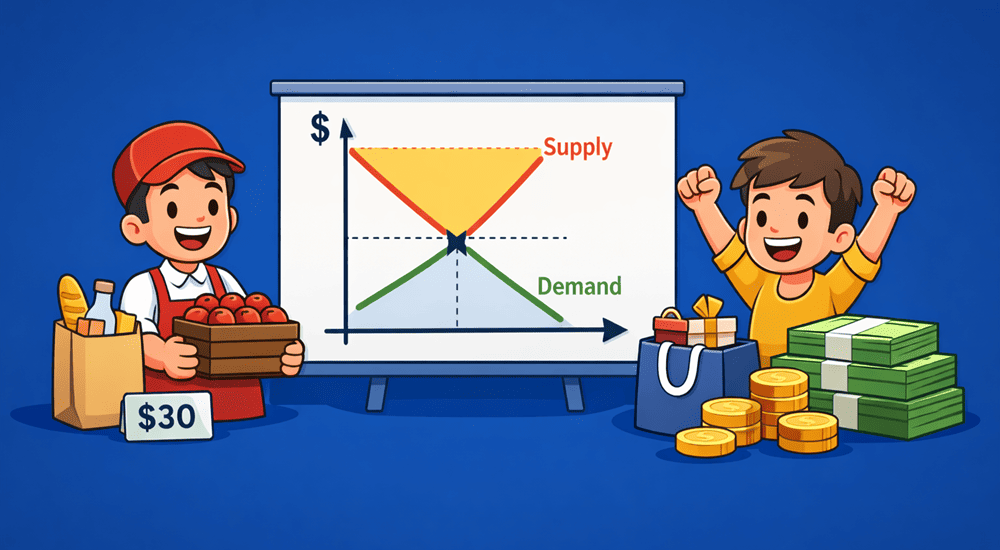
Economists talk a lot about producer surplus because it shows how businesses benefit from market prices. In simple terms, producer surplus is the extra money producers earn when the selling price is higher than the minimum, they were willing to accept.
Understanding it can help you see why companies innovate, invest and sometimes lobby for price supports. Let’s explore what producer surplus means, how to calculate it, and why it matters.
What is Producer Surplus?
Producer surplus is the difference between the price a firm receives for a product and the lowest price it would have accepted. Think of it like a “bonus” over the producer’s minimum acceptable price. If a farmer is willing to sell eggs for $3 per dozen but receives $4, the extra $1 represents producer surplus. This surplus encourages producers to stay in the market, improve products and expand operations.
Economists often express producer surplus mathematically as:
Producer Surplus = Total Revenue – Total Variable Cost
Here, total revenue is the selling price multiplied by the quantity sold, and total variable cost reflects the marginal cost of producing each unit. When revenue exceeds variable cost, producers enjoy a surplus. Fixed costs are not part of this calculation; those matter when calculating profit.
Visualizing Producer Surplus on a Supply Curve
In a supply and demand graph, producer surplus appears as the area above the supply curve and below the market price. The supply curve represents the marginal cost of production. The market price is the horizontal line where supply meets demand. The shaded triangular region between the supply curve and the price line shows how much producers gain.
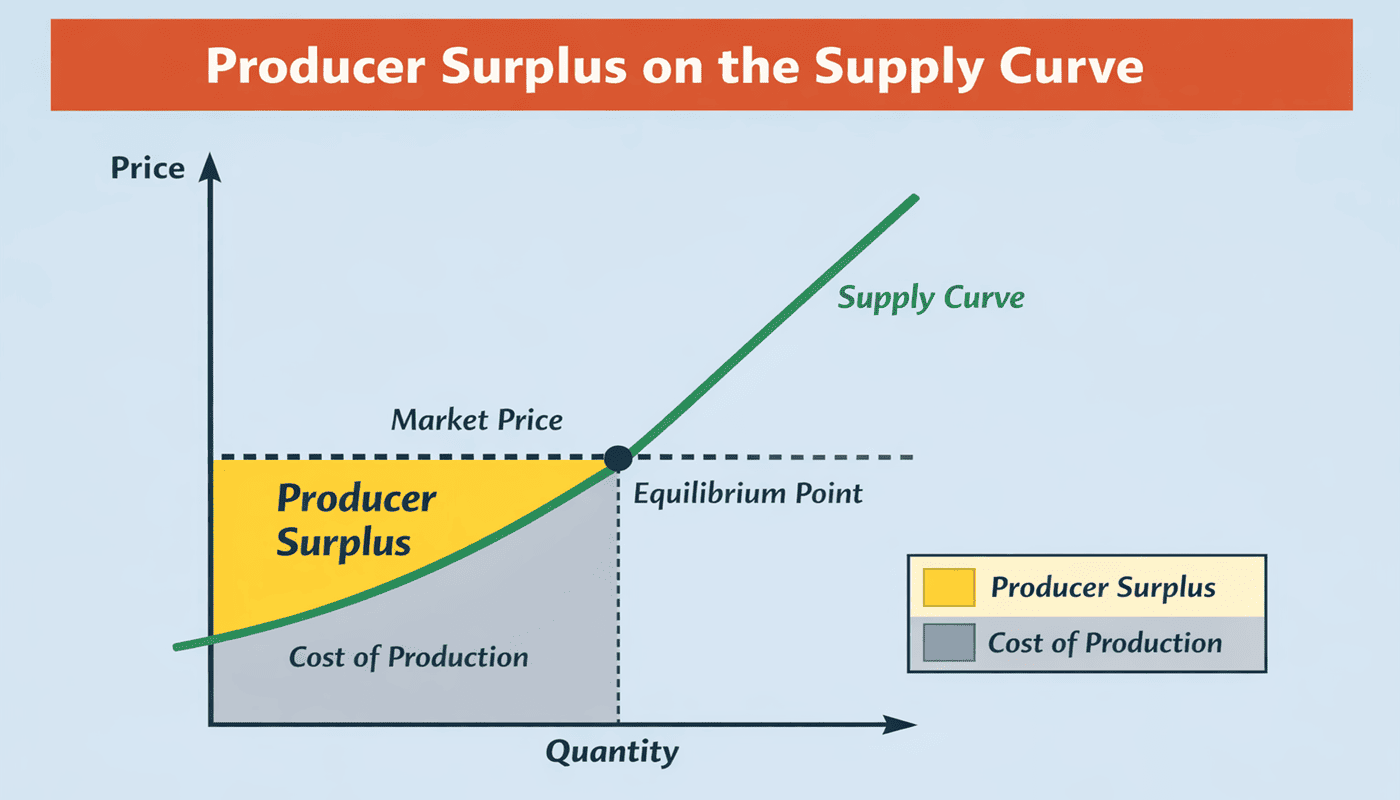
In this diagram, the upward‑sloping line is the supply curve. The horizontal line marks the market price. Producers willing to sell at lower prices (below the intersection) receive the higher market price, generating surplus. The size of the surplus depends on the difference between the price and the marginal cost for each unit.
Producer Surplus Vs Consumer Surplus Vs Social Surplus
Producer surplus isn’t the only surplus in the marketplace. Consumer surplus is the benefit consumers receive when they pay less than they were willing to pay. Social surplus (or economic surplus) combines consumer and producer surplus. Markets reach maximum efficiency when social surplus is maximized, meaning it is impossible to improve one party’s welfare without harming another.
Consider a market for tablet computers. Suppose the equilibrium price is $80 and 28 million tablets are sold. Some consumers would have paid more than $80 but benefited from the lower price, creating consumer surplus. On the supply side, producers willing to sell for as low as $45 still receive the $80 price, generating producer surplus. The triangular areas above the supply curve (producer surplus) and below the demand curve (consumer surplus) illustrate these benefits.
How to Calculate Producer Surplus
Producer surplus can be calculated using either a graph or algebra:
- Graphical method: Identify the market price and the supply curve. Calculate the area of the triangle formed above the supply curve and below the price line up to the equilibrium quantity. For a straight‑line supply curve, the area is
.
- Equation method: Subtract the total variable cost from total revenue. If supply can be expressed as an equation, you can integrate the marginal cost function from zero to the equilibrium quantity to find total variable cost, then subtract it from revenue.
Example Calculation
Suppose the supply function is P = 2 + 0.5Q and the demand function is P = 10 – 0.5Q, where P is price and Q is quantity. To find equilibrium, set supply equal to demand:
2 + 0.5Q = 10 – 0.5Q
0.5Q + 0.5Q = 10 – 2
Q = 8
P = 2 + 0.5(8) = 6
The market price is $6 and equilibrium quantity is eight units. The minimum price suppliers accept for the first unit is $2 (when Q = 0), and it rises to $6 at equilibrium. The base of the producer surplus triangle is the quantity (8 units), and the height is the difference between the market price and the minimum price at Q = 0, which is . Thus:
extProducerSurplus=frac12imes8imes4=16
meaning producers collectively earn $16 more than their minimum acceptable revenue in this simplified example.
Real‑World Examples of Producer Surplus
Rice Support Prices in India
Governments sometimes set price floors to support farmers. In May 2025 India raised the minimum price it pays farmers for common rice paddy to 2,369 rupees per 100 kg, up from 2,300 rupees the previous year. By guaranteeing a higher price, the government increases farmers’ producer surplus. Farmers who would have been willing to sell at a lower market price benefit from the support price, though consumers may pay more or governments must subsidize sales. Excess stock can build up, as was the case when government warehouses held about 59.5 million tons of rice, which highlights the trade‑off between supporting producers and market efficiency.
Tech Gadgets and Innovation
Consider a smartphone manufacturer. Its marginal cost to produce each phone might be $200, but consumers are willing to pay $500. That difference contributes to a large producer surplus. High margins allow the company to invest in research and development, advertise and improve the next generation of devices. When competition enters the market and prices fall, producer surplus shrinks, prompting firms to cut costs or innovate further.
Factors Influencing Producer Surplus
Several factors affect how much surplus producers enjoy:
- Market price: Higher prices relative to marginal cost increase producer surplus. Surges in commodity prices, such as oil spikes, benefit producers when extraction costs stay lower than selling prices.
- Cost of inputs: Lower input costs (e.g., cheaper raw materials or cheaper labor) raise the gap between revenue and variable cost. Advances in technology can reduce marginal costs.
- Elasticity of supply: Inelastic supply curves (steep slopes) produce larger surpluses because producers cannot easily adjust output, leading to bigger differences between low marginal costs and high prices.
- Government policies: Taxes, subsidies, price floors and ceilings can expand or reduce producer surplus. For instance, minimum support prices increase surplus for farmers but may create deadweight loss.
- Market structure: In perfectly competitive markets, producers are price takers, and surplus is limited by competition. In monopolies or oligopolies, firms may capture more surplus through price discrimination and output restriction.
The Impact of Price Floors and Ceilings
Government interventions, such as price floors and price ceilings, can distort market outcomes. A price floor sets a minimum selling price above the equilibrium. Producers receive a higher price, increasing their surplus, but consumers buy less and total welfare falls. A price ceiling caps the maximum price, reducing producer surplus and potentially causing shortages.
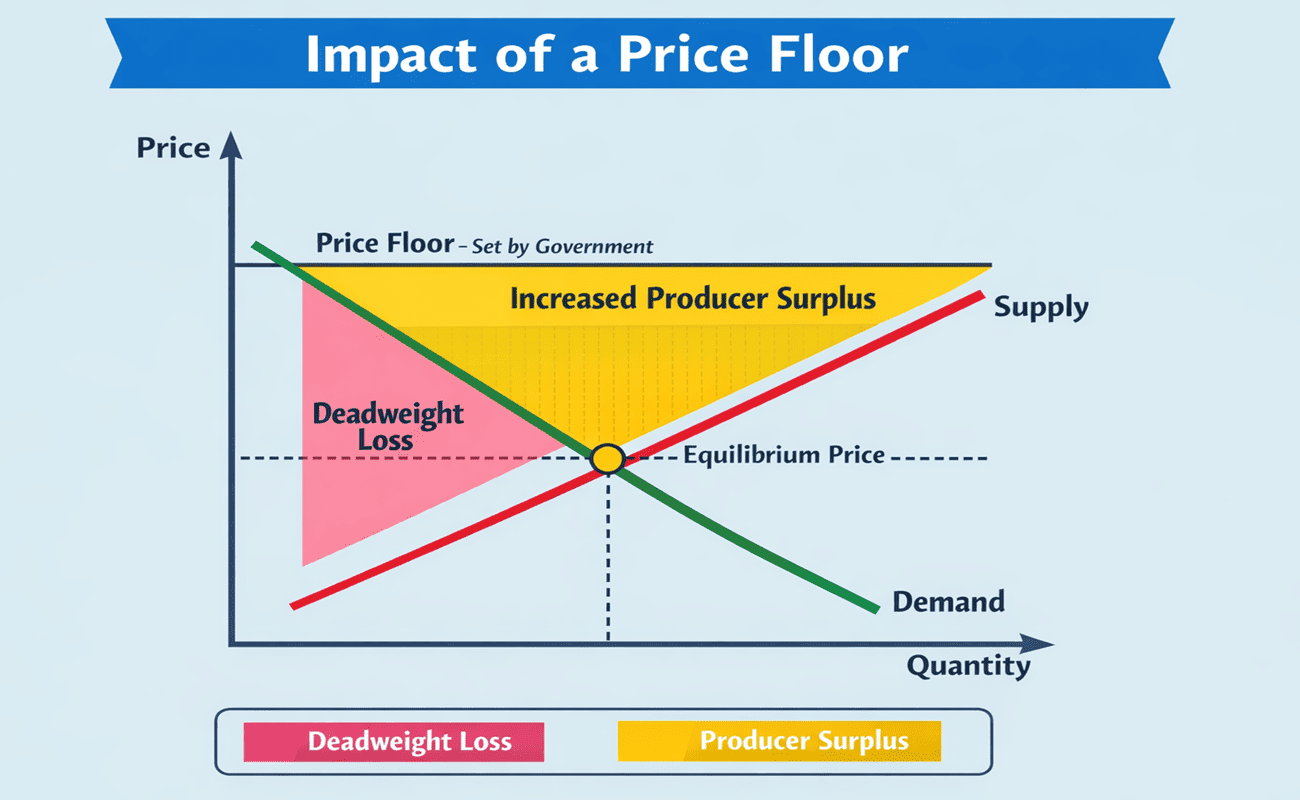
The figure above shows a price floor above the equilibrium. The producer surplus area grows between the price floor and the supply curve up to the equilibrium quantity. However, the triangular area beyond the equilibrium, labeled deadweight loss, represents foregone transactions where both buyers and sellers miss out. This loss demonstrates how interventions can reduce social surplus.
Producer Surplus Vs Profit
Producer surplus and profit are related but not identical. Producer surplus only considers variable costs or marginal costs. Profit accounts for both variable costs and fixed costs, such as rent, equipment or salaries. A firm may earn producer surplus yet still make zero or negative profit if fixed costs are high. Understanding both helps business owners decide whether to continue production or exit the market.
Why Producer Surplus Matters
Producer surplus has practical and policy implications:
- Business decisions: High producer surplus signals that a product is profitable, encouraging firms to expand production or invest in innovations.
- Resource allocation: Surpluses indicate that scarce resources are being used efficiently; a large surplus combined with strong consumer demand suggests the market value of the product exceeds its cost.
- Government policy: Policymakers monitor producer surplus when setting tariffs, subsidies or price supports. While support prices help farmers, they can lead to excess supply and storage costs.
- Economic welfare: Social surplus (sum of consumer and producer surplus) is maximized at market equilibrium. Deviations from equilibrium through taxes or controls create deadweight loss.
FAQs
Q1. What is the difference between producer surplus and consumer surplus?
Producer surplus measures the extra benefit producers receive above their minimum acceptable price. Consumer surplus measures the extra benefit consumers receive when they pay less than what they were willing to pay.
Q2. How do taxes affect producer surplus?
Taxes drive a wedge between the price consumers pay and the price producers receive, typically reducing producer surplus. The size of the decrease depends on supply elasticity.
Q3. Can producer surplus be negative?
No. If selling a product yield less than the minimum price producers require, they stop producing. Negative surplus would mean producers lose money on each unit, which is unsustainable.
Q4. Is producer surplus the same as profit?
Not exactly. Producer surplus subtracts only variable (marginal) costs from revenue. Profit subtracts both variable and fixed costs. A firm can have a positive producer surplus but zero profit if fixed costs are high.
Q5. Why do governments set minimum support prices?
Governments use price floors to protect producers, often farmers from volatile markets. Support prices ensure producers earn more than their variable costs, but they can distort market efficiency and create surpluses.
Conclusion
Producer surplus explains how sellers gain when market prices stay above their minimum acceptable price. It shows why businesses keep producing, improving quality, and entering markets. By understanding producer surplus, readers can see how supply, demand, and pricing decisions affect profits and efficiency. The concept also helps explain the impact of government policies like price floors and taxes. Producer surplus highlights the link between fair pricing, healthy competition, and long-term economic growth in real markets.