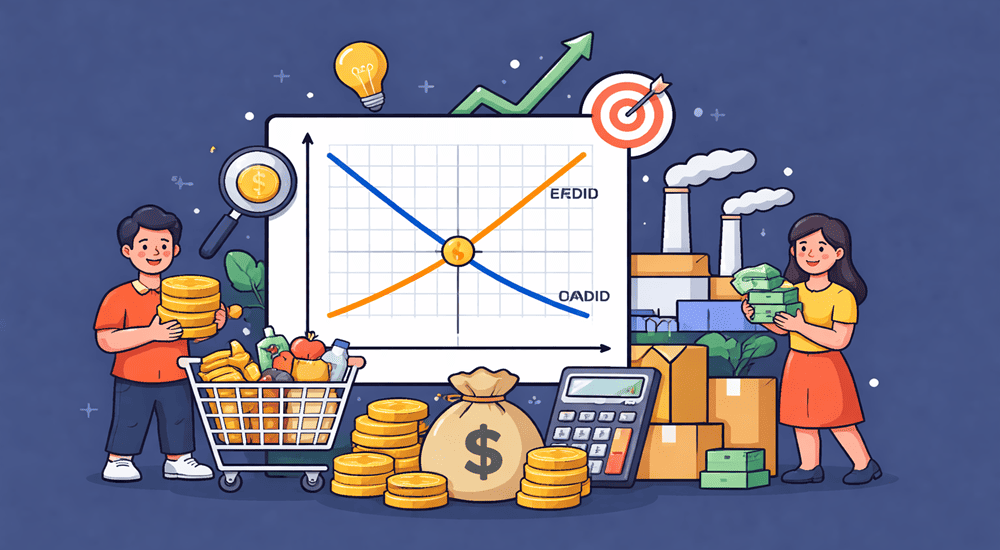
Economic surplus is a measure of the benefit that both buyers and sellers receive from a transaction. It is the sum of consumer surplus and producer surplus, think of it as the total welfare created when a product trades hands. Consumer surplus is the extra satisfaction buyers get when they pay less than the highest price they would have paid; producer surplus is the extra revenue sellers earn when they receive more than the minimum they would have accepted.
Together, these two surpluses reveal the overall health of a market and whether resources are being allocated efficiently. Without understanding economic surplus, it is hard to see who gains and who loses when prices move.
Economic surplus is sometimes called total surplus, total welfare or community surplus. The basic formula is simple:
Economic Surplus = Consumer Surplus + Producer Surplus
That formula may look dry, but it captures a powerful idea: markets work best when both buyers and sellers walk away better off. What happens when prices are too high or too low? How do taxes, subsidies or innovations like generative AI shift the surplus?
We will explore these questions below.
Understanding Consumer Surplus
Consumer surplus measures how much extra value buyers receive because they pay less than their maximum willingness to pay. Suppose you are willing to spend $20 on a book, but you find it on sale for $15. The difference, $5, is your consumer surplus. In a demand‑curve diagram, consumer surplus appears as the area above the market price and below the demand curve.
As shown in the infographic, the green area represents consumer surplus, it sits above the price line and under the downward‑sloping demand curve. Buyers gain surplus whenever they pay less than what the product is worth to them. The larger the green area, the more satisfied consumers are. Consumer surplus is sensitive to changes in price: when prices fall, surplus rises because more people can afford the product and existing buyers enjoy a larger gap between what they pay and what they were willing to pay.
Understanding Producer Surplus
Producer surplus measures the benefit sellers get when they receive a price higher than the lowest amount they would have accepted. Imagine a craftsman who is willing to sell a handmade vase for $30 because that covers his costs and effort. If a customer pays $45, the craftsman earns a producer surplus of $15.
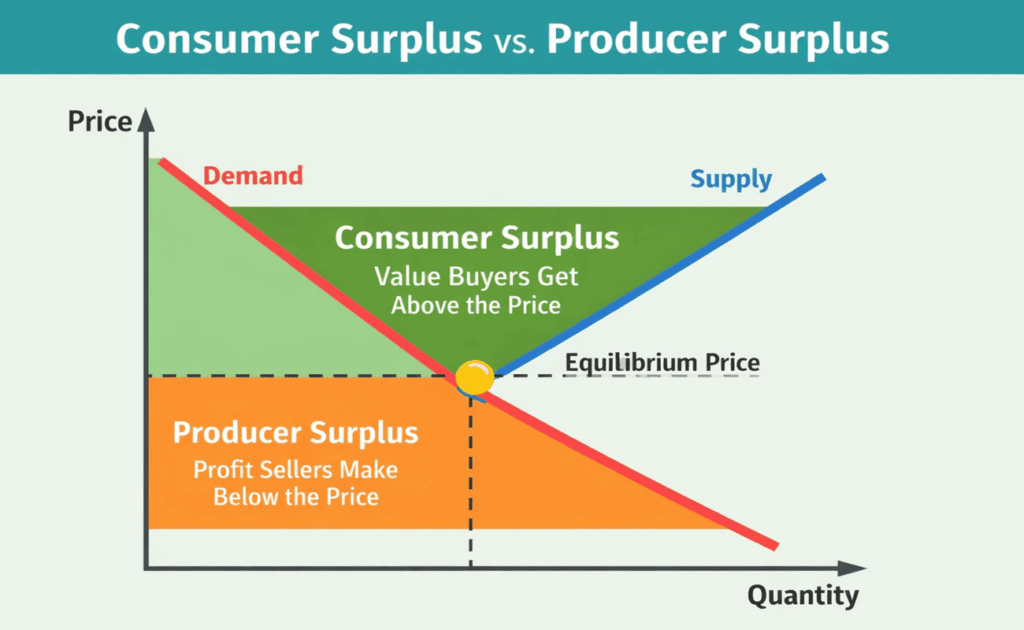
In the above supply‑curve diagram, producer surplus is the area below the price and above the upward‑sloping supply curve (the orange area in the infographic). A higher selling price increases producer surplus because firms earn more than their minimum acceptable price.
Producer surplus reflects profit, incentives and the ability of firms to cover costs. It encourages producers to allocate resources toward goods and services that consumers value. If the price drops too low, producers may exit the market, reducing supply and potentially harming consumers in the long run.
Market Equilibrium and Total Surplus
The market reaches equilibrium when the quantity demanded equals the quantity supplied. At this point, the price balances the interests of buyers and sellers, and total economic surplus is maximized. On the supply‑and‑demand graph, equilibrium appears where the curves intersect. At that point, the sum of consumer surplus and producer surplus is at its largest because neither side has an incentive to change the price or quantity. Outside of equilibrium, total surplus falls: price floors and ceilings, taxes or subsidies distort signals and shrink the green and orange areas.
Real‑World Examples of Economic Surplus
It is often helpful to look beyond classroom diagrams. Recent events provide vivid examples of economic surplus at the national and industry levels.
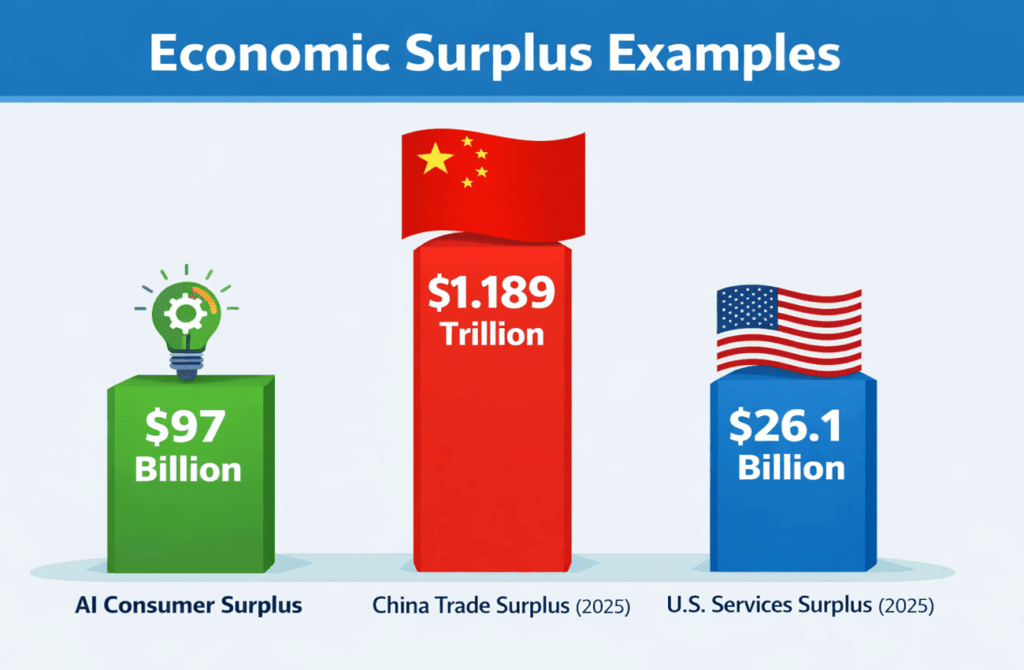
The bar chart above highlights three different surpluses from 2024 and 2025.
- Generative AI consumer surplus (2024): Research by Avinash Collis and Erik Brynjolfsson, summarized in an American Enterprise Institute article, found that Americans enjoyed roughly $97 billion in consumer surplus from using generative AI tools in 2024. Users were asked how much they would need to be paid to give up AI access for a month. The figure exceeded the $7 billion in revenue earned by major providers like OpenAI and Anthropic, illustrating how free or low‑cost digital goods generate enormous value that traditional metrics like GDP miss.
- China’s record trade surplus (2025): According to Reuters reporting, China recorded a $1.189 trillion trade surplus in 2025. Booming exports to Southeast Asia, Africa and Latin America enabled Chinese firms to offset weaker domestic demand and tariff pressure. This surplus represents the difference between the value of China’s exports and its imports, a national‑level example of producer surplus where domestic manufacturers collectively sell more than they buy from abroad.
- U.S. services surplus (August 2025): The U.S. Bureau of Economic Analysis reported that in August 2025 the goods and services deficit fell to $59.6 billion. Within that figure, the services sector posted a surplus of $26.1 billion. Although the United States still ran a goods deficit, the services surplus highlights how knowledge‑intensive industries like software, finance and tourism generate producer surplus for the U.S. economy. At the same time, a large goods deficit reduces overall surplus and may signal supply‑demand imbalances.
These examples show how economic surplus can occur at different scales, from individual transactions to national economies. They also reveal that surplus is not always positive: when imports exceed exports, a country experiences a trade deficit, reducing producer surplus and potentially affecting consumer welfare.
Causes of Economic Surplus and Deficit
Economic surplus arises when market forces align supply and demand in a way that benefits both buyers and sellers. Several factors influence surplus:
- Demand shifts: When consumer preferences change or incomes rise, demand increases. Higher demand can raise prices and producer surplus, though consumer surplus may fall if prices climb too much. Conversely, a drop in demand can lead to surpluses of unsold goods and lower prices.
- Supply shifts: Advances in technology, increased production efficiency or entry of new firms increase supply. Lower production costs allow businesses to offer goods at lower prices while maintaining profit margins. This boosts consumer surplus because buyers pay less and producers still earn a surplus.
- Overproduction and underproduction: Producing too much of a product can push prices down below the equilibrium level, reducing producer surplus and causing waste. Underproduction has the opposite effect: scarce supply drives up prices, hurting consumer surplus and encouraging imports.
- Taxes and regulations: Taxes increase prices paid by consumers and decrease prices received by producers, shrinking both surpluses. For example, tariffs can reduce consumer surplus by making imported goods more expensive and reduce producer surplus if exporters face retaliatory measures.
- Political and economic conditions: Trade policies, geopolitical tensions and market expectations influence investment, production and consumption. China’s record surplus in 2025, for instance, stemmed partly from firms shifting focus to non‑U.S. markets.
A mismatch between supply and demand, whether due to external shocks or policy decisions, is the primary cause of economic surplus or deficit. When prices deviate from the equilibrium, the total surplus shrinks because one side gains at the expense of the other.
Importance of Economic Surplus
Economic surplus is more than an abstract concept; it provides insight into welfare, efficiency and policy. Policymakers use surplus to evaluate the impact of taxes, subsidies and regulations. A large consumer surplus means buyers enjoy significant benefits relative to the prices they pay. A large producer surplus suggests businesses are profitable and have incentives to innovate. Economists also look at total surplus when judging whether markets are efficient or distorted.
For example, the $97 billion consumer surplus from generative AI hints that free digital tools deliver immense value to society despite generating relatively little revenue. Similarly, trade surpluses or deficits reveal how competitive a country’s industries are on the global stage. Monitoring these surpluses helps governments design policies that balance the interests of producers and consumers and ensures resources flow to their most valued uses.
How Businesses and Policymakers Can Increase Surplus
- Encourage competition and innovation. Competition drives down prices and inspires firms to develop better products. When producers innovate, costs fall and both consumer and producer surplus can rise.
- Invest in productivity. Adopting new technologies and training workers improves productivity, allowing firms to offer more value at lower prices. Productivity gains expand the supply curve, increasing total surplus.
- Avoid excessive regulation. Regulations that raise costs or limit entry can shrink surplus by keeping prices artificially high. Balanced policies that protect consumers without stifling innovation help maximize surplus.
- Use targeted subsidies and taxes. Well‑designed subsidies can encourage socially beneficial activities, such as research and development, while taxes on negative externalities (e.g., pollution) can correct market failures. However, broad tariffs or quotas often reduce total surplus by distorting trade and increasing prices.
- Monitor global market trends. Understanding shifts in global demand and supply, like the surge in exports to Asia and Africa that contributed to China’s surplus, helps businesses adjust strategies and avoid overproduction.
FAQs
Q1. What is economic surplus?
Economic surplus is the combined benefit that consumers and producers get from market transactions. It is the sum of consumer surplus and producer surplus, showing total welfare.
Q2. How do you calculate consumer surplus?
Consumer surplus equals a buyer’s maximum willingness to pay minus the price actually paid. It is the area under the demand curve and above the market price on a supply‑and‑demand graph.
Q3. What causes a trade surplus?
A trade surplus occurs when a country exports more than it imports. Factors such as high production efficiency, strong global demand and competitive pricing can lead to a surplus.
Q4. Does a surplus always mean good news?
Not always. A large producer surplus may coincide with high consumer prices, while a large consumer surplus can mean low profits for producers. Balanced markets maximize total surplus for everyone.
Q5. How can technology affect surplus?
Technology lowers production costs and introduces new products, shifting the supply curve rightward and increasing both consumer and producer surplus. Generative AI’s $97 billion surplus in 2024 is a recent example.
Summary
Economic surplus shows the total benefit that buyers and sellers gain in a market. It combines consumer surplus and producer surplus at the equilibrium point. When markets work well, both sides gain value. Real examples, from digital services to global trade, show how surplus reflects economic health. By understanding economic surplus, businesses can set better prices and policymakers can design smarter rules. In simple terms, economic surplus helps us see who gains, how much they gain, and why markets matter.