
When you decide whether to pursue a new project, you need to ask: Will it add real value or drain resources? In a world where money received tomorrow is worth less than money in your hand today, project managers rely on the net present value (NPV) to evaluate investment decisions.
NPV converts future cash flows into today’s dollars by discounting them, allowing you to see whether a project is financially worthwhile.
This blog post explains NPV, shows how to calculate it, and compares it with other evaluation tools.
What is Net Present Value?
NPV represents the value today of all future cash inflows and outflows over the entire life of an investment. To compute it, you estimate future cash flows, select a discount rate, and then convert those flows to present dollars. The discount rate reflects both the time value of money and the risk of the investment. A higher rate reduces future cash values more steeply, acknowledging that risky or long‑term projects require greater compensation.
When NPV is positive, the project is expected to create value; if it is zero, it neither adds nor subtracts value; if it is negative, the project destroys value. These insights help sponsors choose among competing initiatives.
Why NPV Matters in Project Management
Large projects, such as constructing a new facility or launching a new service line, often demand millions of dollars up front. Stakeholders need to know whether those investments will pay off. NPV provides a clear, monetary measure that captures both the timing and size of expected benefits. This makes it a critical tool when developing business cases and feasibility studies. Unlike simple payback, which ignores the value of money over time, NPV enables realistic comparisons between projects of different durations and cash‑flow patterns.
A positive NPV signals that a project will generate returns above its cost of capital. Many organizations set hurdle rates, or minimum acceptable discount rates, based on prevailing market conditions.
For example, the U.S. Federal Reserve maintained a target federal funds rate between 3.5 % and 3.75 % in early 2026, while corporate borrowing rates such as the Secured Overnight Financing Rate (SOFR) hovered around 5.3% for most of 2024 before falling to 4.29 % by early 2025. These rates guide project managers in selecting appropriate discount rates for analysis.
How to Calculate NPV
Formula:

Where:
= cash flow at time
(negative for initial investment)
= discount rate (expressed as a decimal)
= number of periods
Steps:
- Estimate cash flows: List all expected inflows and outflows over the project’s life. This requires close collaboration with finance, operations, and sales teams.
- Choose a discount rate: Consider the risk‑free rate, inflation expectations, and project risk. Use corporate guidance or rates from authoritative sources.
- Discount each cash flow: Divide each future amount by
to convert it to present dollars.
- Sum present values: Add all discounted inflows and outflows. The result is the net present value.
Example: Evaluating a Two‑Year Project
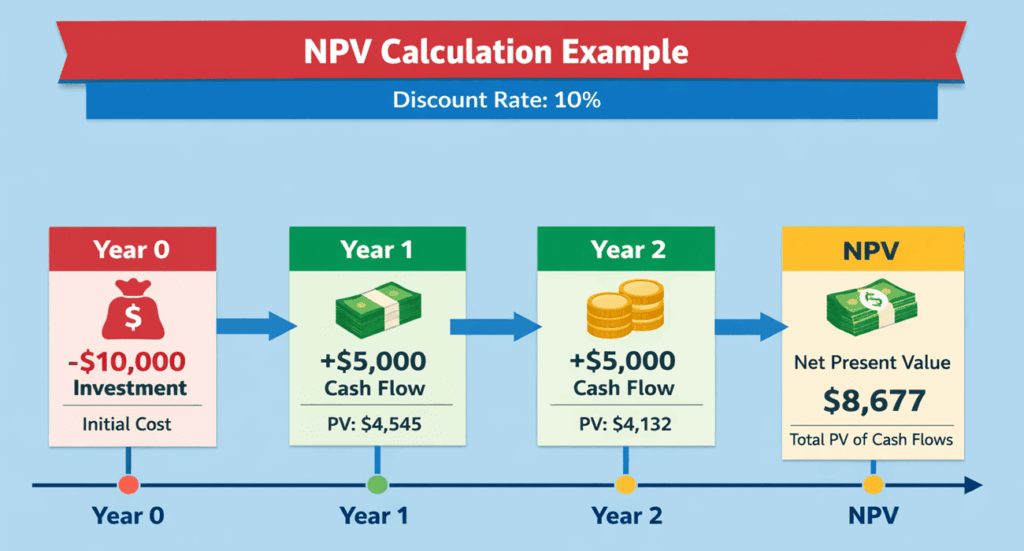
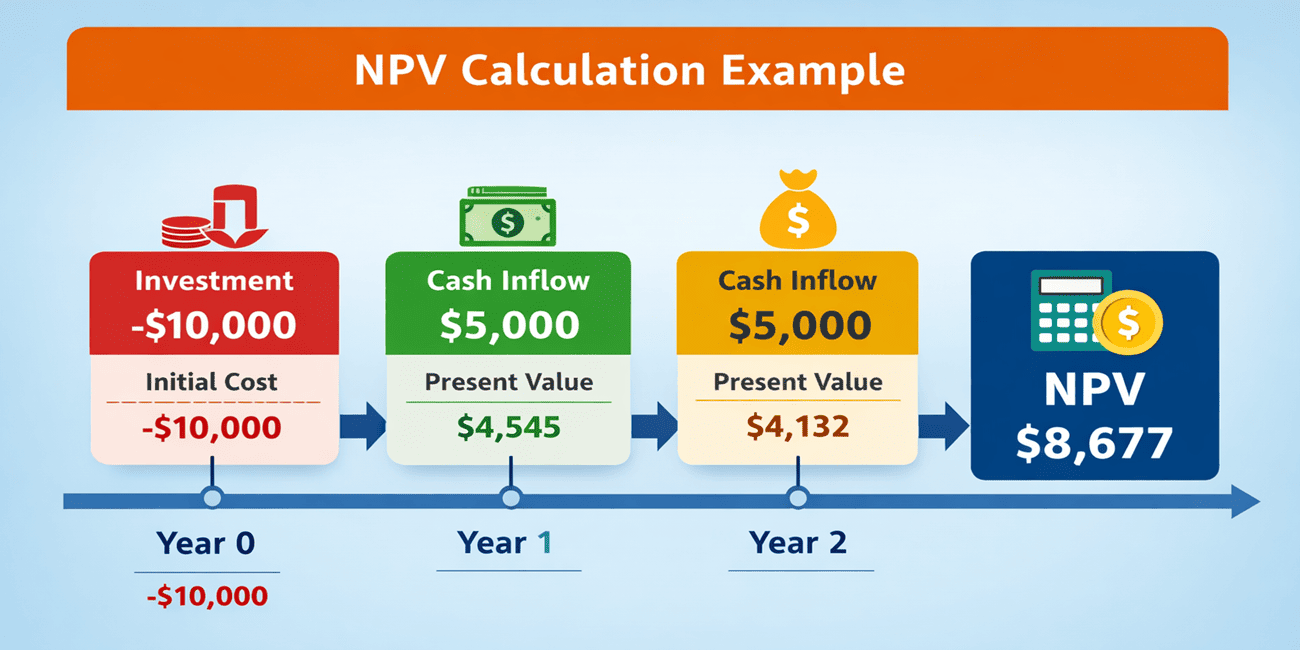
Imagine your company is considering a project that requires an upfront investment of $10,000 today. The project is expected to generate $5,000 at the end of each of the next two years. You choose a discount rate of 10% to reflect the cost of capital.
- Year 0 (today):
. Since it is already in present dollars, no discounting is needed.
- Year 1:
. The present value is
.
- Year 2:
. The present value is
.
- Sum: NPV =
.
The negative NPV suggests that this project does not meet a 10% hurdle rate. Management may either reject the project or consider reducing costs, increasing revenues, or lowering the discount rate (for example, if capital becomes cheaper).
Tools and Techniques
Modern tools simplify NPV computations. Spreadsheet programs like Microsoft Excel and Google Sheets offer built‑in functions. The NPV function assumes regular intervals (e.g., annual cash flows) and returns the sum of discounted values; you must subtract the initial outlay yourself. The XNPV function allows you to specify dates for each cash flow, useful when projects have irregular payment schedules. Project management software also includes NPV calculators, integrating cost forecasts and schedules.
NPV Versus IRR and Payback Period
While NPV is widely used, project managers also consider other metrics. The internal rate of return (IRR) is the discount rate at which NPV becomes zero. It expresses profitability as a percentage, making it easier to compare investments of different sizes. However, IRR can be misleading when comparing projects with non‑conventional cash flows or multiple sign changes.
The payback period calculates how long it takes to recover the initial investment. It is simple to understand but ignores cash flows after the payback point and does not account for the time value of money. Consequently, payback may favor shorter projects even when longer projects yield greater value.
| Measure | How It Works | Pros and Cons |
| NPV | Calculates the present value of future cash flows minus the initial investment | Reflects value and timing; sensitive to discount rate; provides absolute value |
| IRR | Finds the rate at which NPV equals zero | Expresses return as a percentage; can be compared to hurdle rates; may be unreliable for non‑conventional cash flows |
| Payback Period | Computes the time needed to recover initial costs | Easy to understand; ignores cash flows after payback; ignores time value |
Limitations of NPV
NPV is a powerful tool, yet it has limitations:
- Discount rate estimation: Choosing an appropriate rate is often subjective. Rates vary with market conditions and corporate risk tolerance. When the Federal Reserve adjusts policy rates, as it did by maintaining a target range of 3.5% to 3.75%, the cost of capital for projects changes.
- Forecast uncertainty: NPV depends on accurate cash‑flow forecasts. Unexpected changes in costs, revenues, or regulations can render projections inaccurate.
- Comparability: NPV assumes all cash flows occur at regular intervals. Projects with irregular cash flows require careful modeling using functions like XNPV.
- Non‑financial factors: NPV focuses on financial returns and may ignore social, environmental, or strategic benefits. When projects generate intangible outcomes (such as brand recognition or employee morale), these should be discussed alongside NPV.
Real‑World Considerations
Interest rates and economic conditions have shifted over the past few years. According to a January 2026 Federal Reserve statement, policymakers maintained the federal funds target range at 3.5% to 3.75%. Corporate borrowing rates, such as SOFR, stayed above 5% for much of 2024 but dropped to around 4.29% by early 2025. Longer‑term rates, including 10‑year Treasury yields, rose to roughly 4.71% in late 2024. These shifts influence the discount rates project managers choose.
Economic growth is expected to slow modestly in the near term. While global gross domestic product growth fell from 3.3% in 2024 to 3.2% in 2025, most analysts expect inflation to continue declining, easing borrowing costs. When selecting a discount rate, consider both long‑term macroeconomic trends and project‑specific risks.
FAQs
Q1. What discount rate should I use?
Use a rate that reflects your organization’s cost of capital, including risk‑free rates (e.g., Treasury yields) and project‑specific risk premiums.
Q2. Can NPV be negative?
Yes. A negative NPV means the project’s returns fall below the chosen discount rate; management should reconsider or look for ways to improve value.
Q2. How does NPV help in project management?
NPV translates all future cash flows into today’s dollars, enabling you to compare projects, assess profitability, and support data‑driven decisions.
Conclusion
Net present value remains one of the most reliable tools for assessing the financial viability of projects. It balances the magnitude and timing of cash flows and helps you decide whether a project adds value. Yet NPV is only as good as your assumptions. Use realistic forecasts, choose discount rates that reflect current economic conditions, and consider qualitative factors like environmental impact and strategic alignment. By integrating NPV into your project evaluations, you give yourself and your stakeholders a clearer view of which initiatives deserve your time and resources.
Learn how to calculate net present value (NPV) for projects, choose discount rates, and compare NPV with IRR and payback period.
References
- Net Present Value Calculations (managementstudyguide.com)
- Net Present Value (NPV): How to Calculate Net Present Value – 2022 – MasterClass
- Proceedings of the 2022 7th International Conference on Financial Innovation and Economic Development (ICFIED 2022): Analysis of the Net Present Value and Equivalent Annual Cost in Optimal Machine Life
- Analysis of the Net Present Value and Equivalent Annual Cost in Optimal Machine Life | Atlantis Press (Atlantis-press.com)
- Net Present Value Explained – What Is NPV? | Shark Finesse Ltd
- Net present value – Wikipedia
- Net Present Value: A Definition | Rocket HQ
- Using the Net Present Value Rule to Make Value-Creating Investment Decisions | Atlantis Press (Atlantis-press.com)
- UK-net-present-value-brochure.pdf (stantec.com)
- Discount Rate: DCF Formula and Cost of Capital Calculator (wallstreetprep.com)