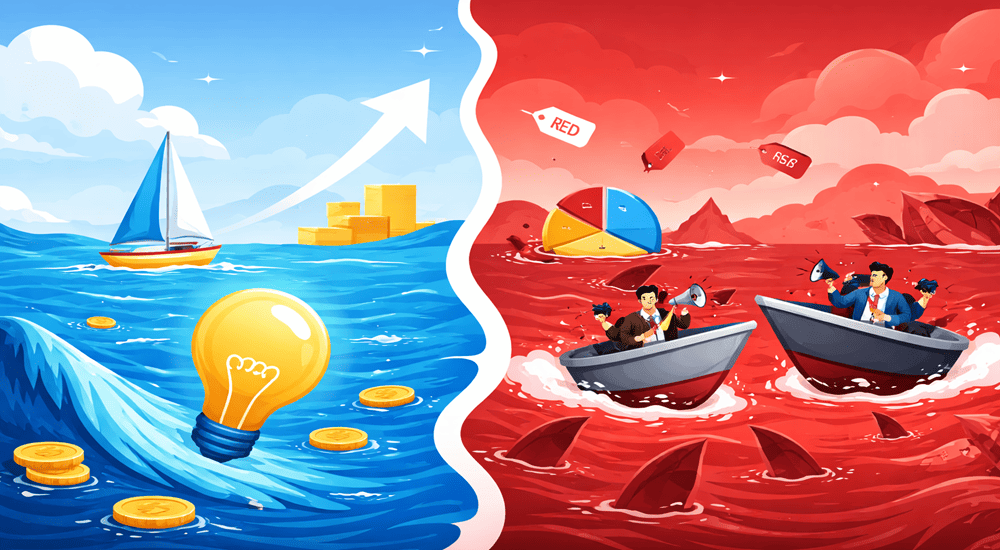
In a crowded marketplace, it often feels like every niche has been claimed and every customer already has a favorite brand. Yet some businesses leap ahead, creating entirely new categories and redefining what customers want. These companies are playing in a blue ocean rather than fighting it out in a red ocean. Understanding the difference between these approaches can help leaders decide how to grow.
This blog post explains blue and red ocean strategies, uses real examples, highlights fresh research, and offers a roadmap for moving into open seas.
What is a Blue Ocean Strategy?
A blue ocean strategy is the simultaneous pursuit of low cost and differentiation to create a new market space where competition becomes irrelevant. According to the official Blue Ocean Strategy site, blue oceans denote industries not yet in existence—demand is created rather than fought over, and there is ample opportunity for profitable growth. Instead of competing head‑on with rivals, companies change the rules by offering unique value that appeals to non‑customers.
Why “Blue”?
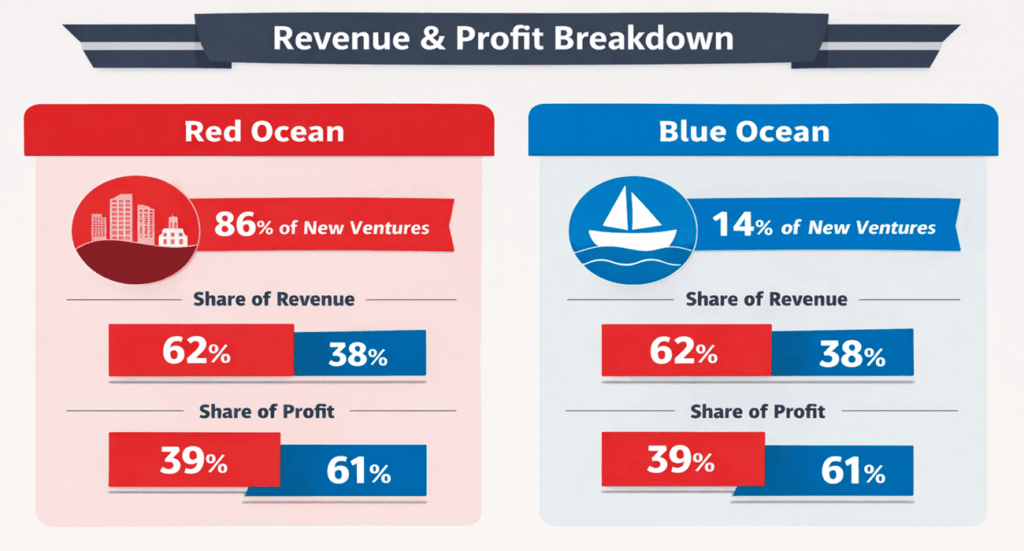
The term “blue ocean” evokes a vast, calm expanse of water—uncharted territory free from the “blood” of cutthroat competition. Chan Kim and Renée Mauborgne found that only 14 percent of new ventures created new markets, yet these ventures generated 38 percent of total revenue and 61 percent of total profits. In other words, the small fraction of companies that break new ground reap outsized rewards.
Key Characteristics
- Seek uncontested markets. They identify unmet needs or develop entirely new categories.
- Make the competition irrelevant. They change the game by offering unique value.
- Create and capture new demand. They attract customers who previously did not consume similar products.
- Break the value–cost trade‑off. They pursue both differentiation and low cost through innovation.
What Is a Red Ocean Strategy?
Red oceans represent industries that exist today. Their boundaries and competitive rules are established, and companies fight for a greater share of existing demand. The waters are “red” because competition is intense; firms engage in price wars and aggressive marketing to outdo rivals.
Core Elements
- Compete in existing markets. They work within known industry boundaries.
- Beat the competition. Success depends on outperforming rivals through incremental improvements.
- Exploit existing demand. They cater to current customers rather than attracting non‑customers.
- Make the value–cost trade‑off. Firms choose between differentiating to justify higher prices or lowering costs to compete on price.
Blue Ocean vs Red Ocean: Key Differences
| Parameter | Blue Ocean | Red Ocean |
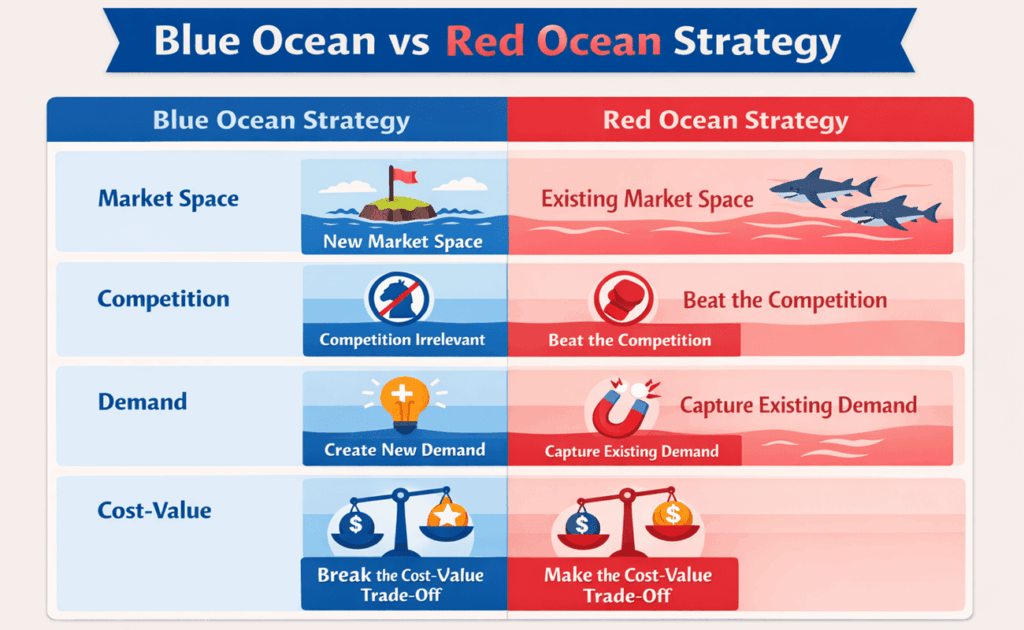
| Market space | Creates uncontested markets | Competes in existing markets |
| Competition | Makes competition irrelevant | Beats rival to gain market share |
| Demand | Creates demand among non‑customers | Captures existing demand |
| Value–cost | Breaks the trade‑off by pursuing differentiation and low cost | Makes a trade‑off between differentiation and low cost |
A side‑by‑side infographic helps convey the key differences between blue and red ocean strategies at a glance.
Examples of Blue Ocean Moves
- Cirque du Soleil reinvented the circus by combining theater, music, and acrobatics. Within twenty years it reached revenue levels that took Ringling Bros. and Barnum & Bailey a century to achieve.
- Canon’s desktop printers shifted focus from corporate buyers to office workers, creating a new category.
- Nintendo Wii targeted non‑gamers with motion controls, appealing to seniors and parents.
- Airbnb connects travelers with homeowners; it redefined lodging by not owning property.
Examples of Red Ocean Strategies
- Amazon competes by offering fast shipping, low prices, and huge selection.
- Colgate vs. Crest demonstrates how brands fight for small market share gains through marketing.
Research and Statistics
- Strategic payoff: In a study of 108 firms, only 14 percent of new ventures aimed at creating new markets, yet these ventures generated 38 percent of total revenues and 61 percent of total profits.
- Home entertainment shift: DVD and Blu‑ray revenue dropped from more than $20 billion at their peak to $2.5 billion in 2021 and is projected to decline to $1.28 billion by 2026. This shows how streaming (a blue ocean move) disrupts existing products.
- Ride‑hailing growth: The global ride‑hailing market is expected to reach $158.65 billion in 2025 and $342.07 billion by 2030, growing at a 16.61 percent compound annual rate.
To visualize the imbalance between red and blue ocean strategies, see the bar chart below. The small share of blue ocean ventures yields a disproportionately large share of profits.
Why Blue Oceans Matter
Competing within established industries often leads to shrinking margins and a race to the bottom. Blue oceans provide a path to sustainable growth because they tap unmet needs and excite customers. By delivering unique value at attractive prices, businesses can lock in early adopters and build loyalty. The success of the Wii and Airbnb illustrates how creative value propositions reshape industries.
Moving from a Red Ocean to a Blue Ocean
Creating a blue ocean is not a one‑off event; it’s a deliberate process. Here are practical steps, inspired by research:
- Define your current market and scope. Clarify your industry and its boundaries.
- Identify strategic groups. Map how similar companies cluster by price, quality, or service level. Decide where you can break away.
- Focus on a specific customer group. Target wholesalers, retailers, or end‑users and examine their unmet needs.
- Explore complementary products and services. Solve adjacent problems so customers can complete multiple tasks with one solution.
- Align with emotional or functional orientation. If your product is functional, add emotional appeal; if emotional, improve functionality.
- Monitor external trends. Technological shifts, regulations, and social attitudes can create openings.
Case Studies of Successful Blue Oceans
- Cirque du Soleil removed animal acts and added theatrical artistry, attracting adults who paid premium prices.
- Netflix disrupted itself by switching from mail‑order DVDs to streaming. As noted, DVD revenue has plummeted.
- Uber connects drivers and riders through apps; the ride‑hailing market is growing more than 16 percent a year.
- Yellow Tail Wine simplified wine flavors and used approachable branding, winning over beer and cocktail drinkers.
- Apple iPhone combined a phone, music player, and internet communicator, creating a new smartphone category.
Challenges and Considerations
- Risk of failure. Not every attempt to create a new market succeeds. Iterate based on feedback.
- Imitation. Successful blue oceans attract competitors, continuous innovation and brand building matter.
- Organizational inertia. Shifting from a red ocean mindset requires cultural change and empowerment.
FAQs
Q1. What is a blue ocean strategy in simple terms?
A blue ocean strategy means creating a new market space where your company offers unique value and doesn’t compete directly with others.
Q2. How is a red ocean different from a blue ocean?
A red ocean refers to existing industries where companies compete for limited demand. In a blue ocean, firms create new demand and define their own rules.
Q3. How can a small business create a blue ocean?
Identify unmet needs, simplify or reimagine products, look for complementary services, appeal to non‑customers, test ideas quickly, and adapt based on feedback.
Conclusion
Competing head‑on often leads to shrinking margins and fatigue. The blue ocean strategy offers an alternative: create new value, capture untapped demand, and make competition irrelevant. Companies like Cirque du Soleil, Netflix, and Uber show that bold innovation pays off. By understanding the differences between red and blue oceans, using research‑backed insights, and following a structured process, you can chart your own course into open waters. Ready to explore your blue ocean? Share your thoughts in the comments and join the conversation.
Understand blue ocean vs red ocean strategy with examples, fresh data, and a roadmap for creating new markets. Learn how to innovate and grow.